
0; line-height:0;} .rcorners .rc-title {border-radius: 15px; border: 1px solid #0a486c; width: 100%; height: auto; background-color: #0a486c; color:#FFF; font-
16px; font-weight:bold; text-align:center; padding:4px; margin:0 0 12px 0;} .rcorners .rc-title-sub {border-radius: 15px; border: 1px solid #0a486c; width: 100%; height: auto; background-color: #fff; color:#0a486c; font-
16px; font-weight:bold; text-align:center; padding:4px; margin:15px 0 12px 0;} .rcorners .caption {font-
0.80em; font-family:Arial, Helvetica, sans-serif; margin:3px auto 8px 0;} .rcorners img {margin:0 auto 12px auto !important;} @media only screen and (min-width: 500px) { .aside {float:right; margin:8px 0 0 8px; width:50%;} .aside-left {float:left; margin:8px 12px 0 0; width:50%;} } @media only screen and (max-width: 500px) { .aside, .aside-left {display:block; width:100%;} .rcorners img {display:block; margin:0 auto !important;} }
Tigers and wipers and splake…oh my!
Crossing two different species of fish to create a new variety has been happening for as long as humans have been raising fish. Today, state fisheries biologists breed and stock hybrid fish for a number of reasons: to provide trophy catch opportunities, to prey on overabundant forage fish, and to create new fisheries.
In order to successfully hybridize, the two parent species must be closely related. A brown trout and northern pike would not be able to produce viable offspring, but a brown trout and a brook trout can produce a hybrid called a tiger trout.
Hybrids often grow faster than either of their parents (a characteristic known as hybrid vigor), and are sometimes more aggressive. One famous example of the latter was the “meanmouth bass,” a cross between a largemouth and a smallmouth bass that reportedly attacked swimmers!
None of the hybrids in the Northeast have been known to attack swimmers, but they all willingly attack baits and lures, making them unique targets for the upcoming fishing season.

Tiger trout are a sterile hybrid stocked to provide trophy opportunities for fishermen in trout ponds and streams. Although they are from different genera (brown trout are in the genus Salmo, brook trout are in the genus Salvelinus), they can be produced quite reliably in hatcheries. This is done by fertilizing brown trout eggs with brook trout milt and then heat-shocking them, which causes creation of an extra set of chromosomes and increases survival.
The tiger trout has a light-colored pattern of vermiculation down its sides that is quite different from the spotted patterns displayed by either parent. These markings give the tiger trout its name.
When it comes to behavior, tiger trout more closely resemble brook trout, showing little of the cagey nature of brown trout. Tiger trout are aggressive predators, and will eagerly chase down a lure or baitfish-imitating fly. While they are relatively easy to catch, they can be difficult to locate since they are usually present in smaller numbers than other trout.
Tiger trout grow quickly and can reach large sizes if they have an ample food supply. The world record, caught in Lake Michigan, weighed more than 20 pounds. The largest recorded tiger trout in the Northeast was a 9-pound, 7-ounce fish taken in Massachusetts.
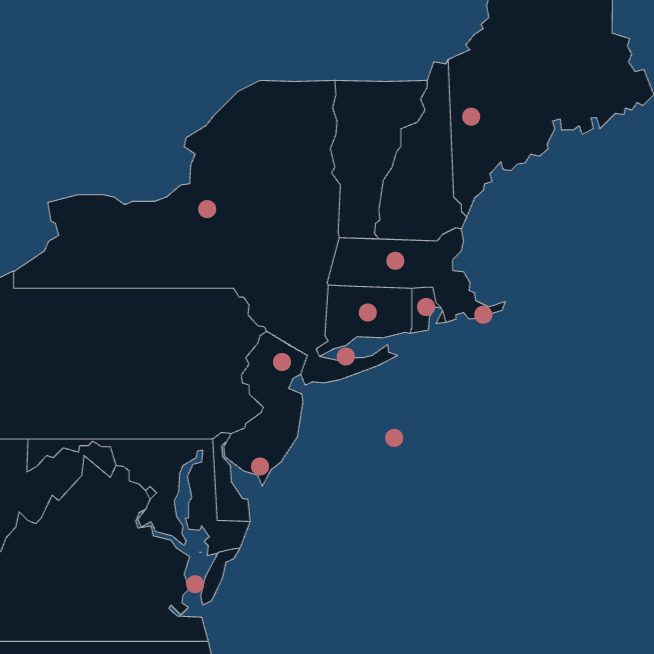
Massachusetts is the only state in the Northeast that currently stocks tiger trout. Private hatcheries do stock tigers in other states for trout derbies or private fishing clubs.
Because tiger trout are rare but aggressive, the best way to find them is to cover water by throwing artificial lures. Jigs, spoons, and stickbaits will all catch tigers, as will streamer flies.

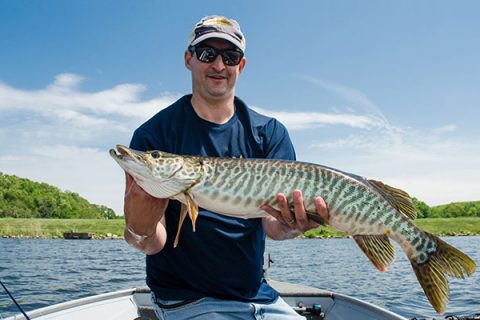
The tiger muskie, a sterile hybrid of a female northern pike and a male muskellunge, has been used by state fish and game programs as a means to control populations of panfish while also creating trophy fisheries. Since the hybrids cannot reproduce, the states can control the number of these top-level predators in a water body.
Tiger muskies are easily distinguished from muskies and pike by their irregular tiger-like stripes. Like muskies and northern pike, tiger muskies are aggressive predators. In waters where both tiger and true-strain muskies are present, tigers often display a little more of a pike’s willingness to bite.
Tiger muskies are stocked in Pennsylvania, New Jersey, New York, and Massachusetts. They share the northern pike’s preference for weedy habitat. While pure-strain muskies will often hold on offshore structure, rock, and wood, tigers seem more likely to hold near weedlines or in thick weeds.
Big tiger muskies feed on smaller fish. Typical pike and muskie lures such as bucktails, spinnerbaits, swimbaits, spoons, and soft-plastic baits will all work on tiger muskies, but they seem to prefer smaller-size baits. Matching the forage in the lake can be important, such as fishing perch-colored lures in lakes where they are prevalent.

When fisheries managers in Maine were looking for a hardy fish that would provide excellent put-and-take fishing in some of the state’s waters, they discovered that the cross between brook trout and lake trout was the perfect fish. Called splake—an amalgamation of speckled trout (brook trout) and lake trout—this hybrid char is stocked for its high growth rate and sporting qualities.
Splake are fairly close in appearance to brook trout. The most reliable way to differentiate a brookie from a splake is to look at the tail. Brook trout have a squared-off tail, while the tail of a splake is forked, like a lake trout.
Splake grow faster than either brook trout or lake trout, reaching a length of 18 inches rather quickly. They also have a better rate of survival than stocked brook trout, giving anglers more opportunities to catch fish. Splake have been able to survive in waters where brook trout have not because splake feed on species that tend to out-compete brook trout, such as yellow perch and white perch. They also eat smelt and minnows.
Splake are highly piscivorous (meaning they feed on other fish), resembling lake trout in that regard. While splake are capable of reproducing, reproduction has not been documented outside of a hatchery environment.
Maine is the only state in the Northeast where splake are stocked. They are put into lakes to provide a quality fishing opportunity in waters that would otherwise have very little value to anglers.
In winter, splake spread throughout a lake as they search for smelt and juvenile perch. In the spring and fall, they feed close to the surface, but in the summer, they move deep, preferring water cooler than 60 degrees.
Splake are a popular species for ice fishermen in Maine. They will take a live shiner under a tip-up and also hit jigs. Spring and fall, when the splake are feeding near the surface, is the best time to fish for them. They can be caught on artificial lures cast on light tackle and on flies.

The hybrid striped bass, nicknamed “wiper,” was initially created as a sport fish to be stocked in southern reservoirs with robust populations of gizzard and threadfin shad. Millions of pounds are also produced as food fish in aquaculture facilities in the United Sates. In hatcheries, the most common hybridization is the female striped bass and the male white bass. Wild hybrids do occur, but are usually between male striped bass and female white bass, which produces a slower-growing offspring.
The wiper has a deeper body than a striper, grows larger than a white bass (reaching up to 10 pounds in New Jersey lakes), and has broken stripes on its sides. Some fishermen believe that, pound for pound, hybrid stripers fight harder than true striped bass. In the lakes that they inhabit, hybrid stripers usually roam in packs, hunting schooling baitfish like alewives.
New Jersey stocks hybrid stripers in three waters: Lake Hopatcong, Spruce Run Reservoir, and Manasquan Reservoir. In those lakes, hybrid stripers are often found suspending near baitfish schools or over drop-offs and channels in open water. They rarely move into shallow or heavily weeded areas.
Though hybrid stripers aren’t as likely to come to the surface for a topwater lure as a striped bass, they will aggressively hit jigs and diving plugs. However, the most effective tactic is using natural bait. Live alewives and shiners are the most popular baits for hybrid stripers, but chicken livers can be surprisingly effective when other tactics fail.
THANK YOU
Hi.. Certainly enjoy your website as i have had freshwater in my veins for the last 61 of soon to be 63 years on the 17th and am hoping you can identify the following fish going just by my description as i was too busy trying to lure him / her in to think about a picture…. It simply looked like a Tiger Muskie but instead of stripes he was an extremely glossy white with dark black splotches all over and for lack of a better description on the color, looked like Dalmation breed dog????
It had the huge Muskie head and start to the body but slimmed down to even a smaller body and tail than a Northern Pike..
My Girl and i were on vacation in Manistique, Mi were my Mom was from and i had several other relatives after my Grandmother took a young boy and girl in after there parents had succumbed to a boating accident….
We were fishing in a small harbor were there fog horn and small lighthouse were located….
I was fishing with a Bucktail jig with a nightcrawler trailer on the hook… The jig was about 3 1/2” long without the worm and i was working it along the various sized granite boulders that they used to shore up the about 10′ wide harbor wall on both sides….
I was on the south side of the harbor were there were more shadow on the rocks at about 1:00 p.m. … I had taken a look at my girl instead of following the last of my cast all the way in and when i looked down i had that huge mean eyed head looking at me and the jig which was teasting next to his head which was resting on a small rock… We made eye contact and he did not move except for his eyes when i jumped the jig from one rock to another and even put it up to his mouth and tried to entice him by opening his mouth slightly….Then i put the jig in the water hoping to get a figure 8 or oval move with the jig around him but he swam off about 25 ‘ and ducked back into his hiding spot in the boulders…. I made a valiant try to coax him out of the rocks again changing lures and patterns to no avail. I forgot to ask any of my 3 male cousins though we did have something to talk about after my Lady caught a Rainbow while we were floating in a part of the Manistique river where there were only supposed to be River Walleye and where no one had ever pulled a Trout from that spot….. Well….Thanks for reading and if you supply me with any info on my mysterious fish, it would certainly be greatly appreciated!
My Best…… Gary
Maine is NOT the only state in the Northeast that stocks splake. The New York State DEC stocks them in approximately 12 watersheds, mostly in Northern New York.
I’m into Hybrid black bass I’m looking to buy some like a largemouth x spotted bass
I love hybrid fish as pets alot I think they are the true kings and queens of the fish world I have a jag cichlid which I will be breeding him with a female beani cichlid to make another generation of royal diamond fish.
I’m breeding my male jag cichlid with a female smallmouth bass fish
Does Massachusetts stock lakes with so lake?
I caught a trout on 12/30/22 that one could argue looked like a brookie, a tiger, or a laker. Trout Facebook forum had about 80 conflicting guesses. I can send a picture. Curious!
My apologies for the typo in my prior comment. I was asking about “splake”. Darn spell check…
Hi Jamie – I don’t believe MA stocks splake anywhere. I know Maine does, I’m not sure if NH does. Sometimes holdover tiger trout become very silver, and lose their stripes, making them look really different. I’d love to see a photo – you could email it to me at jimmy@onthewater.com
Thanks!
Connecticut Massachusetts and Rhode Island all stock Tiger trout in the bodies of water that they stock!