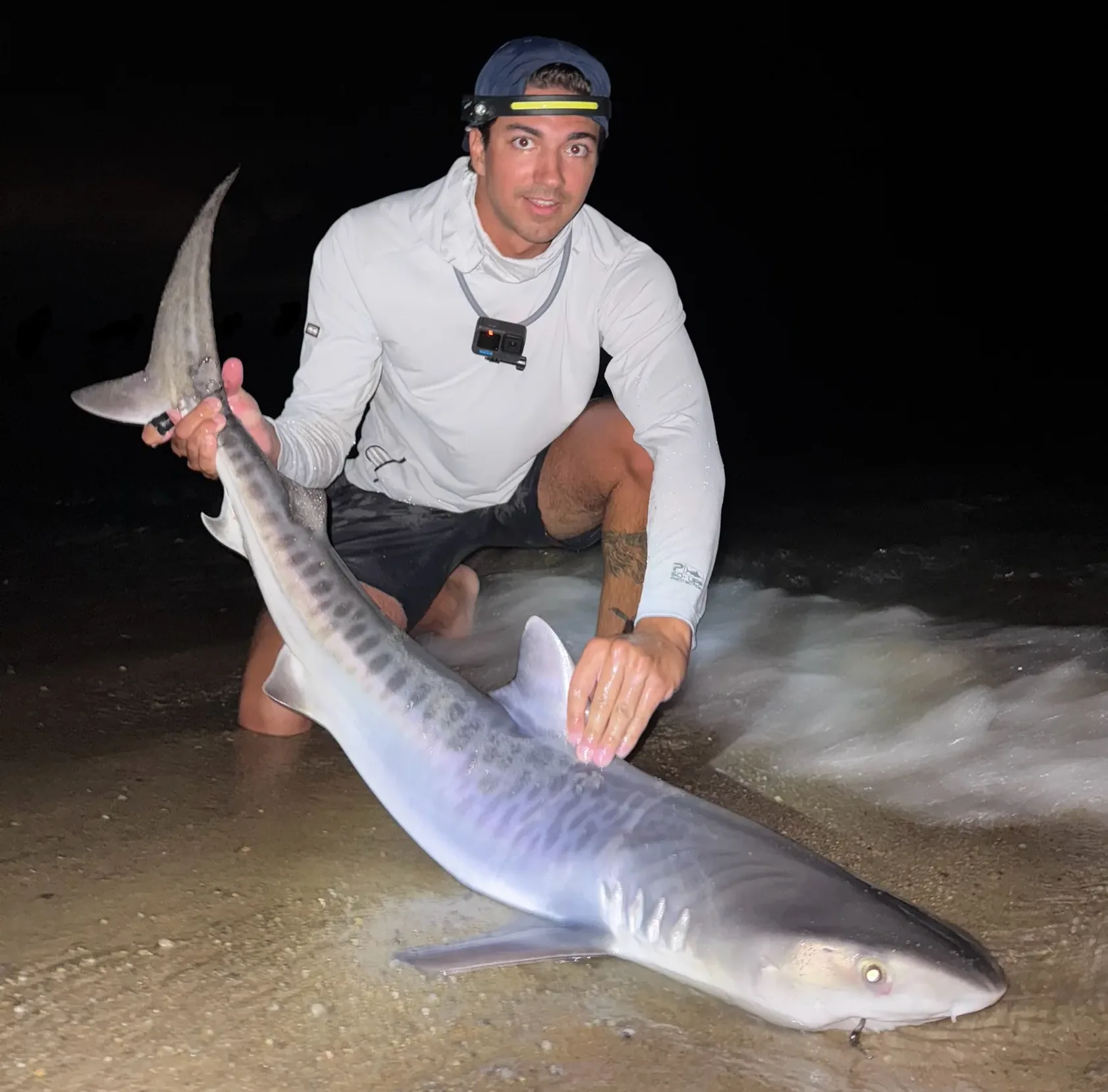

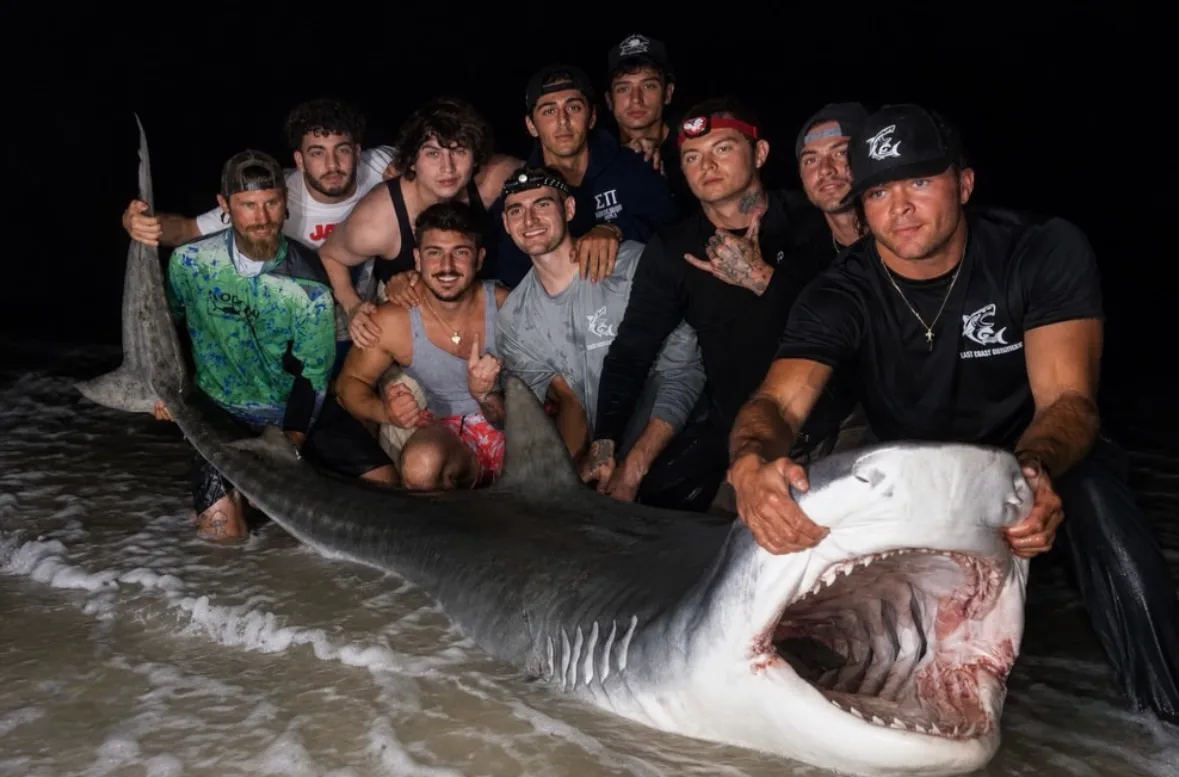
It has been the summer of big sharks down the Jersey Shore. In addition to the federally-protected sandbar and sand tiger sharks that maraud the beaches for dogfish, skates, rays and more, shore fishermen have encountered a surprising number of large bull sharks in recent weeks. But one of the more astonishing species to hit Jersey sand—coincidentally, during Discovery’s Shark Week—is an adult tiger shark.
Not to be confused with sand tiger sharks, which are rather docile, tiger sharks are opportunistic predators that will eat nearly anything they can fit in their cavernous, toothy maws. Their diet includes (but is not limited to):
- sea turtles
- seabirds
- dolphins
- seals
- rays
- squid and octopus
- crustaceans
- smaller shark species
- human trash
These indiscriminate eating habits have earned tiger sharks the unfortunate moniker “the trash cans of the sea”. However, many shore-based shark fishermen, like Mac Johnson (IG @macjohnson1) and Kurtis Walrath (IG @justlike2beoutside), revere tiger sharks for their raw power and majesty. And on the evening of Monday, July 27, their crew experienced that power firsthand.
Kurtis Walrath of Grumpy’s Tackle in Seaside Park—who provided the bait, a cownose ray—insisted that the group’s success is owed to rigorous attention to detail in rigging, and a group of knowledgable anglers who live and breathe shore-based shark fishing. Walrath was invited by his friend Kenny (IG @east.coast.shredderz) to join Kenny’s friend Jake (IG @njsharkfishing) and Mac Johnson for an evening soak on a Monmouth County beach. “High tide was at 7:40 and by 9:30, the tide had started running south. We were just hanging out waiting for a bite when the rod went off,” Walrath said. “It took the bait on a custom-built rod, which was paired with a Shimano Tiagra 80W spooled with 200-pound-test braided line. The 30-foot leader from East Coast Shredderz consisted of 25 feet of 1200-pound monofilament attached to a 5-foot, 900-pound cable,” he added. “Even with that heavy gear, the whole endeavor was a real team effort. We see plenty of sandbar sharks in the 5- to 7-foot range caught and released from shore all summer, but this night unfolded different.”
On the initial take, Walrath noted, it was clear this was no ordinary sandbar or sand tiger shark. “The fish started dumping line like you wouldn’t believe,” he said. “At first, it seemed unstoppable. Everybody involved had their shot at reeling in this fish. Without the crew we had, there is no way we would’ve landed the shark and been able to release it safely.” After a long battle of give and take, they had the shark within sight of the beach around midnight. “When we saw its fins in the wash, we all knew it was something incredible. We lost our minds not only because of the size of the fish, which Mac estimated to be 10- to 12-feet long, but because it was clearly a tiger shark,” Walrath continued.
View this post on Instagram
View this post on Instagram
Even with low tide and calm surf working in their favor, bringing such a hulking fish to shore and releasing it is far from a simple task. With the fish in the wash to keep water flowing through its gills, Johnson and company quickly removed the hook and snapped a few photos and videos to document the impressive catch. “Mac (Johnson) was neck-deep in the water cradling the shark just to ensure a healthy revival and clean release,” Walrath added. “These guys are the real deal. They fish for sharks up and down the East Coast and it’s clear they have the utmost respect for the fish. I’m just the dude who showed up with the bait,” he chuckled.
Several juvenile tiger sharks have been caught on the beaches of Cape Cod over the past few years, with last week’s being the most recent, but this is one of the first recorded tiger sharks caught from shore in New Jersey. “It’s a memory I’ll carry forever,” Walrath said. “I’ve still got goosebumps just thinking about it.”
Walrath noted that shore-based shark fishing with big baits and heavy gear is exhilarating, but requires experience and strict adherence to New Jersey’s shark fishing regulations. The use of non-offset, corrodible, non-stainless steel circle hooks (except when fishing with flies or artificial lures) is required, and anglers are advised to avoid dragging any sharks that are going to be released onto dry sand.
» Click here for NJDEP’s recreational shark fishing regulations
READ MORE