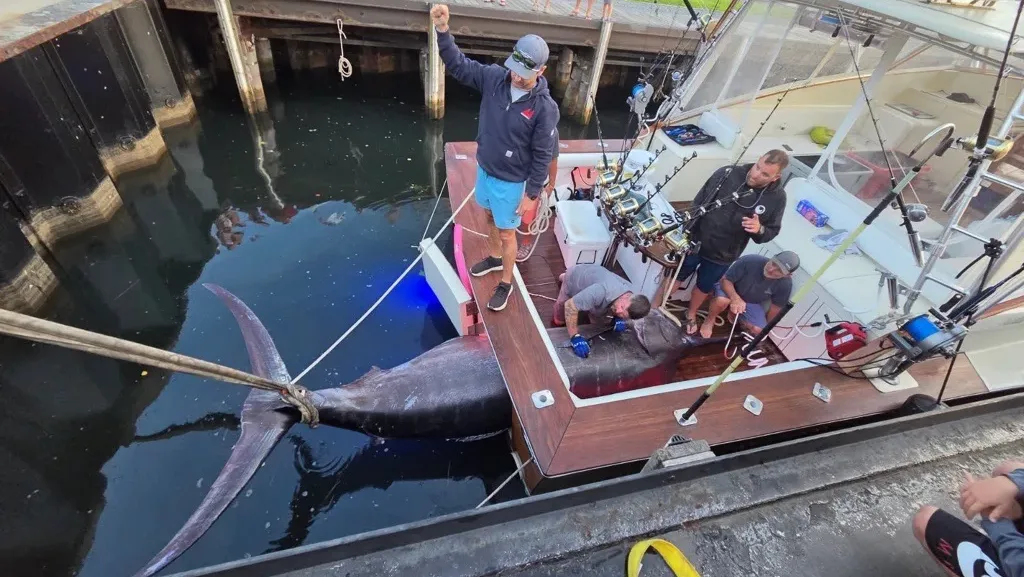
Editor’s Note: Captain Damon Sacco wrote this story for the May 2007 Issue of On The Water Magazine about an encounter with a giant blue marlin in the Northeast Canyons. On August 19, 2026, Damon and his crew landed a 1,260-pound blue marlin in Atlantis Canyon, a new Massachusetts state record, and the largest ever caught on the East Coast.
Massachusetts marlin – now there’s an interesting concept. It took getting spooled a few times while fishing the Northeast Canyons before I began to fully understand. There are monsters living out there in the blue water off our coast.
In July of 1999, one of my clients had his catch, a 40-pound-class albacore tuna, literally whacked in half by a glowing apparition that suddenly appeared beneath the Castafari’s wash. Most good captains I know who regularly fish this obscure offshore fishery have endured bouts with tremendous fish, contests that were often halted by blindsiding knockouts only seconds into round one. I grew tired of the ropes myself, and decided to beef up my arsenal. My “eye of the tiger” came in the form of braided line, 700 yards of it, coiled around the spool of a Penn 70. We have since released two of these billed monsters well over 800 pounds. Here’s a story about one of those fish that I think you’ll find entertaining.
The 2006 season was a true test for all who worked onboard the Castafari, a test of endurance, patience and sanity. It all started in mid-July when I lost an engine while fishing the offshore canyons, roughly 100 miles south of Martha’s Vineyard. There is nothing quite like a 19-hour ride in on one engine at 6 knots, especially with a paying charter on board. Then, as if that wasn’t enough, I discovered that my engine was “compromised” and that I needed a new one, all because of bad fuel and a failed $200 injector! Needless to say, the next four weeks were not spent fishing. My finances went down the drain, as did my easy-going outlook. My mates probably hung around out of a concern for my mental state more than anything else. I won’t tell you what the repair bill amounted to. Can you say loan?
Eventually the Castafari was reassembled, and I was released back into the game of chasing fish. After a solid day of cleaning and preparation, the boat was her old self and ready for the next offshore adventure. Our first step back into the ring would be an overnight voyage to the blue water, a second home for the Castafari in August, and none of us could wait to get back out there.
The following morning we welcomed returning celebrity guests Ivo “Tiger Shark” Allen and Andre Mallegal. Ivo and Andre have caught a ton of fish with me over the years – Ivo, over a ton with just two fish! We didn’t waste time when these two showed up. The boat was swiftly stocked with ice and provisions, and less than an hour later we were blasting our way across a flat, rolling swell at 26 knots. The Castafari was pointed away from civilization and toward a deep crack in the ocean floor that snaked along the bottom roughly 90 miles from the nearest beach on Nantucket. I was in search of a five-degree temperature break that was situated along the 500-fathom curve just south of Veatch Canyon. This particular break marked the northern edge of a huge eddy of cobalt blue water that had spun its way off the Gulf Stream. This thing had fish written all over it.
The weather was perfect, and the mood in the bridge deck was entertaining. Fish tales were preached, and the snack inventory waned. The four-hour voyage under the hot summer sun passed quickly, and eventually we glided over the continental shelf into a much deeper patch of mysterious blue sea. We were in the zone, but the ocean looked barren. It was an endless stretch of sparkling sapphire, an alluring sight for most sore eyes, but a sight that had fooled me one too many times. The tachometer gauges on my dash didn’t flinch, nor did the unbroken hum of the twin diesels that pushed us. Castafari’s bow remained pointed south, and we wandered across the oceanic desert into even deeper water, looking for signs of life. Eventually I stumbled across a vast weedline and decided to start fishing 15 miles south of the canyon in roughly 6,000 feet of water. The place felt right, and things were looking good.
As we slowed to a crawl, I noticed something drastically wrong. White smoke began pouring from the starboard exhaust port. I immediately shut the engine down, guessing there was a coolant leak of some sort. The reggae music faded, and the excited chatter in the cockpit morphed into a church-like silence. My stomach turned. I knew right away that a new plan was in store. After chatting with my mechanic via satellite phone, the new plan was determined. I couldn’t use the starboard engine, and I was 90 miles offshore – again. That meant one thing. Castafari had another 19-hour, one-legged slow dance home. It was hard to believe. This particular mishap wound up being something minor, but at that moment, it was anything but. After “speaking my mind” to my mechanic, I told the crew the bad news and to start fishing.
Bad weather was on the way the following day, so I began a northwesterly truck out of Veatch Canyon toward the tip of Atlantis Canyon, which was a little closer to home. What a great way to start the day! The charter was something less than thrilled. Oh, the joys of boating. We all pay our debts sometime. In 2006, I paid the motherlode.
So there we were, trudging along on one motor, wondering what else would go wrong and if we would still be able to raise fish. I climbed into my tower and took a much-needed “time out.” Not long after, three lines started screaming and eventually two jumbo bull mahi hit the deck, one tipping my bass scale at 34 pounds. These colorful critters were very nice fish for our waters. The bigger fish missed the Massachusetts record by 4 pounds. We took some pictures and then continued trolling. Eventually I sighted a school of crashing tuna. Many of the fish looked to be 100 to 150 pounds, possibly bigeye with yellowfin mixed in. The school was moving swiftly, probably in hot pursuit of fleeing baitfish. Having only one working motor kept me from chasing the flurry of action. That was pure torture, watching from the tower as the splashes from the leaping fish grew smaller and smaller.
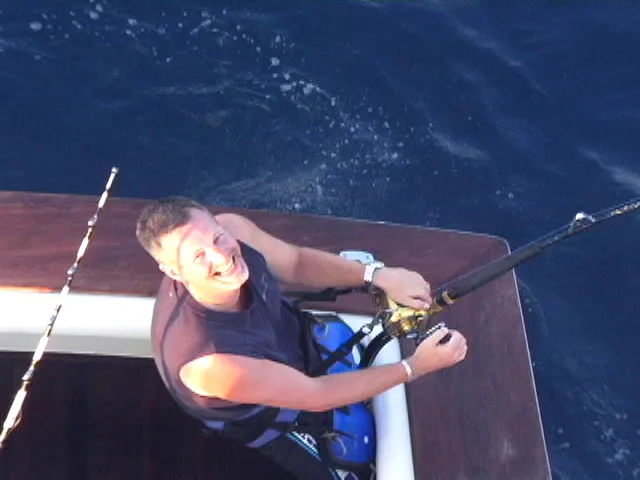
Then just before I was about to point the boat north and exit East Atlantis canyon, I noticed a section of water behind the port corner changing color. I watched in amazement as the shaded piece of ocean grew larger and more defined. Before I could scream, the starboard outrigger bounced, and one of my reels sounded off. I never did see the fish, but I saw what it left behind. A hole the size of a small bus churned in the ocean, and I knew right away that it was the mark of something huge. I watched the screaming reel as the cozy 700 yards of backing around its spool began to vaporize. The sound was deafening.
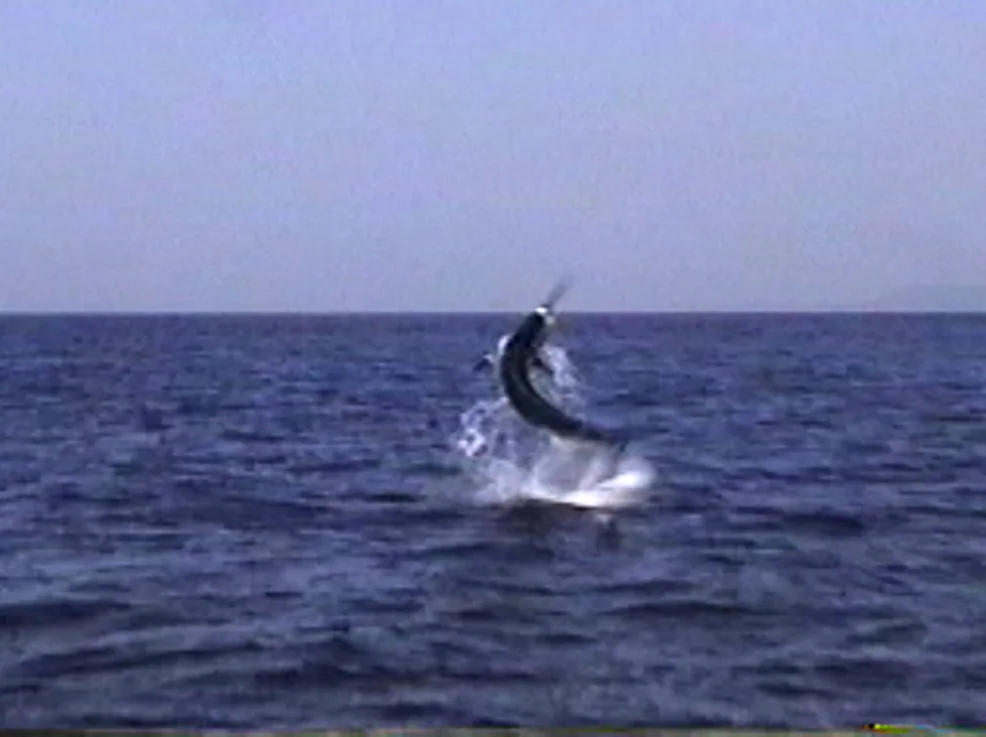
Things got crazy quickly. The spool was half empty in just a few seconds. I was amazed at how fast the line disappeared. Then out of the corner of my eye, I saw white water in the distance, and I mean a long distance. The monster was on the surface, tearing up the ocean in a fury. I had a hard time grasping that the splashing was actually from the fish at the end of our line. It looked a half-mile away. Everyone scrambled into position and began clearing the 10-rod spread, my mate Blake reeling two rods at once. One engine on, one engine off was a painful proposition. I couldn’t start the down engine as I was informed by my mechanic not to, to avoid getting coolant into the engine in case there was a bad leak. The reel continued its submissive wail as if there would be no end until the last coil of line was ripped away. A sound that I had grown to cherish had now become my worst nightmare. I had to do something.
There’s nothing quite like a nice wide turn on one engine, while pulling against a greyhounding fish. I began to attempt a chase by spinning the wheel hard, and pushing the boat forward. Despite my efforts the Castafari lunged in the wrong direction. I cringed, threw the engine in reverse, and spun the wheel hard again. My mate Nick yelled at Ivo to put the drag on full. The reel still screamed, and things looked bleak. Another KO was on the way. Despite my cursing, the boat sat in the ocean like fully loaded barge, seeming almost unwilling to turn the way I wanted her to. My console quickly became a whirlwind test of motor skills. The gear shifted one way and the wheel the other. “We’re getting spooled!” was repeated over and over. Eventually the boat began her sluggish counter-clockwise rotation. I continued expediting “with precision” my five-point turn on one engine while the reel hollered for help. Then I heard the inevitable; “We’re seeing gold!” The hooked fish was indeed a half-mile away. Ivo drove his palm into the spool, and the Biscayne rod bent like I’ve never seen it bend. We all waited painfully for the balloon to burst. But it never happened.
Instead the shrieking stopped. I could hear the churning of the diesel engine beneath my feet again. Everyone’s eyes seemed to be fixed on the bent rod, still waiting for the inevitable. Nick informed me that there was less than 20 feet of line left on the spool. Then the rod tip began to straighten. I became the one doing the screaming. “Reel!”
The reel uttered a different sound now, a mechanical whisper compared to before. Ivo reeled as if his life depended on it. I spun the wheel hard again and the Castafari jolted forward. We had a new problem. The fish had changed direction and the belly of slack line was literally draped across the ocean’s surface like the string of a fallen kite. I tried to keep the boat clear of it, but the line was everywhere. Turning around and chasing a marlin down like this is always a gamble because of slack line, especially braided line because of its buoancy. I know because I’ve run it over! I kept the boat forward, running along the line trying to maintain a parallel angle to where I thought the fish might be. Ivo reeled as fast as humanly possible while maintaining a small amount of pressure.
Eventually the rod doubled over again, and the drag sizzled. That was a good thing. We had made it through round one. All I could think of was getting a closer look at this fish, which was somewhere in the next town over. Ivo remained on his feet, now fully decked in stand-up gear, clutching the rod and forcing line back onto the reel whenever possible. But his hard work was repeatedly tested by lingering runs made by the fish. Ivo is an exceptional angler and did a perfect job of remaining in the game. The first hour was nothing more than a grudge match of will and stamina while the boat’s stern swerved its way across the ocean. The fish would run hard, and as soon as it slowed, Ivo would put the heat on and try to keep the tired monster from settling into the depths. Gaining line as quickly as possible is crucial, and backing the boat down on one engine made the game interesting, to say the least. Once a big marlin is allowed to sound or gets into cold, deep water, it could easily die. And getting a huge fish to the surface while it’s straight below in deep water is virtually impossible. Keeping the pressure up helps keeps the fish up. Anyway, we were fortunate enough to have pulled this off.
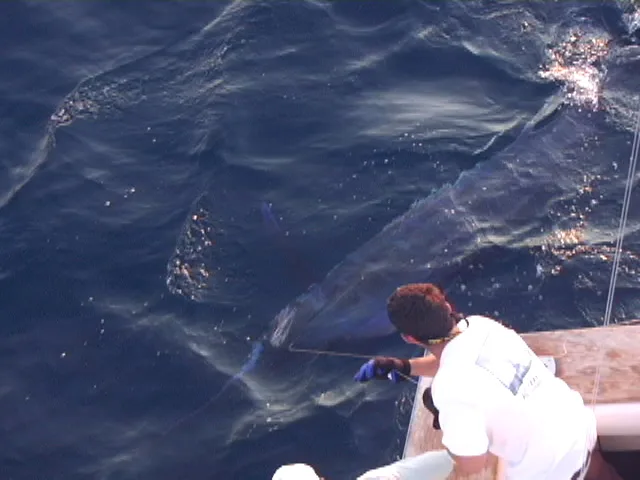
When I first saw color, I couldn’t believe my eyes. The fish was a phosphorescent spaceship shimmering from the depths. Nick grabbed hold of the leader and stepped into the line of fire, holding on for life. Eventually the monster rose to the surface and we all gazed in awe at the magnificent fish. I knew it was well over 800 pounds, and I was certain it topped 1,000. The frame dwarfed the 300- to 400-pound fish we are used to seeing. The fish broke the surface behind the stern, right side up. Her tail was huge and looked to span about five feet. Her color was electric blue. The dorsal was huge. Then the fish rolled over on her side and revealed a girth that blew me away. It was so wide that the fish looked deformed, especially in the shoulder area. We all guessed that the width of the fish was at least 3½ feet. It was hard to keep control of the fish at boat side, so it was difficult to get a good measurement. The width at the top was about 18 inches. Her length was somewhere between 120 and 135 inches from the fork to the lower jaw. Could it have been a grander? The charts say so, but it’s tough to tell. The best description I can give is that the fish looked old, like it had stopped growing in length and continued growing out. Her frame was massive, and the shoulders on this fish were absolutely huge. Blue marlin the Northeast tend to be fairly svelte critters when they get big. Perhaps it’s the colder water, or maybe just age. But this was a big North Atlantic blue, an Azores fish that probably spends most of her time crossing back and forth from one side of the pond to the other. I’m sure it was dining on the 50-pound yellowfin that seemed to be all over the place out there last year.
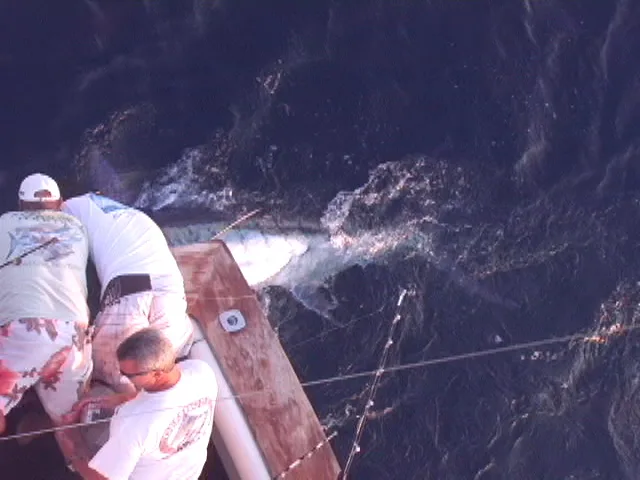
section of the fish stretches behind the transom.
The fish was plastered with remoras, and had beautiful turquoise stripes across her sides. Her bill was roughly three feet long and so wide that Blake had trouble getting a grip on it. Eventually he was able to secure the bill with both hands, and Nick was able to sprawl across the gunwale and grab the dorsal fin, while Andre secured Nick’s feet. The fish was becoming exhausted, and I knew that since we were heading into nightfall, we needed to ensure she was given a healthy release to avoid becoming a meal for sharks. We towed the fish right side up for a couple of minutes, and her pectorals began to light back up. Her tail began to swim with the boat’s momentum, and eventually Blake could no longer hold the bill. What an awesome sight it was from the tower to see that fish swim back into her mysterious world with her pectoral fins extended and sky blue. Needless to say, the 15-hour ride that followed wasn’t so bad. I wonder where the fish is right now. Tight lines, and I hope you too someday can connect with the most majestic fish that graces our offshore waters.