

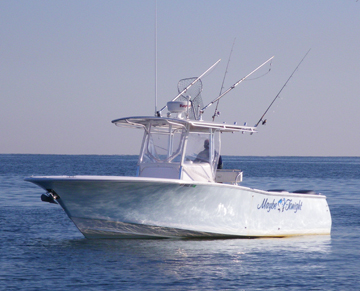
I have to admit to never having heard of Southport boats at the time of my first eyeful of this wonderful hull. It was the winter of 2007 when I had the good fortune of seeing a Southport for the first time while looking at an entirely different manufacturer. I was immediately taken by her lines, notably, the large Carolina-style bow flair and the unique tumblehome astern. While aboard the boat we were there to see, my eyes continued to be drawn to the Southport sitting just across the way. Now viewing her from the stern, I was amazed to see the beam the boat carried. I believe I may have disappointed my salesman that day as it was obvious to him that I had completely lost interest in his boat.
I could not wait to get home to hit the Internet for more information about this newcomer to my center console search. I came to learn that Southport Boatworks came into being in 2003 as the result of collaboration between several of the boating industry’s more respected names and C. Raymond Hunt Associates, whose design the Southport was built on. I read all I could find on the Southport line. I read all the advertising touting her amazing economy and being designed exclusively with the weight of 4-stroke outboards in mind. I read online forum posts where owners were claiming this hull to be “the driest, smoothest, most stable ride ever.” While taking all of this with a grain of salt, I came to the conclusion that I would have to trial this boat.
The day of the sea trial, I had my wife, her mother and my fishing buddy John along for the ride. My wife, who up to this point was never a boating fan, and my mother-in-law, who was even less a fan, would provide me valuable feedback during this trial. We trialed the boat on the eastern end of Long Island Sound. It was not a terrible day, but there was a 2- to 3-foot tight chop as a result of the southwest blowing down the Sound. To say the Southport ate it up would be an understatement. We ran into, across, up and down the chop, and never did I detect a slam, pound, bang or rattle. The boat tracked true and cornered like a European sports car. As the dealer pushed the throttles against the stop, the smile on my face grew even wider. Looking back and seeing the smile on my wife’s face sealed the deal. We signed the papers as soon as we were back at the dock. I still have that smile on my face every time I run this boat!
The bulk of my charter trips involve live bait fishing for striped bass in the Fire Island Inlet on Long Island’s south shore. As this type of fishing calls for drifting baits through areas of fast moving currents and rips, the extraordinarily wide 10.6-foot beam is something to be greatly appreciated. I can fish four adults down one side of the boat without the exaggerated heeling over I’ve seen with other makes. The boat stands solid as a rock. This stable platform does not sacrifice anything while underway either, with her 30 degree deep-vee amidships slicing through the tightest slop my local inlet can dish out. My clients and friends are always amazed at the boat’s sea-keeping abilities.
This boat gives me the very best of both worlds; I can carry every bit of fishing tackle required for a charter trip as well as load up a bunch of our friends and beach gear for day-tripping to our favorite local anchorages. Storage comes in bunches aboard the Southport. In the forward console, there is a compartment where I store two laundry baskets that carry my four castnets. Directly in front of the console is a huge 157-gallon coffin box. I am over 6 feet tall and I can lie out on the cushioned cover comfortably. Moving aft, there are tackle storage compartments under the gunwales on both sides. The back of the leaning post offers additional storage using the typical plastic compartment-type boxes. Just forward of the transom cap there is another large 38-gallonfish box, with macerator discharge.
As for rod storage, three rods fit under the gunwale on both sides forward, three rods store under the gunwale cap to stern and there are holders for seven rods in the rocket launcher on the hardtop. If the Southport 29cc does not have enough storage, then the 29 Tournament edition offers even more, with rocket launchers on the leaning post and transom.
As I previously mentioned, my primary focus is live bait fishing for striped bass. Around Long Island’s south shore, this typically involves live bunker (menhaden). By far, the easiest method of quickly gathering enough bait for the day is tossing a castnet on them. For me, one of my very favorite features of the boat is one that some of its detractors despise. The huge, dance-floor foredeck at the bow is provided courtesy of the boat’s large bow flair. It is large, and I feel very comfortable up there with plenty of room to maneuver my castnet into position. Some feel this large foredeck takes away valuable deck space. I personally have not felt cheated of space and actually feel I have more room than other boats in the same size class due to the extra beam.
I had mentioned reading about the boat being very economical, and after putting 700 hours on her, I am forced to agree. The designers state the boat was designed with 4-stroke outboard power in mind. The hull is laid out to balance this weight while underway and this leads to a very flat-running hull that, to be quite frank, amazes me with its frugalness. I have some real-world numbers that I see under typical operation on my boat rigged with twin Yamaha F250 outboards. I love running the boat at 3900 to 4000 rpms and cruise at 33 to 35 miles-per-hour on a flat plane with no tabs. She will burn 18 to 20 gallons per hour at this rate. The sweet spot on the boat seems to be around 3600 to 3700 rpm, where she hits 29 to 30 mph while using 14 to 16 gallons per hour. On a very calm day the first year I had the boat, I hit 53 miles per hour on the GPS running against the stops; I stay away from there as she was sucking down 45 gallons per hour at that speed! Good to know she has that in her, if needed. One more interesting performance note on the boat. For maximum economy, I can jump her up on plane and, with the help of some tabs, keep her running on plane as low as 3100 rpm. I’ve seen the Flo-Meter down as far as 12 gallons per hour while doing right around 20 miles per hour. Pretty good usage for 500 hp on the transom.
The original Southport Boatworks based in North Carolina ended operations and there was concern among the owner community over what would happen to our boats if we needed parts and/or support. Southport owners were very happy to hear of the line being picked up by Kenway Corporation of Augusta, Maine and that the Southport name would continue. Still, there was concern over support, as dealing with the previous owners was simply amazing. While I can only speak for my dealings, I am very happy to say that the new owners are ready to support their product with the same vigor as the original company did. I had the need to replace a cracked transom door (user error) and reached out to the new company. They stepped right up and got me my replacement in no time. I’ve heard other good stories as well which bodes well for the Southport lineup going forward.
To close, I would suggest to folks searching for a center console fishing/family boat, if you are like I was and have never heard of Southport, do yourself a favor, research them and then get on this boat for a trial. I think you will find yourself wearing a smile similar to the one I wear while aboard my boat.
I had the opportunity to tour the Augusta boat works and was equally impressed with the quality, workmanship, attention to detail and the noticeable pride and commitement displayed throughout the ranks. On heading back home to Rockport, ME., I was pleased knowing Maine had acquired such a top flight business and without doubt, that their skill and work ethic would assure their ongoing success and South Port would be remain the class leader.