
As I drive over the bridge I glance out and survey Niantic Bay. The water is like glass; the clock on the dashboard glows 4:15 a.m. No boats can be seen making their way out of the bay and the parking lot at the ramp is empty.
It’s hard to describe the feeling I get when I see the water for the first time on the way to the launch. No matter that I’ve only had four hours of sleep, there’s a spring in my step as I transfer my gear from the truck to the boat. I can’t splash the boat fast enough.
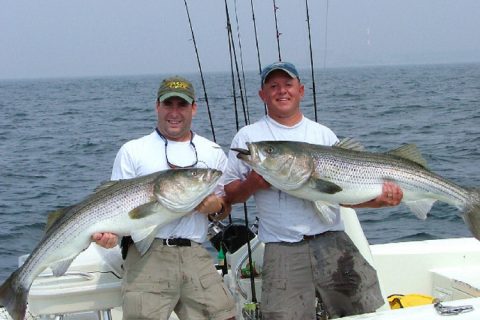
The plan is to load up on hickory shad and head out to the local reefs to trade them in for real fish…40-inch-plus striped bass. When it comes to fishing, I’m always early and rarely need the alarm clock. Some might say it’s a sickness, but if it is, I’m not interested in a cure.
It’s now 4:30 and my partner won’t be here for another half-hour. As I wait I go through all my equipment, checking leaders, re-tying a frayed one and rigging up my hickory shad rods. As I tie knots, I hear the occasional splashes from shad chasing silversides around the dock in the shadows cast by the parking lot lights.
By the time Bob shows up, water is circulating in the livewells, rods are ready, the motor is warm and my heart is pounding. It doesn’t take long to find the shad. As we round the bend I shut down the motor and we drift, listening for that telltale splash. The calm water reveals the distinct disturbance of feeding shad along the edges of the channel. We’re in luck, the tide is coming in and we’re drifting right toward them. As we close in, the lids to the fore and aft livewells are opened in anticipation of receiving the first of a dozen shad.

There isn’t much in life more exciting than watching a 21-inch hickory shad on the surface, fleeing for its life with three big stripers in hot pursuit. Live-lined shad produce my biggest bass every year. Stripers cannot pass up a struggling shad and the ferocity of their attack has to be witnessed to be believed. This technique can be used on shallow reefs or deep humps. I regularly fish waters from 10 to 70 feet in depth both during the day and at night.

When starting the morning off targeting shad, I rig up with a 2 ½-inch Fin-S Fish on a ¼-ounce jighead. I use a fluorocarbon leader of 3 feet or so of 12-pound-test, tied to 20-pound-test Power Pro. Overkill? Absolutely! While the hickories are a blast to catch, I am not interested in playing with them. The mission is to grab the bait quickly and get to the reef before dawn. Some of my most memorable mornings featured screaming drags just as the sun rose over the horizon. The rods I use are the same ones that will be used later in the day to live-line the shad. They are medium-heavy, 8-foot rods that are rated for up to 3 ounces, but with the braided line on the spool, I can still cast a ¼-ounce jighead and soft plastic far enough for the shad.
For those who have never caught a hickory shad, they have all the fight of a miniature tarpon with the soft mouth of a crappie – a frustrating combination at times. Most mornings the shad are easy to find. As I get into the Niantic River, I shut down the motor and listen for the fish. On the rare occasion when they are not up on top, I will idle along the edges of the channel, keeping one eye on the fishfinder and one on the surface around me. Once I find the fish, I shut down the engine and drop the trolling motor.
Hickory shad have definite patterns; the trick is to find out what will work on a particular morning. At first it involves a lot of blind casting, but pay attention to where your hits are occurring. Some mornings they are right along the edge of the current, other days they are in the calm water. I have found that working my jig back to the boat with the current works much better than going against it. Working with the flow keeps the jig down deeper. The resistance of the water against your line will cause the jig to rise as you work it in the opposite direction.
There are some mornings when the shad are stubborn and will not come off the bottom. That’s the time to try some vertical jigging. Drifting along and snapping the jig a couple feet off the bottom and allowing it to fall with a tight line will work every time. It’s tough not to set the hook, but it is something you must get used to when using braided lines. With practically no stretch in the braid, a hard hookset will more often than not rip the hook from the paper-thin mouth of the shad.

You’ve located the shad, found out what they want and have finally hooked up. Now comes the hard part. Remember that reference to tarpon? Most fish are lost when they jump, and shad are the same in that respect. When doing so, they shake their heads violently; this combined with a heavy jighead, slack in the line and a soft mouth can drive a person nuts. I find what works best is to hold the rod tip high and try to get the fish on top of the water. Once it’s splashing around on the surface I crank like mad, skipping it along the top, never giving it the leverage to jump and put that slack in the line. In one smooth motion I swing the fish right in the boat and into the livewell. I never let the fish hit the deck and I try to handle them as little as possible. Hickory shad are extremely delicate and will go belly-up just by looking cross-eyed at them. Once they’re in the livewell, I grab the jighead firmly and give it a twist and a shake at the same time. Most times, the fish pops off on the first try. The whole process must look pretty funny from another boat. I have visions of the Saturday morning bass fishing shows, watching the fisherman plane the bass across the water and yank it into the boat. But like I said, I’m fishing for bait, not for sport.
Shad require a lot of water exchange to keep them lively. I split them up between my two livewells to stress them as little as possible. A round livewell is best, as they tend to gather in the corner of a rectangular well.
OK! We can relax now, the hard part is over. The rest of the trip is gravy.
I like to start my mornings on the reefs in shallow water. I consider water less then 20 feet to be shallow when using shad. I live-line them in the shallow water with no weight, but I still use a three-way swivel to attach the Power Pro to a fluorocarbon leader. This is just in case the fish are on the bottom. If they are, I can quickly attach a weight without having to tie on a whole new rig. My fluorocarbon leader is 4 feet of 50-pound-test. On the end is either an 8/0 circle hook or a 5/0 treble. We all know about the lower mortality rates when using circle hooks; however, I have done very well with trebles. The difference between the two styles is how long you let the bass run with the bait. With a circle hook, 10 seconds is acceptable; with a treble, it’s ZERO. I do not let my stripers run when using a treble, and I see very few gut-hooked fish this way.
When rigging, I prefer to hook the shad through the top of the head, in the space between its eyes and nostrils. The hook holds well there but it allows the shad to breathe easily, keeping it alive much longer.
Spinning or conventional gear can be used. When it comes to spinning gear, I prefer Baitrunner-style reels. This type of reel has two separate drag systems. In “bait” mode, a striper can pick up your bait and run without feeling any tension on the line. You can adjust this secondary drag so that a shad can’t pull line off on it’s own, yet keep it light enough so that a striper won’t notice the drag when it grabs your shad. Some of these reels engage the main drag simply by turning the reel handle; others engage by pushing a lever.
Over the last couple of seasons, I have made the transition from spinning to conventional gear for my live-bait fishing. Obviously, it’s an advantage when three-waying bait in deeper water but I have found that they work equally well when live-lining. This allows me to get away with lugging fewer rods down to the boat every morning. When using a conventional set up, start in free spool with the clicker engaged. This will provide enough tension so that the shad is prevented from straying too far from the boat. When the reel starts singing, I point the tip of the rod at the fish and while still in free spool, I raise the rod straight up to the 12 o’clock position and drop it quickly back toward the fish and then engage the spool. Doing this gives you a few feet of slack in the line. I then wait for the bass to take the slack out of the line. As soon as the line comes tight again, I come up to the fighting position with the rod…fish on! That’s it – no hook set. Even with the trebles I don’t set the hook. Setting the hook on a bass that doesn’t have the shad completely in its mouth will usually rip the hook out of the shad. It doesn’t take long to burn through all your bait doing that. If you drop a fish immediately after coming tight to it, do nothing except go back into free spool again. On several occasions, I’ve repeated that process five times before finally hooking up. That fish WILL come back!

Every morning on the water is a new day with new parameters. Just because you caught fish in 18 feet of water yesterday doesn’t mean they will be there today. Some mornings I find the stripers are holding in front of the reef, during the last portion of the tide they may be right on top of it, and tomorrow you may find them on the back side. My first couple of drifts will be very long until I figure out where the fish are holding. When I get to the reef, I motor well up-tide of the crest and drop the shad. Then I keep the boat in gear for a couple of seconds until I have some distance between the bait and myself. Then it’s time to shut down and begin the drift.
Hopefully, your shad is feeling frisky and will be moving about on its own. During the drift, you should do your best to keep slack out of the line. It can be a challenge at times to keep up with a shad if it insists on heading back toward you and up-tide. High visibility lines can really help to keep tabs on your bait in low light conditions. Too much slack in the line and you will never know the shad has been taken and you will gut-hook your striper.
Later in the day as the sun is higher and boat traffic increases, I prefer the deeper water. This calls for a change in tactics. Instead of live-lining the shad, now I switch to a three-way rig. This method really calls for conventional gear; the majority of spinning rods don’t have enough backbone to handle both a shad and the 16 ounces of lead needed for the deeper water. I use only enough weight to keep the bait straight down under the boat. Depending on wind and tide, some days I can get away with as little as 8 ounces but there are days when 16 ounces isn’t enough. Drop the shad, make contact with the bottom and reel up 4 or 5 feet of line. I call this area the strike zone. Any higher than that and a bigger, lazier bass is less likely to leave the structure to come up and fight the current to chase down a bait. Any lower and you run the risk if snagging your rig on a boulder as you drift. The faster the tide, the more important it becomes to know when your lead has touched down. The quicker you can detect bottom and get your rig up in the strike zone, the fewer weights and shad you’ll lose.
I drift with the reel engaged and hold the rod upward at about a 45-degree angle. This gives me somewhere to go when my shad gets blasted. As soon as I get a hit, I lower the rod down to the fish; this is usually enough time for the bass to engulf the shad but not so long that they are gut-hooked. Again, do not set the hook. When the line comes tight, simply begin reeling. If the bass is not there, raise the rod tip slowly and wait for it to return.
When fishing reefs for stripers, bluefish encounters are an inevitable occurrence. Some days it’s impossible to avoid them, while other days changing depths can make all the difference in the world. Last September we were going through shad almost as fast as we could put them on the hook. We noticed we were getting shredded on the back side of the reef with the baits in 50 feet of water. Instead of drifting that far back, we started picking up the baits when we hit 45 feet and moved up to start another drift. We stopped sacrificing our shad and continued to catch bass for the remainder of the trip.
Not all is lost if you can’t escape the bluefish. Resist the urge to pull up and inspect your bait. Reeling up through a pack of blues will only get your bait shredded further. If anything, drop down a little closer to the bottom to try to get under the school and keep drifting.
Big bass may be lazy but they’re not stupid. When a school of bluefish start tearing into bait, stripers will station themselves underneath and just down tide and casually wait for the tide to bring them the scraps. I have lost count of how many fish I’ve boated over the last few years by finishing the drift with the bloody head of a shad. I caught a 53 inch striper after a blue shredded my bait one October afternoon. She was released, so I never got to weigh her and I hope she is still swimming today.
Even if you are not picking up bass on shredded shad heads, save them, you may need them later. I’m not saying that the heads work as well as a kicking and screaming shad but when you are out of live bait and the tide is still cranking, rather than heading back to the dock you can drop the heads down and still have a reasonable shot at stripers. Sometimes all it takes is to move to a place with more current. The quicker the bait moves over the stripers, the less time they have to decide whether or not they want the shad head. It becomes more of a reaction strike at that point. This method has saved many a trip for me over the last few years.
Using hickory shad for bait is about the closest you can get to a sure thing these days. There are other methods and they all work, but I can’t think of a more entertaining way to spend a day on the water. It is truly awe-inspiring to witness the food chain in action and use it to catch trophy stripers.
Great article! These articles are what makes you’re gang (On The Water) a great resourch for fishing from the novice to the old salts like myself. Keep’em coming! Tight-lines!
This was a great informational read. Just a wealth of info here. Can’t wait to head up I95 and take the dory to the Niantic Bay and try my hand at catching shad. Then head out to Bartlett’s Reef.
fasten your seat belts!!!