

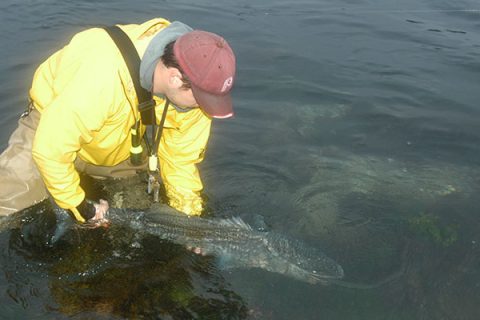
Sometimes, the best spring-run strategy is to let the stripers come to you.
Captain T was enthusiastically and carefully describing a new fly pattern he had just developed when he suddenly began spitting profanities. At the wheel, he careened his car across the breakdown lane, scraped over the curb, and stopped sharply on a grassy tract between a tree line and guardrails. Cutting the engine, he said “Sorry about that, man.”
I took a deep breath and calmly told Captain T that I had recently renewed my AAA membership and could have us towed out without a charge. Still buckled into his seat, the captain turned toward me, where his face showed a look of pure bewilderment. Then, in an instant, he smiled, followed with a belly laugh that only a man of his size and stature could accomplish. The car filled with laughter as he managed to say, “We’re here, man. This is the spot!”
As if not to waste any more time, Captain T hurriedly exited the car, and I cautiously followed. Under the streetlight we assembled our fly rods, 9-foot 10 weights, and then seated large, intricately machined reels with powerful carbon-disc braking systems. Captain T joked that if I hooked a motorcycle on the backcast, I would be able to stop it.
He opened a rigid plastic box, about the size and shape of a briefcase, revealing an array of pastel-colored furs and feathers festooned with tinsel. “Check out my herring patterns,” he said as he thumbed through his school of dressed hooks. He chose one, inspected it as if to assure himself it was indeed the correct pattern, and then passed it to me.
Isolated from the boxed school and in my hand, I admired the tied work. The body was composed of blended bucktail colored white, pink, purple, blue, and dark green, interspersed with accentuating tinsel flash. Long and wide rooster feathers positioned symmetrically extended from the back, giving a tapering profile to the tail. The front sides were made with short and blunt olive-colored feathers from exotic fowl, and the eyes were made with short and narrow yellow-spotted feathers. In sum: very fine tackle.

I said, “T, this looks like it belongs in a shadowbox displayed in an aristocrat’s study. Is this really what I’m fishing?”
The Captain saw my naivety and not the compliment. He said, “Oh, give it some moving water and that’s a herring.”
Jokingly, I said, “Yeah, looks like we’re fishing for salmon or sea-run trout tonight.”
“You’ll see,” Captain T said, confidently.
Rigged and ready to fish, he blazed the way along the roadside. The steel guardrails lining the way provided little sense of safety from the roaring onslaught of traffic. Headlights of blue, white, and yellow lit our path through an obstacle course of rubbish that sparkled from glass shards and shattered windshields. Parts and pieces shed from cars, and the ubiquitous fast food wrappings and containers that some believe obliged to jettison were strewn about. The Captain walked hastily and with purpose, and I kept pace, but with care and skepticism. I imagined the punch line of a fisherman’s practical joke, where an unwitting angler is casting for shopping carriages in a roadside gulley. T is a jokester, I thought, but reminded myself that fishing was far too important to him for that type of joke.
In a lull between traffic bands, Captain T turned and said, “Let’s cross.” We dashed across dark pavement, climbed over the leeward guardrail, and headed into brush and thickets. He switched on his headlamp, set it to red light, and advised that I do the same.
He said, “Okay, it’s a short, steep path down to the water so keep the light red and move slowly.”
The path was not a footpath, but rather a rainwater drainage course that had eroded away any growth, but had exposed fixed rocks good for footholds. We each negotiated the embankment and then moved through a concealing layer of brush.
“Just upstream is the bridge. There are some good spots to swing that herring fly,” Captain T said, standing along the narrow and slow stream.
I nodded.
As we approached the bridge abutment, the water suddenly began exploding at multiple points. I looked up, expecting to see someone heaving cinder blocks or sandbags off the side. There was no one.
Captain T looked at me with a big smile and said under his breath, “They’re here.”
My heart began pounding. I said, “Those are fish?”
“Yup. Big ones.”
Captain T and I crept closer to the abutment of the discreet bridge, and there with a low voice, barely audible, he described the next maneuver, clearly struggling to restrain his excitement.
The Captain said, “There are some big, flat rocks that you can walk out on from the bank. You’re going to sidearm cast under that tree hanging over the stream, and then shoot the line across to that pool in the corner.”
I said, “Okay, I can hit that.”
The “corner pool,” as it were, was wedged between the stream bank and the opposite abutment. A nearby streetlight partially lit the edge of the pool with unnatural yellow.
“A lot goes on in that pool. Launch that herring pattern over there, and let the currents do the work,” said Captain T.
I walked out on the Captain’s flat rocks, and could see that the stream was full of river herring. The air above had a sweet quality, reminiscent of fresh-cut cantaloupe. Along the shore and beside the rocks, hundreds of fish held rank and file before continuing upstream to their spawning grounds. Other herring seemed to prefer this stretch of the pool for spawning, as we could hear them rapidly thrashing in a cyclonic motion at the surface to release their milt and eggs.
I stripped the approximate amount of line from the reel, adjusted the drag to a high setting, and gingerly cast under the tree limbs, and plopped a fully adorned 6/0 hook just ahead of the pool and allowed the current to naturally carry it away. The streamer bumped through the herring orgy in the corner pool, perhaps being mistaken as a suitable mate. “Very deceitful,” I thought. The swing ended and the streamer was in the channel drifting downstream when the line jolted through my hand.
I pulled back hard on the line, and heard it snap taut on the surface. The pile of slack line by my feet jumped up and raced through my hand and out through the guides. The fish was on the reel almost instantly. This was no shopping cart. I pegged the fighting butt of the rod on my right hip, braced myself, and then lifted the rod so it would load deeply and thereby do its share of the work. All hell broke loose. The fish tore downstream under the bridge, held, then ran back upstream, across stream, and downstream again. The water roiled with rage and pandemonium.
It was close-quarters combat fishing, where one truly fights a fish—and this one was impossibly strong for that water. It fought with the power and fury of the wild ocean all in a confined shallow stream no wider than 30 feet. I wondered, apparently aloud, if I could land a fish of this size and magnitude in such a location. The bridge pilings were an obvious concern, but I figured there were many submerged objects that could cut my line.
The captain quickly and confidently stated, “Oh, it’s possible. You’ll get this fish, just be cool.”
The fish then returned to where it had been ambushing herring before being hooked and dug in. I maintained the tension in the line and the arc in my rod, and then a battle of attrition ensued. Both opponents tired under the strain. We were miles from the ocean, and the stream ran purely fresh, in the strictly technical sense.
This fish, I thought, must have doggedly followed the scent of river herring through coastal estuaries, brackish waters, and entered into this freshwater tributary. At last, the fish had found its optimal, or perhaps its annual, hunting grounds—this narrow stream banked in urban heartland with a good hide. And there, below the corner pool, the fish had been feeding on herring.
Holed up for some time, the fish then rallied and charged. The rod bent deeply and into the cork grip. The fish made a series of rapid high torque tail sweeps that pulsed through the rod, and tore line from the reel.
Captain T shouted, “Don’t let that fish take any more line, or else it’ll cut you off on the pilings.”
“Okay. Okay,” I said nervously, as I tightened the drag knob.
Captain T said, “Just try to pull that fish straight upstream, but not toward you until it’s on this side of the bridge.”
I repositioned myself, and with the rod tip pointed across stream, I began to reel the fish upstream. With ease, it came through the bridge, and as the Captain instructed, I then repositioned to fight the fish toward me. As it entered the shallow water the fish began violently shaking its head, which knocked and rattled through the rod. I reflexively found my footing, lowered the rod tip, and held on tight, as the fish attempted to dislodge the hook from its mouth.
The persistent pull from my fly rod eventually overcame the fish, and without that technological advantage it very well might have pulled me into the water. The fish, exhausted and made docile from our fight, then turned broadside up at about twenty feet away.
Captain T, who had been coaching and spectating from higher ground, shouted, “Now that’s a fish!”
I reeled in the line, readied and anticipated another bout with the fish, but it remained still. I passed the rod to Captain T, grabbed hold of the 40-pound-test leader, and pulled the hand-over-hand until the fish was beside my rock perch.
Captain T said, “Keep your light off until you get her secured,” as he handed me his fish gripper.
I got the fish gripper on its lower jaw and pulled it toward the bank. The light revealed a head like a watermelon, and identifying long, dark stripes against a silvery body. The edges of each stripe shined purple, and the dorsal area was dark green.
I said, “It’s definitely not a river otter!”
Captain T laughed and said, “Nope. Hang that bad girl, and let’s see how much she weighs.”
With both hands on the gripper, I lifted her from the water, and my right arm burned and trembled in protest.
Captain T turned on his headlamp and leaned in, rotating the gripper to the scale side for the reading. Time passed slowly and in silence.
“What’s the problem?” I asked.
“Hold on, buddy,” said Captain T as he fussed with the gripper. “Problem is the scale only reads to thirty pounds, and you buried it. That’s a legit thirty-plus pound striper!”
Holding the fish, I was inclined to believe him, as her head came nearly to my chest with her tail just above the shore.
Without any more delay, I put my left hand under the great striped bass, turned her horizontal and returned her to the water. Still holding the gripper, I turned the fish round and round clockwise, moving water over her gills. After a few rotations, her tail kicked powerfully and her head shook in disagreement. I obliged and released the gripper, and gratefully watched her glide away…away toward unlit water sheltered within urban sprawl.
The Captain and I laughed about how ridiculously large the fish was for the stream, and joked that half of her total weight was probably the herring stacked in her belly. I found it absolutely amazing, and thanked Captain T for taking me to his “herring spot.”
“The place isn’t much to look at,” said Captain T, “and I bet it wasn’t what you were expecting.”
I laughed, and said, “Not at all what I expected. I figured we’d be pounding sand and fishing the surf.”
Captain T chuckled, and said, “This is the Spring Run, buddy! Let the big stripers come to you.”
“When we were walking in here, I thought we’d find water too dirty to support typhoid, let alone a herring run,” I joked.
“Yup. That’s probably what most people think,” Captain T said, “but it actually runs pretty clean.”
I then asked him if he was going to take a cast, but he said, “Nah, I’m good. This is a one-fish-a-night kind of spot, but let’s go check some other spots.”
We climbed up the embankment, where I was abruptly reminded of where I’d been fishing—below a busy, roadside bridge. We skirted our way beside the guardrail, back to the Captain’s car. Traffic raced by, oblivious to the wilds that lie below.
Great piece – well done!
Well told story. Excellent writing.