
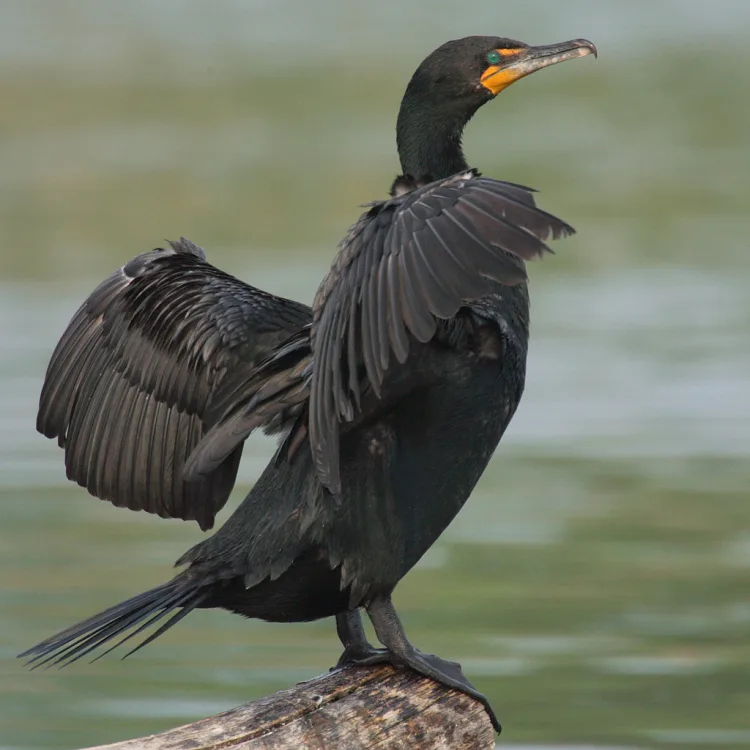
 If you fish waters where cormorants have moved in by the hundreds (or thousands), you’ve probably questioned the effect they have on the species you like to target. These birds are abundant, they eat a lot of fish, and for years anglers and fisheries managers have asked for better tools to deal with places where they impact fish populations. Federal fish and wildlife estimates put the continental U.S. and Canadian population at 871,000 to 1,031,750 birds, each eating roughly 1 to 1.5 pounds of fish a day. The U.S. Fish & Wildlife Service says cormorant numbers have “increased dramatically since the 1960s and 1970s.”
On November 17, the U.S. House passed legislation aimed at exactly that problem. H.R. 8195, the Responsible Cormorant Management and Control Act of 2026, would give state and tribal fish and wildlife agencies greater flexibility to manage overabundant double-crested cormorants and address their effects on fisheries, according to the American Sportfishing Association (ASA). It still has to clear the Senate, and it would not be an open season. Here’s what it would do, and what it wouldn’t.
How the Population Got Here
Cormorants were once heavily persecuted, and contaminants like DDT took a further toll. Reduced contamination, legal protection, and the birds’ ability to thrive in human-altered environments allowed a strong recovery, according to The Wildlife Society. In the Great Lakes region, nesting pairs grew from roughly 200 in the early 1970s to about 115,000 by 2000.
What Managers Have Documented
Impacts vary by location, and not every water is affected the same way. One of the best-documented cases is Les Cheneaux Islands on Lake Huron in Michigan, where more than 11,000 cormorants nested on some islands. The yellow perch fishery collapsed by 2000, and later research linked cormorants to natural mortality as high as 85 percent. After egg oiling and lethal control reduced nesting numbers by 90 percent within six years, perch metrics trended upward (The Wildlife Society).
What the Bill Would Do
Per the bill text, if enacted:
- Regional frameworks. Within 180 days, the Interior Department would work with each flyway council (Atlantic, Central, Mississippi, and Pacific) to develop a management framework for that region.
- Defined authority. Frameworks would identify who may take cormorants, which could include state and tribal agencies and, where the Secretary deems appropriate, state-licensed or authorized hunters and licensed lake and pond managers. They would also specify allowed methods and time periods.
- Sustainability requirement. The breeding population must remain sustainable under the Migratory Bird Treaty Act. Frameworks must also weigh effects on fisheries, other migratory birds, water quality, and endangered species.
- Ongoing review. Population surveys and framework updates would occur every five years.
Because impacts differ from region to region, the ASA says the legislation is intended to allow action only where impacts are documented and justify it, while keeping cormorant populations biologically sustainable.
Where Things Stand
The bill is not law. The Senate companion, S. 5514, was introduced September 24 by Sens. Ted Cruz (R-TX) and Katie Britt (R-AL), and the ASA is urging the Senate to act. Cormorants remain federally protected. Under a 2020 rule, state and tribal agencies can obtain a federal permit for lethal control, but they must try nonlethal methods first, and the Service retains overall authority over take (The Wildlife Society). Federal courts invalidated the earlier depredation orders in 2016. The bill’s text does not address how its frameworks would interact with that permit system, a question likely to come up as the Senate takes up the legislation.
What Anglers Can Do
If you’re seeing changes on your water, document them and share them with your state fish and wildlife agency. Documented impacts are the foundation of any management action. You can also share your views with your senators as S. 5514 is considered. Sources: The Wildlife Society, “The Rise of Double-Crested Cormorants”; The Wildlife Society, USFWS cormorant rule; The Fisherman, Oct. 26, 2026; H.R. 8195 text, govinfo.gov; American Sportfishing Association press release, Nov. 17, 2026.