

Many anglers claim to remember catching their first fish. While I do not recall my maiden fishing trip, I will never forget the first sheepshead that picked up my jig baited with a fiddler crab. The 7-pound fish made four brutal runs toward structure and ignited my obsession with the species.
Sheepshead (Archosargus probatocephalus) are a member of the porgy family and are commonly found along the Atlantic coast, from New York down to Texas. Often referred to as “convict fish” due to their distinctive black and white stripes, these fish have strong, human-like teeth used for crushing barnacles, crustaceans, and shellfish.
(Note: On The Water is reader-supported. When you buy through links on our site, we may earn an affiliate commission.)
I learned about the New Jersey sheepshead fishery during a trip to the Atlantic City International Boat Show several years ago. I attended a seminar presented by a local sharpie, Khoa Nguyen. Like many local anglers, I wrongfully assumed that sheepshead were found primarily in the southern United States. As Khoa shared his knowledge of these fish, I absorbed many details about their habitat, diet, and behavior. Khoa and I became friends, and we often fish together for these toothy critters between May and late October.
After the seminar, I committed more time to sheepshead research. Capt. Dan Schafer of Insomniac Guide Service consistently popped up in almost every search about New Jersey sheepshead. I contacted Dan and quickly realized that he was an authority on the subject and one of the most sharing anglers I’ve come across. We spoke for over an hour. He wasn’t shy about providing intel and helping in my quest for trophy sheeps. Dan manufactures the deadly Bottom Sweeper jigs many sheep anglers use and I sell in my shop.
Structure and food are the two basic factors to consider when searching for sheepshead. I spend hours studying electronic charts and finding prospective structure that may hold sheeps. I explore bridges, navigation markers, jetties, rock piles, and broken sod banks within a few miles of an inlet as I believe that the tidal rinse from the ocean is important to the sheepshead habitat. I scout prospective spots during low tides, which helps me gauge how much growth is on the pilings and rocks. These fish feed primarily on shellfish and crustaceans so the presence of mussels, barnacles, or oysters is a welcome sight.
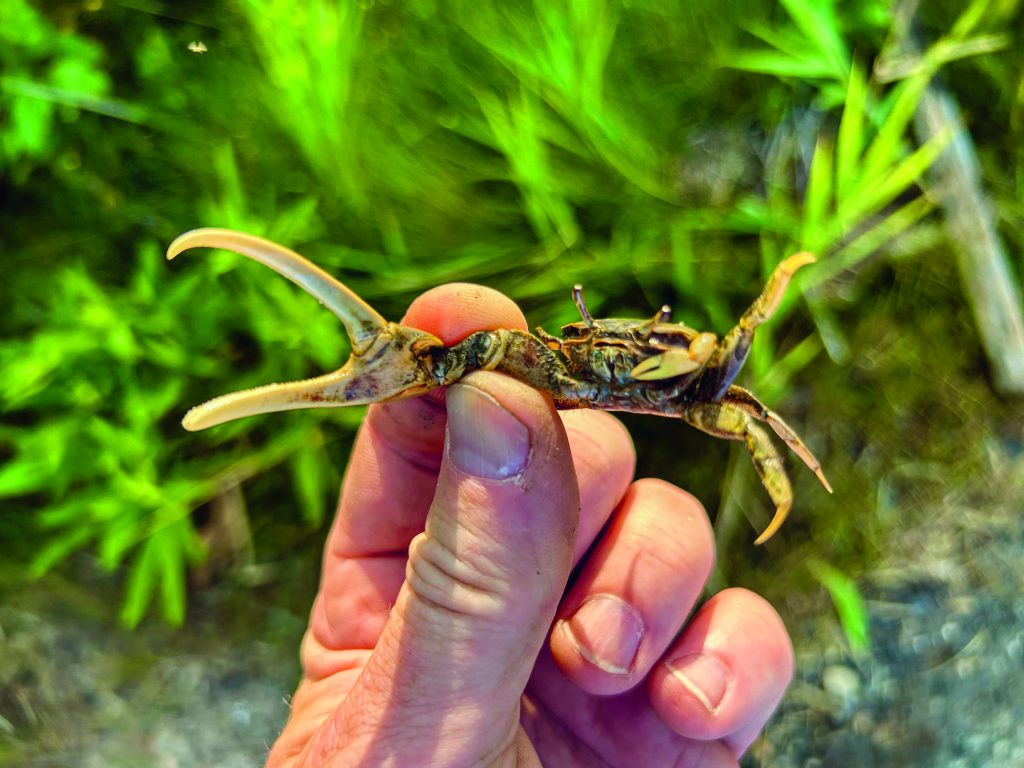
My bait of choice is the fiddler crab, which I harvest along muddy creeks during low tide. The telltale signs of a colony are the small burrows that fiddlers dig along the banks. Mud crabs, Asian shore crabs, and sand fleas also work well. If your local bait shop doesn’t stock these, hit the sod banks for fiddlers and mud crabs, flip a few rocks for Asian crabs, or rake the ocean at the waterline for sand fleas. No live bait? No problem. You can target sheepshead with artificial lures like a Vudu shrimp tipped with Pro-Cure scent or a similar product.
Sheepshead are a surprisingly hard-fighting fish with a subtle bite, so choose your tackle wisely. The rod must be sensitive enough to pick up on the slightest tick yet have enough backbone to guide these fish out of the structure. A 7-foot medium-power rod with fast or extra-fast action paired with a 3000-class spinning reel is a good start. Although I don’t find these fish to be particularly line shy, I spool my reels with 20-pound-test or lighter braid. The thinner-diameter line helps keep the lightweight jigs vertical in the tumultuous bridge currents. A 20- to 25-pound-test topshot of fluoro or mono tied to a ¼- to ¾-ounce Bottom Sweeper jig completes my typical outfit.

Sheepshead can frustrate the heck out of an angler. I must have sacrificed more than 100 fiddlers before I connected with my first fish. The bite is stealthy, and their feeding patterns don’t remain constant. It’s important to note that they move up and down the water column with the tides. If you drop your jig directly to the bottom, your bait may blow past the strike zone to where you’re more likely to catch a tog or a sea bass than a sheep. Lower your bait a few feet at a time on the leeward side of the structure.
If you’re fishing a bridge piling and the current is running north to south, position yourself on the southern side of the piling. Find a pocket of non-turbulent water and lower your bait along the water column, then watch your line for anything out of the ordinary. Be ready to firmly set the hook on any tick, slack in the line, or sideways movement. After you connect with a sheep, move your kayak away from the structure and fight the fish in open water.

My Old Town BigWater ePDL is an ideal platform for chasing sheepshead. Sure, my boat is more comfortable and is equipped with a Rhodan trolling motor, but its size doesn’t permit me to squeeze into spots often inhabited by sheeps. When targeting sheepshead, you may be fishing in tight quarters under bridges, piers, or between pilings. Don’t clutter your kayak and don’t bring 10 rods that can get hung up on the bridge. I usually bring two outfits so that I can switch between jig weights or quickly get back to fishing if I get snagged on structure.
When fishing from my boat, I have three or four spots in mind and can run from one to another at 40 mph. I don’t have that luxury when fishing from my kayak, so I must maximize the possibility of success during every session. Good electronics save time. I use a Humminbird MEGA Helix 9 with side scan to scout the structure before I commit to a spot. I also use MEGA Live forward-facing sonar to scan individual pilings to determine the depth where the fish are holding. I find that kayaks with propeller drives are better suited for fishing along or over structure. The instant reverse of the prop drive allows me to hold my position more easily without having to pull on cables to reverse a fin drive. Kayaks like the Old Town Autopilot are equipped with Minn Kota trolling motors with Spot-Lock technology, which facilitates holding a steady position over structure with a click of a button.
Sheepshead are slow-growing fish. A 23-incher may be more than 20 years old, so please keep this in mind when deciding to harvest any fish over 20 inches.

Fishing for sheepshead from a kayak is a satisfying yet challenging pursuit that rewards patience, skill, and preparation. By understanding their habitat and selecting the right tackle and bait, kayak anglers can enjoy the thrill of battling these bait-stealing fish. Remember, they’re nicknamed “convict fish” for a reason.