

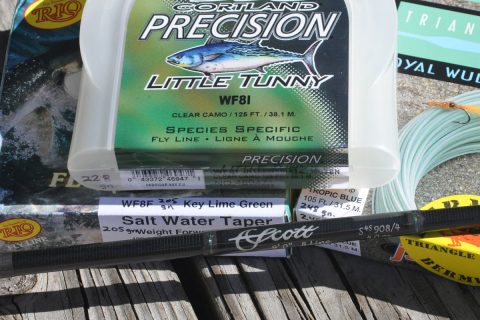
What better time to pick out a new fly rod than winter? Visits to fly shows and fly shops, checking out websites and catalogs brush away the mental snow of the cold season and are wonderful therapy as you make plans for your next purchase. Some experts can pick up a rod, wiggle and wave it, and solemnly proclaim that it’s good or bad. Not being a casting wizard, I cannot do this, so whenever possible, I take a potential new rod for a test ride in the dealer’s parking lot.
Test casting can be illuminating, but keep in mind that 60- to 80-foot casts in a parking lot are not too tough. On the water your casts may not be so amazing. It’s a good idea to try several different line weights on the rod you’re considering because the results you experience may vary greatly, perhaps with one line seeming to outgun the others regardless of the rod manufacturer’s line rating. The ideal line for you may not be the same one your buddy might choose for the same rod. Opinions are freely given by fellow fly-fishers in attempts to explain these variations. Here are a few of mine.

Manufacturers assign a line rating based on computer technology blended with field-tester opinions to match what they believe is an Average Joe’s casting skills. Trouble is, we’re not all average, nor do we all have the same casting skills so the rod’s recommended line weight is simply a starting point, and every fly rod is capable of casting several different weight fly lines, regardless of the rod’s label.
Manufacturers also rate their rods based on what they believe is a typical casting distance. However, their typical distance may not match your skills or your needs, so it’s important to make the test casts at the same distances you will usually be casting. Forty-foot casts to striped bass around bridges are easier using a line with a short taper like the Cortland All-Water, Royal Wulff Triangle Taper or RIO Outbound Short. Or, you can over-line the rod by one or two line weights.
Seventy-foot casts to the edge of a salt marsh are easier with a line extruded with a long taper, or you can under-line the rod by one line weight. With 70 feet of line outside the rod tip, that 8-weight line now weighs 300 grains or more, the equivalent of a 10-weight line. That’s why distance casters often select a line one weight lighter and put up with an additional false cast or two to get enough line weight in the air.

Years ago line manufacturers agreed to abide by certain grain-weight standards set by the American Fly Fishing Tackle Association for the first 30 feet of line. An 8-weight line is supposed to weigh 210 grains for its first 30 feet, give or take about 10 grains; but if you retrieve all but 15 feet to the rod tip you have the equivalent of a 160-grain 6-weight line, and the rod is under-lined until you make enough false casts to get 30 feet of line outside the rod tip. With 60 feet of line outside the rod tip, the rod is now handling more weight and is over-lined.

Lines also vary greatly because some manufacturers pay little attention to industry standards. It’s not unusual for the actual grain weight of an 8-weight line to exceed one, sometimes two line weights! The box may say 8-weight, but the actual grain weight of the first 30 feet may weigh 280 grains, which is a 10-weight line! These over-rated lines are great when you need to shoot line with few false casts, but not so hot for distance casts.
The disparity in line weights can be exasperating when buying a new rod. Depending on the line you test cast, the rod may be a joy (or a bummer) to cast; and it may not be the rod that’s at fault.

Use an inexpensive digital scale, like the one sold at Bear’s Den Fly Fishing Company, to accurately weigh your lines. Pull off 30 feet, weigh it and label the fly box with the grain weight. You’ll be amazed at the variations, but in the future you can match your 8-weight (or any rod) to the correct weight line you need. Some manufacturers list the grain weights of their lines on their websites; others do not. Be aware that some variation can still occur. I weighed two identical 9-weight lines (same manufacturer) at 245 grains and 270 grains. The second line is closer to a 10-weight.
When choosing a new rod, keep in mind that the rod is just one part of the team—the rod, the line and the caster must all be considered.
I liked the info. I’m just finding out all the info. before I rig up this fly rod a good old friend of mine left me.
Thank you,
Interested buying a 7wt fly rod 10ft long. I like to swing fly and also nymph fish. What size line would you recommend ?
Joe