
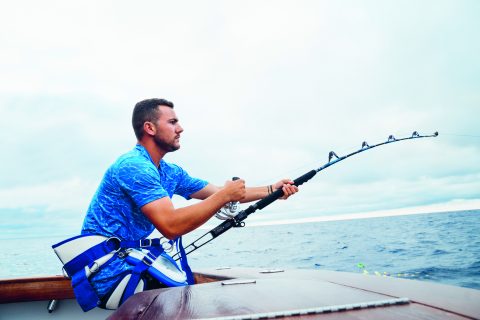
Watching an experienced crew and angler work the cockpit and tackle while a veteran skipper makes the boat dance to every move of a wild tuna is a beautiful thing. Like winning the Super Bowl, battling a big bluefin, a donkey-size bigeye, or a jumbo yellowfin tuna takes teamwork and a good game plan, with every team member knowing exactly what’s needed for success. The angler gets to bask in glory back at the dock, but everyone’s role is equally important to the catch.
The battle plan begins with tackle choices, proper rigging, and dialing in maximum drag settings. Except for giant bluefin, super-heavy tackle isn’t needed for most fish. For my money, the most versatile rod and reel combination for the majority of tuna trolling is based on 30-weight or 50-weight reels filled about two-thirds with 65- or 80-pound braided line and a topshot of 50-pound mono.
While single-speed reels are still #1, two-speed reels make lifting a 150-pound bigeye much easier if you can downshift to a “stump-pulling” power-gear ratio. Like owning a four-wheel-drive SUV, you’ll be glad you have it on that one day you get stuck in snow.
Stories of huge tuna that dumped an entire spool of line are almost certainly the fault of an improperly set drag. The crew at Shimano proved this by asking hundreds of fishermen at sport shows to set drags by hand and then tested the settings against a scale. Most fishermen were far off on the low side of the scale. On my charter boat, drags are always set by scale at one-third the breaking strength of the line at Strike, and about half the line’s breaking strength at Full. This may seem like too tight a drag because it takes a gloved hand to yank line from a reel set at 15 pounds of pull. It feels too tight to the hand, but it is just right by the scale.

While trolling, the lever should be pulled back from Strike to a setting about one-fifth the line strength. That’s about 10 pounds of drag for 50-pound line, which is plenty of punch to set the hook but light enough to prevent snapped lines. After the rush of the initial hook-up and once the angler is strapped into the gimbal belt, shove the lever to Strike position to fight the fish. Only push to Full for more lifting power; back off to Strike when the fish makes a run.
Depending on the direction of the wind, the captain may have to veer the boat right or left after the strike to get the wind off the stern. It’s tough to fight a fish with the boat heading directly or quartering into the seas and wind. A slow turn toward the lee puts the breeze off the beam, then off the stern where there’s less chance of tangled lines.
On calm days, center console boats offer 360-degree fishing room to do the tuna two-step as the fish is fought. On rough days when merely standing is a victory, it’s helpful to again keep the stern to the fish so the angler can get support by leaning against a rocket launcher or a gunnel (or get seated in the fighting chair if there is one).
Maintaining slight forward motion after the hook-up is a good idea. Momentarily shifting in and out of gear keeps the line tight and is especially helpful as the fish gets near to the boat because you lose the safety factor of line stretch.

Watching an experienced angler skillfully work the rod and reel is a pleasure and separates the winder-grinder from the superior angler. Spool diameter changes as a fish takes line and the drag increases. If a fish pulls enough line to halve the spool diameter, the drag is effectively doubled. Before the line pops slightly back off the lever on every long run of the fish, return to strike at the end of the run to gain line.
At boatside, when the fish may be holding just below the surface, a few extra pounds of drag are needed to lift it. Move the lever to the full setting, but to avoid pulling the hook or a line break, be ready to back off if the fish makes a quick dash. Extra drag can be applied when vertically lifting a tuna from the deep by using the left hand, protected by a glove, over the top of the reel to grab the spool. Your thumb and forefinger are also in the ideal position to move the lever while the right-hand cranks the handle.
With lighter tackle, use the right hand to crank and work the lever. Stop the reel handle on the upswing so the cranking arc places your hand close to the reel lever rather than with the handle at the bottom of the reel, which places the hand too far from the lever.
We’ve all seen TV shows where the angler lifts the rod in a high, graceful bend. He’s usually sweating but grinning as if he’s having the time of his life. Later in the battle, he appears in agony as each mighty rod bend causes arm muscle spasms and aching shoulders. It may look impressive, but it’s not how to fight the fish.

The high lift works against an angler because most of the line gained is lost when the rod tip is lowered and the reel cranked. The fish senses the momentary reduced rod pressure and swims back down a few feet, so the angler has to regain that lost line on the next lift. Aggravating this is the stretch factor inherent in monofilament line. For every 6 foot lift of the rod tip, perhaps 2 feet is lost as the fish swims back down and 2 more feet are lost due to line stretch. Only 2 feet of line gets cranked onto the reel, which is a lot of wasted effort and work.
Short, quick lifts of the rod tip always get the fish to the boat in less time, with less effort and fewer lost fish. With the left arm held nearly straight to the rod, the angler makes a short lift of the rod tip about 30 degrees to the angle of the line by leaning back with his legs, reducing the fatigue of arm muscles by using much stronger leg muscles to work the rod. The tip is lifted only 2 to 3 feet, then quickly lowered while the right hand makes one turn of the reel handle. Only 2 feet of line is gained, but when this motion is repeated rapidly, the angler can gain much more line with far less fatigue than with the high rod lift. The angler applies lifting power through the rod’s butt section and the fish is kept off-balance with minimal chance to pull more from the reel. And, use sea conditions to your advantage. As a wave lifts the boat, it also lifts the fish, and as the wave passes, the boat falls into the trough and more line can be gained.
The short-stroke technique works equally well with the angler fighting the fish standing up and wearing a gimbal belt or seated in the fight chair. Big fish may require the addition of a kidney or bucket harness, but the technique of leaning back and using leg muscles instead of arm muscles is still the same. The angler uses his leg muscles to slide back on the chair to gain line, then cranks in the line by sliding forward on the seat. On the back slide, the rod is lifted; on the forward slide, the reel is cranked to gain line as the rod tip is lowered.
Tuna Escape Tactics
The fish you hooked is focused entirely on escaping, and it will do everything possible to accomplish this. As it runs, it changes direction. When it dives, the boat must be maneuvered to keep the angler working the fish properly. However, the maneuvering of the boat may cause other problems. Let’s take a look at some typical fish-fighting situations that may be encountered while fighting tuna.

The End Run
Some tuna strike the lure, run straight away from the boat, then angle toward the right or left and eventually try to move ahead of the boat. The fish can move much faster than most boats can go in reverse, so the best tactic here is to swing the bow toward the fish, get the angler facing forward, and race after the fish. Once the tuna is close to the boat, the more traditional tactic of placing the angler and boat so they are stern to the fish can be used.
Whether to run forward or back down is dependent upon how much line has been dumped from the reel on the initial run. If the fish is relatively close to the boat, backing down works beautifully, but if a lot of line has been lost from the spool, it can pay to follow the fish with the bow forward before water drag causes the line to break. It’s a judgment call that only experience can help you make.
Running with the Current
Many fish conserve their energy by swimming away from the boat with the help of the prevailing current. The typical maneuver is to back down to follow it, but when the fish slows or stops its run, the current and wind will push the boat toward the fish, possibly overrunning it.
The solution here is to have the angler face the side of the cockpit so the boat can be maneuvered alongside the fish. When the fish is close to the boat, on a short line, the captain must be especially careful to be ready to pull away from the fish if it moves to dart under the boat. The stand-up angler is ready to move to a new position in the cockpit to thwart the fish’s efforts, or the fight chair angler is assisted by the mate as the chair is swiveled to turn toward the new position of the fish as the captain moves the boat.
A variation of this technique uses the boat to corkscrew a fish toward the surface. The angler remains facing the side of the cockpit and the captain continually moves the boat in a controlled circle around the fish to gain the best line angle to constantly apply lifting and to bring the fish toward the surface.

Hunker Down
A big fish may remain several fathoms below the boat and pull with tremendous power against the angler. This vertical, straight-up-and-down line angle gives the advantage to the fish and can prolong the struggle. With pectorals flared out like wings, the fish requires little effort to stay deep below the boat, yet the angler cannot exert any dramatic pressure to lift it. In essence, all the angler can do is hang on and grow tired.
An effective solution to throw deep-holding fish off balance is accomplished by pulling away from the fish, thereby gaining a better line angle that places more pulling power at the angler’s end. While some line is lost from the reel as the boat pulls away from the fish, the improved line angle usually allows the fisherman to not only recapture the line lost as the boat moves away from the fish but also additional line because of the advantageous line angle. After several maneuvers like this, the fish will be within gaffing range.
Go Wild
Some tuna go nuts with wild boatside antics that test the skills of everyone onboard. A quick hand on the throttle and shift controls can save the loss of a fish that makes a dash under or alongside the boat. The captain relies on hand signals from the mate to indicate the position of the fish as it nears the transom or if the fish suddenly changes direction.
I recall a beautiful, big yellowfin tuna that gave me a few good fits as it neared the boat. Rather than fight deep, this fish aggressively turned first to the left and then the right as it darted from side to side only 60 feet from the transom. Here’s where a nimble boat and skillful handling meant a trophy catch. I’m sure the angler in the chair remembers the hard pulling power of his big fish, but I remember the challenge of working the boat, shifting, turning, and accelerating to keep the fish from cutting off and escaping.
Slight forward motion is also a big help in the last few seconds just before sinking the gaff or tagging the fish. The slow forward motion keeps the line and leader tight and helps oxygenated water flow over the fish’s gills if it’s about to be released. Many tuna swim toward the boat as the mate places firm pressure on the leader while maneuvering the fish within gaffing or tagging range. With no forward motion to the boat, the leader man may quickly run out of options before the mate is ready to gaff. The result is a lost fish as it spits the hook from slack line or as it rolls under the boat.
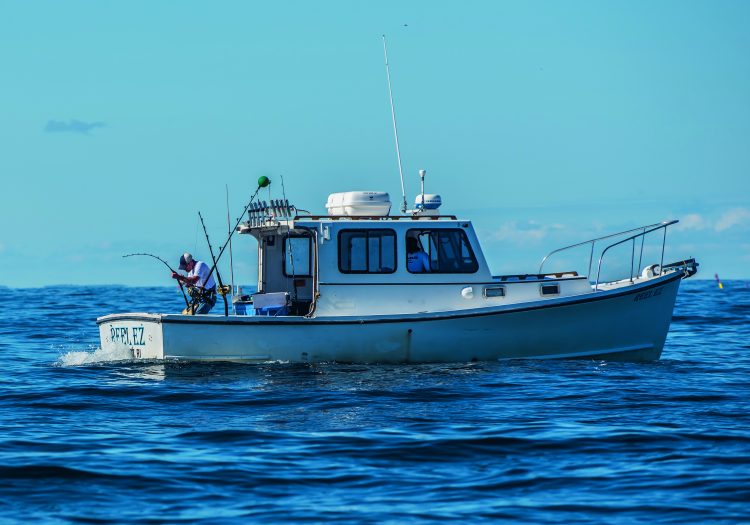
The safest gaffing/tagging procedure is with the boat in gear at idle RPMs just as the leader man grabs the leader. The forward motion usually causes the fish to rise to the surface and lie on its side or belly, parallel to the boat. Ideally, the leader man should move to the transom corner, take a wrap, and walk forward three steps so the fish is lying in perfect position for the gaff man to lean over the corner and do his job, neatly and cleanly.
The captain applies only enough motion to keep the line tight. Too much speed can cause the fish to be pulled from the leader man’s grasp. If the fish makes a hard turn away from the boat, the leader man will release the leader and the angler again plays the fish. Since the boat is moving away from the fish, there is less chance of a cutoff on props or underwater gear like rudders or struts.
Get the gaff hook into the head area so no meat is destroyed and to get a firm bite into muscle and bone, not soft flesh that may tear and cause a lost fish. The instant the gaff is struck home, the angler should back off the drag, but not into free spool. Only after the fish is securely gaffed should the angler place the rod and reel in a nearby holder. He can then assist the mates in lifting the fish aboard.
The best place to lift the fish is at the transom corner, not over the transom. This is the only unobstructed area on outboard, stern drive, or bracket drive boats, but even inboards with their clean transoms usually have the lowest gunnels at the transom corners so the lifting distance is minimized. To avoid the destruction of valuable meat, a tail rope can help lift the fish from the water to the deck. The process of hauling the fish aboard is, of course, made much easier with a transom door.
Tackle choices, rigging options, and fish-fighting techniques vary from skipper to skipper based on personal experiences and procedures that seem to work best. There are no absolutes. What I’ve mentioned here may work for you, or you may want to modify them to suit the talents and skills of you and your crew. Whatever you decide, if it’s based on developing a team attitude that relies upon respect for everyone in your crew, it will be a winner.
Big fish and stand up style of fight with the harness is the best angler satisfying experience!
Great advice here.
Thx KL >