
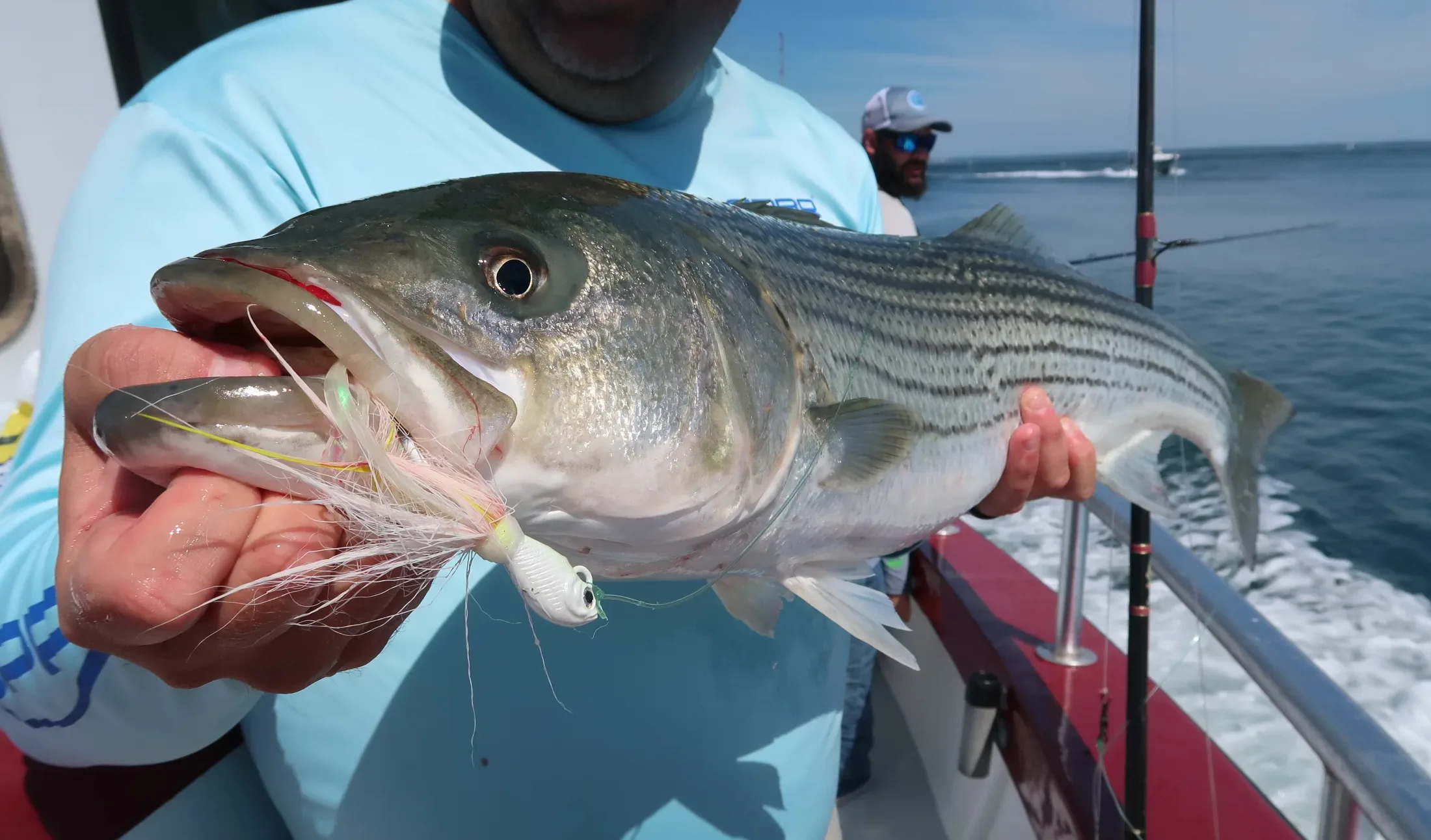
Maybe we were celebrating a little too much with the high fives and everything, but boating a 35-pound bass in the middle of a beautiful October day certainly seemed worthy of celebration. The only other boat fishing the rip rode over to us to see what happened. Upon hearing that the fish was only in the mid 30s, they laughed at us as one of them added, “Geez, with all of the commotion we thought you had boated a fifty!” They were still laughing as they motored into the tide for their next drift.
We weren’t far behind as we aimed to repeat the previous drift that had produced the nice fish. As soon as my 3-way bucktail rig collided with the bottom 45 feet under the boat, I engaged the reel, took three quick cranks, and held the rod steady with the tip pointed at the water. I swung at a bump that was probably the tip of a sand wave, and then at a distinct tap that I was sure was a fish. The rod arched as if I had stuck a rock, but I knew better. After a few minutes of give and take, my fishing partner reached over the side and dragged a true trophy onto the deck of the 20-foot Privateer. “Wait a second,” he said, as if he had forgotten something. He lifted the fish, turned to the other boat that was only a stones throw away, and said, “Here’s the fifty!” They weren’t laughing at us anymore.
The trip was an exceptional one, and quite a few years ago, but time has done very little to change the potential for quality stripers in the many deep rips from Fishers Island to Orient Point. Fishing bucktail jigs on 3-way rigs is a well-known technique in the major rips – Plum Gut, the Sluiceway, and Fisher’s Island Race – but the technique is equally as effective in most deep-water current rips of Long Island Sound during the fall. The required ingredients are deep drop-offs, varied bottom structure and plenty of current. When the current is running, the bass hug the bottom and use the structure to break the current. They would expend too much energy if they were forced to fight it. The 3-way rig is the perfect delivery tool to get and keep an offering in the strike zone, and a bucktail/pork rind combo needs nothing more than to be dragged near the bottom for it to be effective enough to be the top choice for many commercial pinhookers.
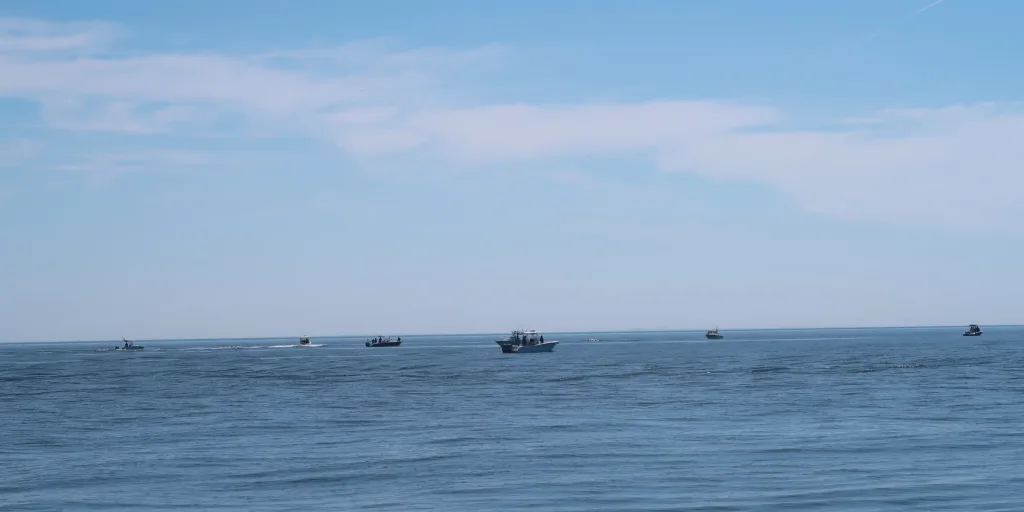
I see this type of fishing as breaking into three components – the rig, the technique, and choosing where you drift. The last component is the one that separates the pros from everyone else. I’ve been fortunate enough to fish the Orient rips with Captain George Grosselfinger on numerous occasions. He’s pinhooked these rips for many years and was known as one of the best guys to charter if your goal was to boat a 50-pounder. What I see as one general area with some nice rips, he sees as dozens of little “subspots,” each of which hold fish for varying portions of the tide. His drifts are short and precise. He’s hitting a boulder here and a subtle depression there, and all at the appropriate time. Go near him when he’s targeting a piece and he’ll immediately move to another; he has plenty, and he knows there’s a good chance you won’t hit the first spot properly and he can return to it when you leave. Compare his catch to the average angler’s catch at the end of the night and you’d have a hard time believing they fished the same place with the same technique. There were a few others like him, and what they know cannot be taught in a magazine article. It can be learned only from the experience of getting the other components of this fishing right.
The rig is pretty simple. One loop of a sturdy 3-way swivel is attached to a 5-foot length of 80-pound-test monofilament that terminates at a bucktail. Another loop goes to a 1-foot dropper of 40-pound mono that terminates with a heavy sinker. The last loop goes to the main line. The sinker dropper has loops at both ends so that you can change sinkers or sinker droppers without having to cut or tie anything. You should bring a bag of pre-tied ones with you on every trip. It’s best to keep the breaking strength of the sinker dropper a little less than the main line so that if you snag the sinker, you can break it off without losing the entire rig. Cannonball sinkers are the best for this kind of fishing. The round ball is much less likely to snag than the irregular shape of a bank sinker. The round shape also has less resistance when being dragged through the water, allowing you to use less weight. For example, if you need a 20-ounce bank sinker to stay down, a 16-ounce cannonball will work just as well.
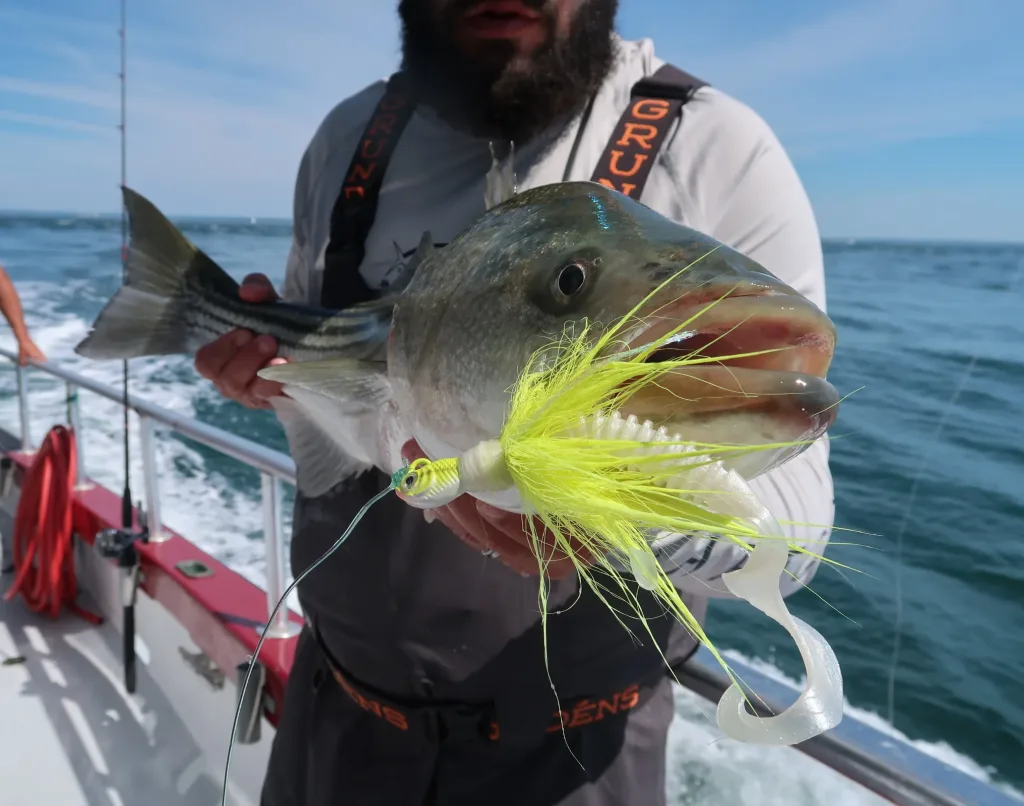
The most important requirement of a bucktail used for this kind of fishing is that it must have a strong hook. You can usually get away with a 7/0 Mustad 34184, but an 8/0 would be better. Any off-the-shelf bucktail in sizes from 1 to 1½ ounces with a strong enough hook will catch. I prefer ones with lots of hair because they tend to stand straight out from the three-way swivel as opposed to riding below it and snagging bottom. As for colors, wine red is superb in the dark and chartreuse is an excellent color in the daylight. If you had nothing other than white, you’d probably be fine. Tip the bucktail with a strip of red, yellow or white #70 Uncle Josh pork rind, and your rig is complete.
You’ll need a rod that can handle a 16-ounce sinker. I spool up with 50-pound-test braid. There are many reasons why braid is the way to go for this kind of fishing. Fifty-pound-test braided line has the same diameter as 12-pound-test monofilament, reducing drag through the water and allowing you to use less lead to reach bottom. In addition, because braid has almost no stretch, it is much more sensitive and will help you distinguish the difference between the bump of the bottom and the bump of a fish.
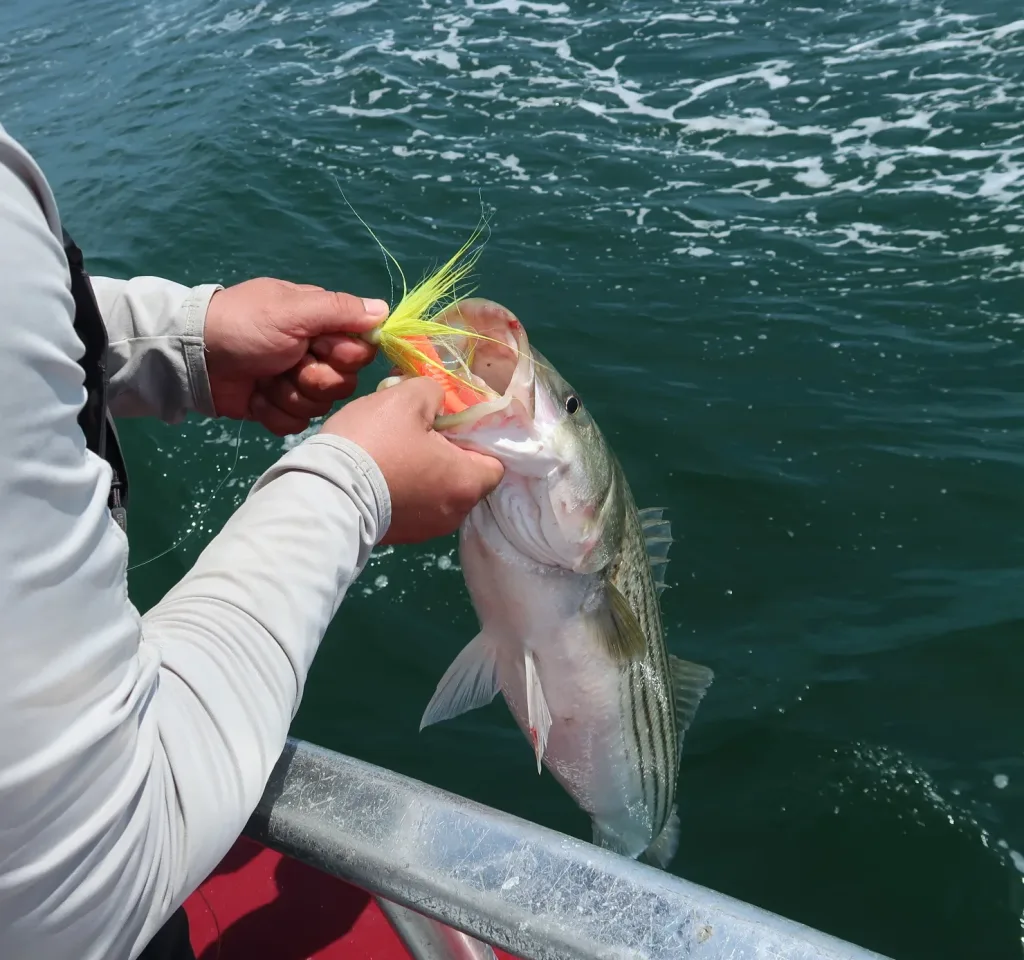
The objective is to glide the jig near the bottom without getting snagged. Do that in the areas mentioned, and you can’t help but catch fish. With almost constant monitoring of the bottom contour on the fishfinder, drop the rig to the bottom, immediately take two or three cranks, and then just hold the rod in a position where you’re ready to strike. If you’re new to this type of fishing, bottom taps may feel like fish taps. Swing at them. Who cares if you’re wrong? Better to swing because your sinker bounced off a rock than to not swing at a fish because you thought it was a rock.
I used the word “immediately” when describing when to take those cranks. This is very important because many of these areas have sticky, rocky bottoms. Drag your rig on the bottom of Plum Gut for a few seconds and it will probably stay there. It’s important that your rig stay nears the bottom, but that’s not so easy because the depth changes frequently and sometimes drastically in these areas. If you feel dragging, hurry and take a couple of cranks. If you see the bottom rising on the fishfinder, anticipate picking up some line. If you go over a dropoff, hurry and get that rig back near the bottom. The bass are frequently hugging the drop, while the nuisance bluefish often cruise higher in the water column. Big blues can be fun under some circumstances, but not when you know you might be a bump away from sticking a big bass. If you drift for a bit, maybe 10 seconds, and don’t feel anything, touch the bottom again to make sure your rig hasn’t risen out of the strike zone.
If you have to keep dropping back to stay near the bottom, you’ll likely start scoping out too far. This means you have too much angle in your line. Your line should be pointing just slightly out from being straight down. If you’re scoping, switch to a heavier sinker, but use the lightest sinker that you can without scoping out. Expect to be using cannonballs between 10 and 16 ounces.
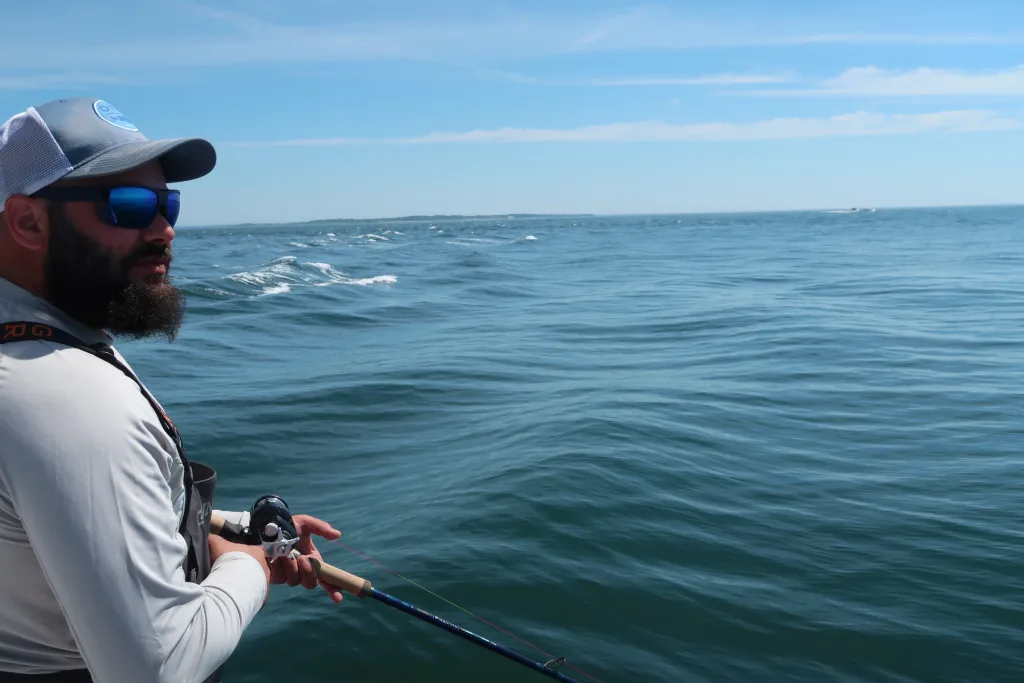
A lot of this type of fishing is targeted at a few days either side of the new and full moons, which are the times of the month when the current runs the fastest. It’s hard to argue with the past history of great catches during these windows, but areas such as The Race where the water runs hard all of the time should not be overlooked at other times of the month. Some areas work better on certain tides, and learning these patterns will come with experience. I think most captains would agree that the ebb is favored overall, but The Race can be very good on the flood current, as can Plum Gut in May. Even some of the lesser points in the Sound can put out a good catch on the flood.
No matter where you fish or on what tide, your drift speed and the speed that the water is moving near the bottom must be different for the 3-way bucktail rig to work. I don’t recall having this be a problem in the Gut or Race. Even with no wind, bucktailing works just fine in these places, and you still need substantial weight to keep from scoping out. However, in most smaller rips, if you don’t have any wind, your rig will hang ineffectively straight down. The reason is simple – if the boat is moving at the same speed as the bottom water, the bucktail will not stand out and swim at the end of its leader. It can be very frustrating, and I mention it here because if you try a new piece of water under those conditions, you may conclude that the fishing is poor there even if the place is a gold mine.
Excellent bass fishing is underway in Plum Gut and The Race by mid-May. Plum Gut can be an especially productive place to bucktail on the daytime flood tide in May. As the waters warm, the fishing shifts to the night hours, and the rips east of Orient will become the summering grounds for an impressive population of quality bass. The fall sees good day and night fishing from Orient Point to Fishers Island, at least through the month of October.
If you have not fished these waters before, be aware that Plum Gut and The Race are sometimes downright treacherous, especially when there’s a significant wind blowing against the current. If you don’t own your own boat or would rather leave the worrying to someone else, there are numerous charter and head boats that can put you into some of the best striper fishing Long Island Sound has to offer.


