


I started surf fishing for striped bass in 1973. Soon after my introduction to the sport, some of my surf-fishing mentors, expert anglers like “Gill” Gliottone, Matt Squillante, Andy Lemar and Frank Benassi, touted the importance of utilizing eels if I wanted to score consistently with stripers of all sizes. They were right! Casting an eel, either live or rigged, into productive waters drew almost automatic strikes.
Over the more than 30 seasons since my rookie year, I have racked up impressive scores on live and rigged eels. There was the 48 ½-pounder (my second largest surf bass) taken on a live eel in Westport, Massachusetts on a cold Halloween night. Consecutive 800-pound nights in Chatham in the early 90s on rigged eels. Six 40-pound-plus fish at Bonnet Point, Rhode Island, during World Series week in 1996. A great full moon evening using live eels at the Mussel Bed in Rhode Island on 40- and 42-pound fish. A 41- and a 47-pounder at the mouth of Narrow River on rigged eels one election night not too long ago, and the list goes on.
In my book, live and rigged eels were the best bait for stripers, and other than in early spring, I rarely fished with much else until the summer of 2003. Then, two of my long-time surf-fishing friends, Tim Coleman and Pat Abate, formally introduced me to a soft plastic artificial bait they had been using with amazing success for striped bass. Both of these gentlemen are sharpies, consummate surfcasters with 70-plus years of experience between them chasing linesiders from shore. Both men have a penchant for consistently landing major-league bass. Moreover, Tim and Pat were always strong advocates of live and rigged eels. The soft plastic bait they had become so excited about was the 9-inch Slug-Go, manufactured by Herb Reed’s Lunker City Company in nearby Meriden, Connecticut. Since then, Tim and Pat have become so impressed with the Slug-Go that they have just about shunned eels in favor of this amazing soft plastic creation, and both can cite numerous surf-fishing trips in the recent past when using the 9-inch Slug-Go resulted in unbelievable striper catches. In fact, Tim and Pat both exceeded the magic 40-pound mark with this artificial. At first, I was extremely skeptical of this artificial alternative to the eel, not believing the Slug-Go could come close to replacing the real thing. My feelings changed dramatically, however, when I had the opportunity to see the 9-inch Slug-Go in action. On several occasions I fished with Tim and Pat—I using my beloved eels and they the 9-inch Slug-Go. Amazingly, our catches were similar, and on more than one occasion they out-fished me.
Observing their comparable and sometimes better success, I decided to give the soft plastic bait a try. After a bit of experimentation and some fantastic action over the last three seasons, I am now a true believer. I have not bought a live eel since the summer of 2003! In that time, I have taken small bass, big bass and a lot of bass. My most recent was a 30-pound fish taken three nights before writing this article. So, while some may scoff at the notion, I can say without hesitation that the 9-inch Slug-Go is as effective as a live or rigged eel. I believe I have come up with a way to rig one of these baits that turns it into a striper-catching machine. The following is a list of materials needed to modify this bait so the angler will achieve optimal results.
When the 9-inch Slug-Go is prepared in this fashion, it casts well, has much better action than one without weight, hooks more fish that “short hit” the lure and enables the angler to fish the rips and a variety of water depths. Fishing the Slug-Go The modified Slug-Go should be fished much like a Zara Spook or pencil popper. The surfcaster must use a moderate retrieve, twitching the rod quickly throughout and keeping the lure subsurface at all times, which is important. This can be achieved by holding the rod parallel to the water and to the side of your body while retrieving.
In deep water or rip currents, allow the Slug-Go to sink a bit, and count the seconds as it sinks. Try starting your retrieve after it has sunk for a specific number of seconds, and when you get a hit, allow the lure to sink to that level on subsequent casts. Vary the amount of time you allow it to drop until you find the prime feeding zone. Do not fish this lure like a live eel or at a slow pace. I firmly believe the Slug-Go’s appeal to stripers is based on its erratic action, and said action can only be achieved by fishing the lure as stated above. Furthermore, when the fish hits the lure, set up immediately, much as you would with any artificial. Although you can certainly use a long, heavy-action surf stick, I like to use a rod between 8 and 9 feet long. The shorter rod helps me stay in contact with the Slug-Go. I always use a fluorocarbon leader with a quality ball-bearing swivel and snap because I like to be as stealthy as possible, and fishing the Slug-Go will cause line twist without the ball-bearing hardware.
Color? Slug-Gos are available in a wide variety of shades. I have tried just about all of them, but all-black is by far my favorite. It works best during low-light periods and after dark. Black sparkle and rainbow trout colors would be my next choices if I couldn’t find black. I don’t fish much during the day, but a charter captain friend of mine, Jimmy White, who guides anglers in sunlight and who is familiar with the productivity of soft plastics, prefers all white and pink (bubblegum) Slug-Gos. Captain White has taken fish in the 40s on these colors. The 9-inch Slug-Go is absolutely the best artificial I have ever used over decades of pursuing stripers in the surf. When I cast this lure along any coastline into water I know is productive, I am sure a bass will take it if there is one present— just as sure as I was when I fished with live and rigged eels.
How to Rig a 9″ Slug-Go (Steve McKenna style)
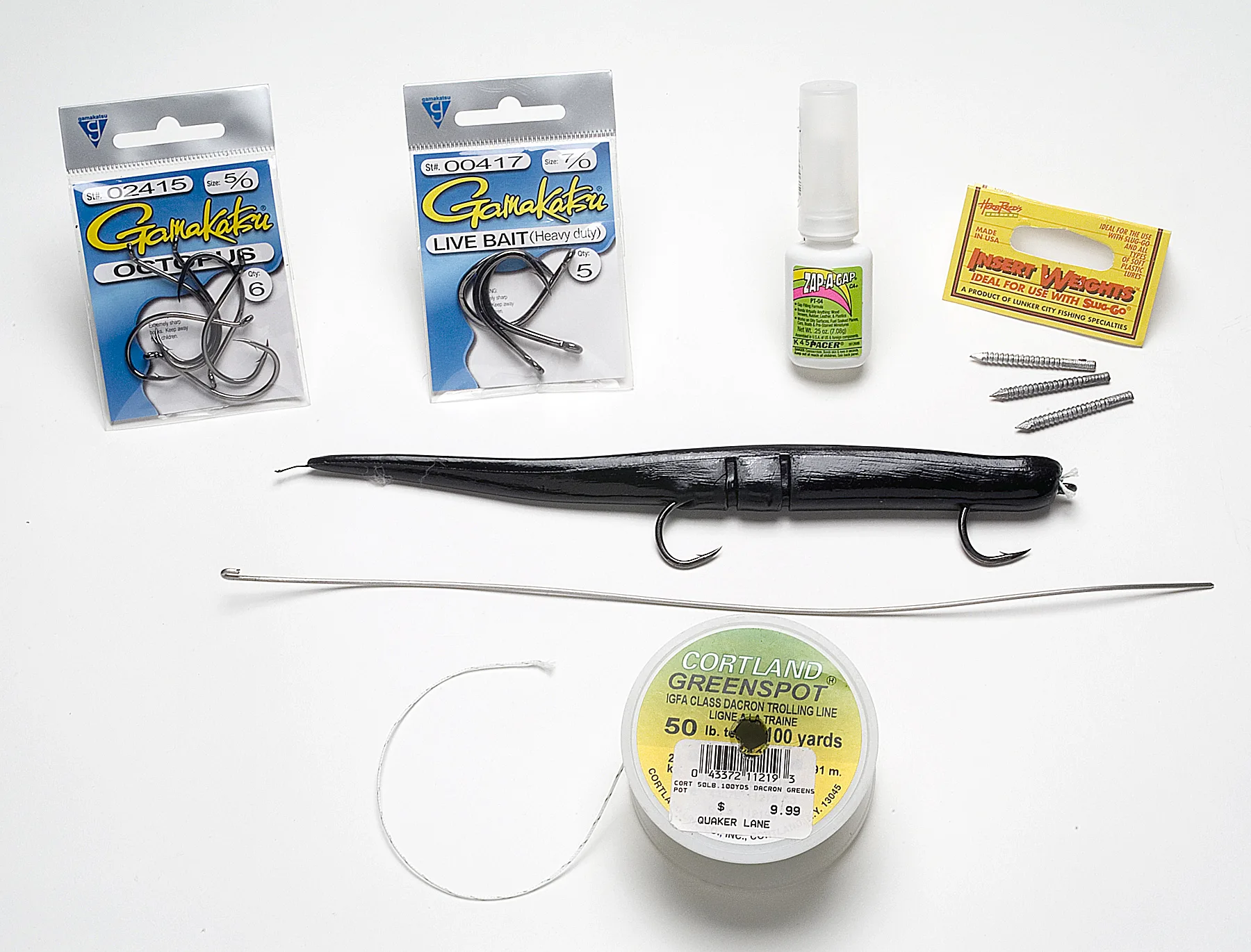
Materials
- 9-inch Slug-Gos
- Rigging needle (this can be easily fashioned by cutting a 10-inch section from bottom of thin-wire hanger, sharpening one end to a point, and, with a pair of pliers, bending the other end to a small u-shaped hook)
- 7/0 and 5/0 Gamakatsu hooks, either live bait or octopus models.
- 50-pound-test Dacron line
- Superglue or Zap-a-Gap glue or any quick-drying, strong cement
- 3/32-ounce Lunker City Insert/Nail weights
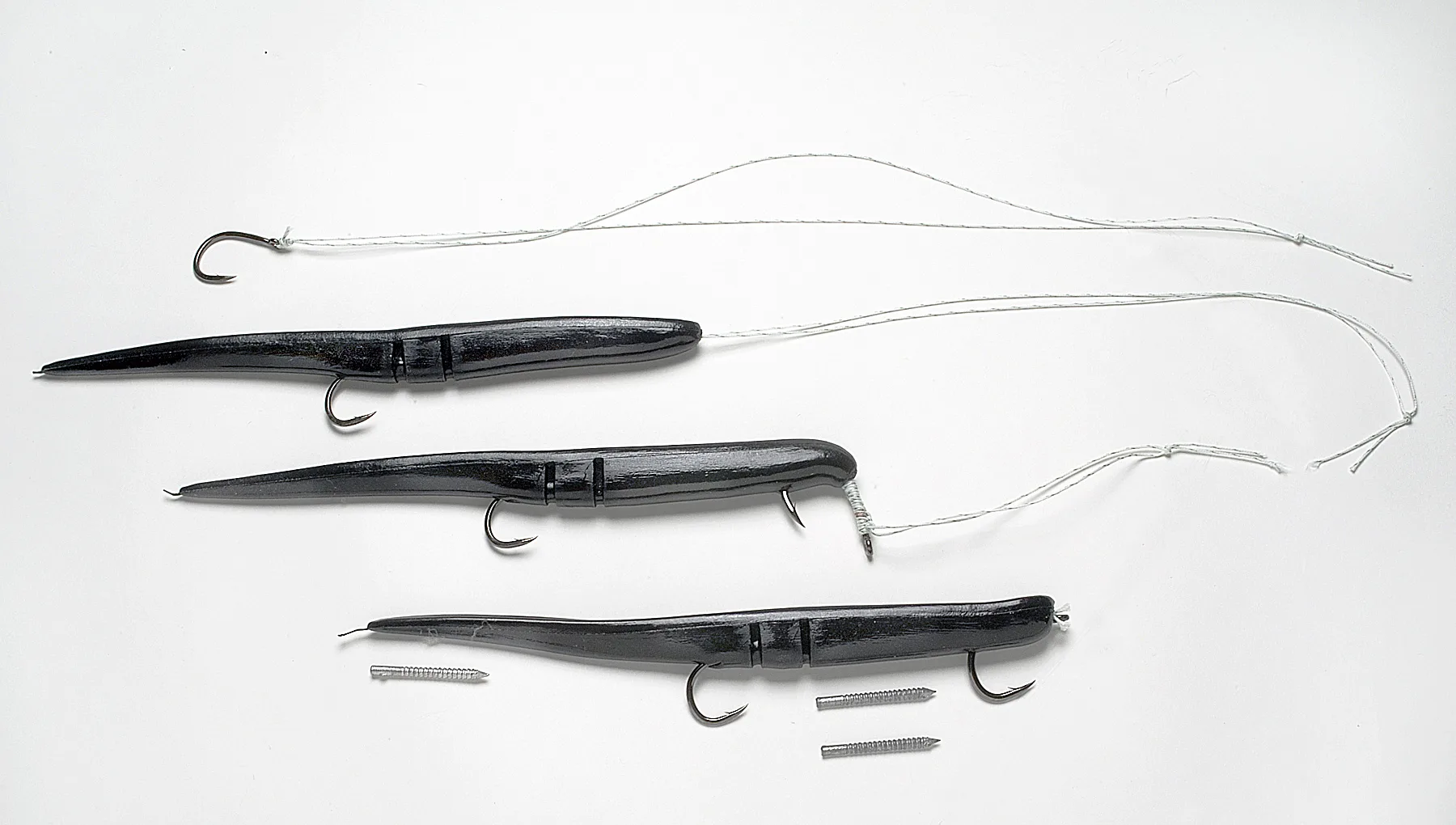
Rigging Process
Step One: Double a 24-inch length of 50-pound-test Dacron line, tying together tag ends with an overhand knot.
Step Two: Tie looped end of doubled Dacron to 5/0 Gamakatsu hook with an improved clinch knot.
Step Three: Attach doubled Dacron line to u-shaped hook on the rigging needle.
Step Four: Insert pointed end of rigging needle into the body of the Slug-Go just to the rear of the segmented section in the middle of the bait.
Step Five: Push rigging needle lengthwise through the center of the Slug-Go, exiting out the front of the lure. Then pull the rigging needle and Dacron line through the Slug-Go until the hook shaft is concealed and just the hook gap and point are exposed.
Step Six: Insert 7/0 hook into the head of the Slug-Go about half the overall length of the hook, then poke it through the bottom of the bait. Half-hitch the doubled Dacron line up the exposed shank of the hook. Make an overhand knot after the half hitches are completed. This will prevent half hitches from unraveling.
Step Seven: Liberally coat half-hitched Dacron with glue, then push the covered shank all the way in, leaving just the eye exposed.
Step Eight: After glue dries, push one Slug-Go insert weight directly into the tail of the lure and another weight on either side, and be sure the head is hook parallel to the body.
Originally Published in the September 2005 Issue of On The Water Magazine