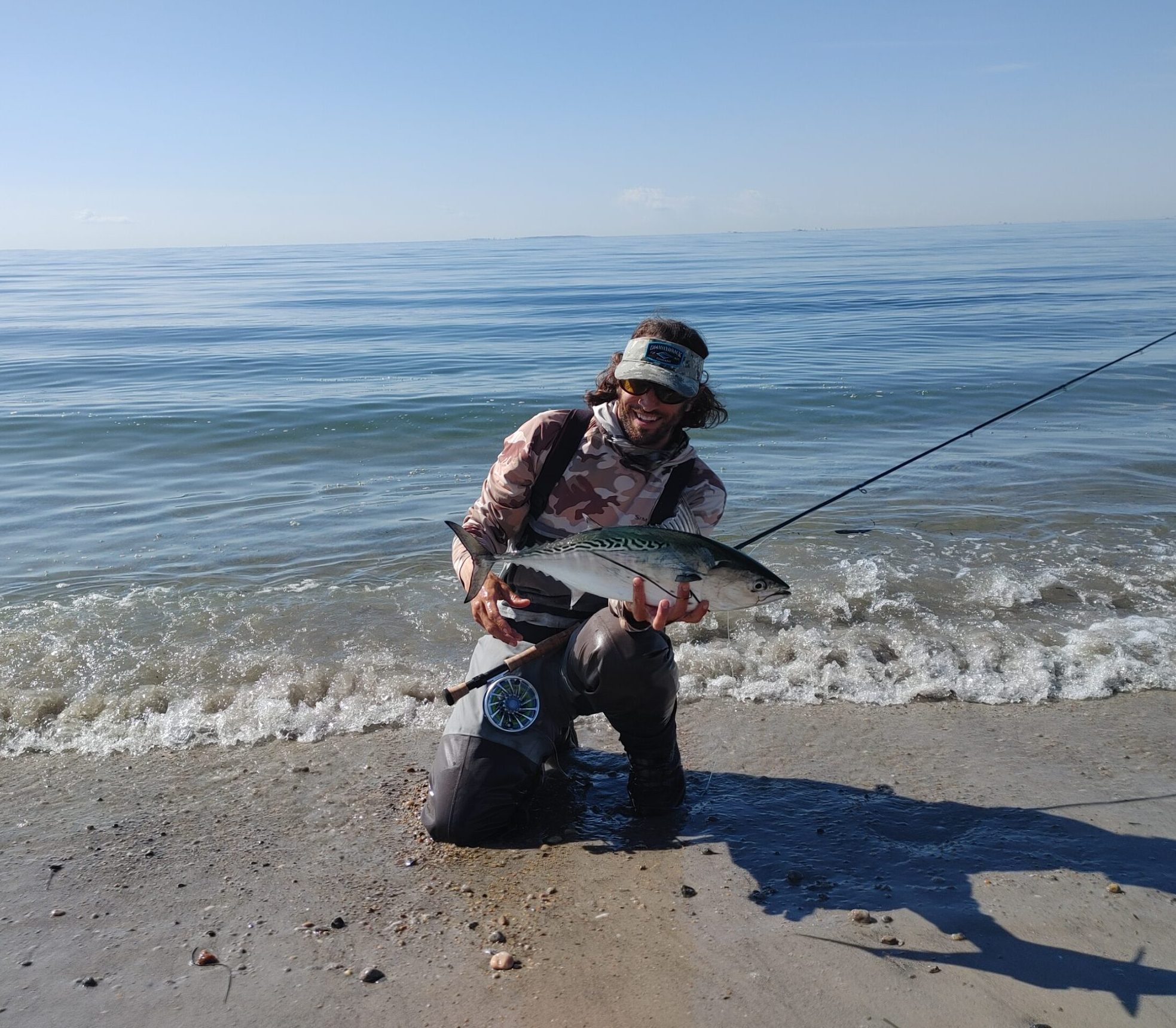

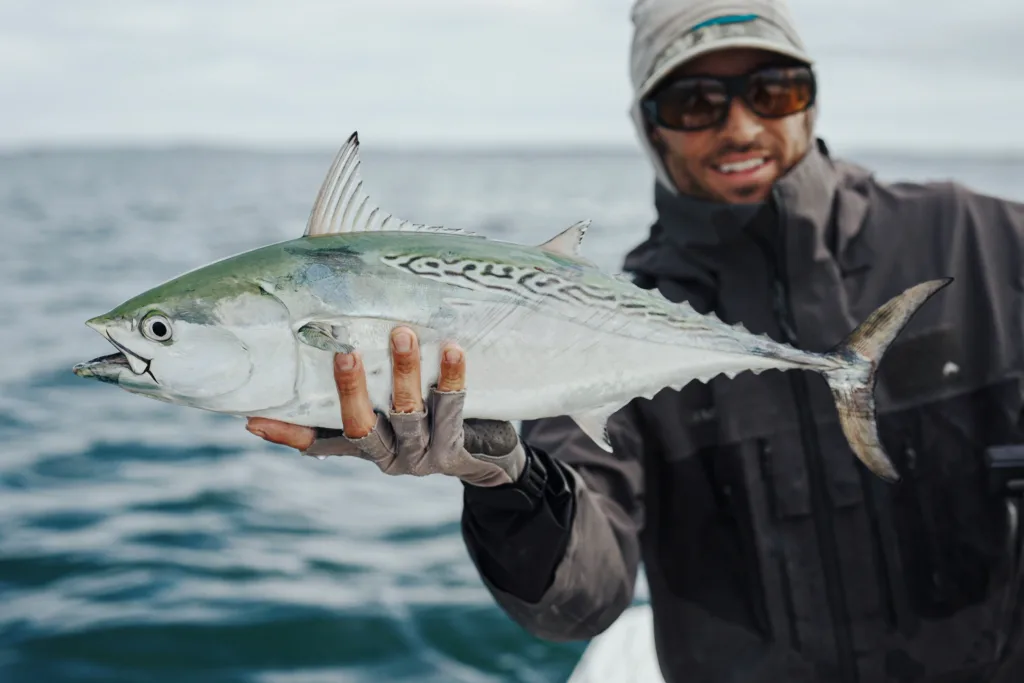
2026 is looking like a particularly prolific year for the squid population in the Northeast. Squid are a staple food source for false albacore, and anglers often see them coughed up after catching on squid-imitating soft plastics like Albie Snax. However, with the dramatic increase in squid numbers this season, it seems likely the albies will be feeding on them at a higher rate than normal.
Squid are predatory creatures that hunt solo or in packs. Their food sources tend to overlap with the forage species of false albacore, creating a unique situation where squid and albies end up vying for the same bait. There were some great videos posted earlier this season that showed packs of squid hunting in shallow water. This behavior typically happens below the surface and out of sight, so it’s difficult for anglers to know when squid are present or how many are around. Some of the best fishing opportunities associated with squid imitations might be happening with no visual cues or occasional surface boils.
Based on the overlap in food that squid and albies eat, we can make calculated assumptions about when they are likely to be present without ever seeing them. When albies are feeding, they typically force their food source toward the surface, allowing us to get a good look at the bait and identifyit. Whether it’s bay anchovies, silversides, peanut bunker, or otherwise, we can usually tell what is being balled up and attacked. While targeting albies that are focused on a certain type of minnow, however, fishermen frequently see them cough up parts of a squid, or a whole one, amongst a pile of half-digested minnows.

There is an easy explanation for why this is such a common occurrence: squid and albies are present for the same feeding event. They might be preying on the same baitfish or working below a feed to clean up the leftovers. This provides albies with an opportunity to pick off an occasional squid between minnows. The smaller and more difficult those minnows are to imitate and present as a meal to albies, the more likely squid are to be focused on them. The result is a unique situation for fly anglers to “mismatch the hatch” and connect on squid imitations during these challenging rain-bait albie bites.
Watching shore anglers hook albies on large, translucent, squid-like soft plastics while fly anglers fish small imitative minnow flies is fascinating. Violent strikes often happen outside the margins of a visual surface feed and demonstrate a certain level of commitment and distance traveled to eat. They are the types of bites we rarely see when targeting albies with flies. The action of these soft-plastic lures seems to be the factor, which allows spin fishermen to take albies on much larger offerings than fly anglers typically connect with. Fly presentations just lack the erratic flexing, flashing, and sudden directional changes that stimulate the predatory responses to a soft plastic lure.
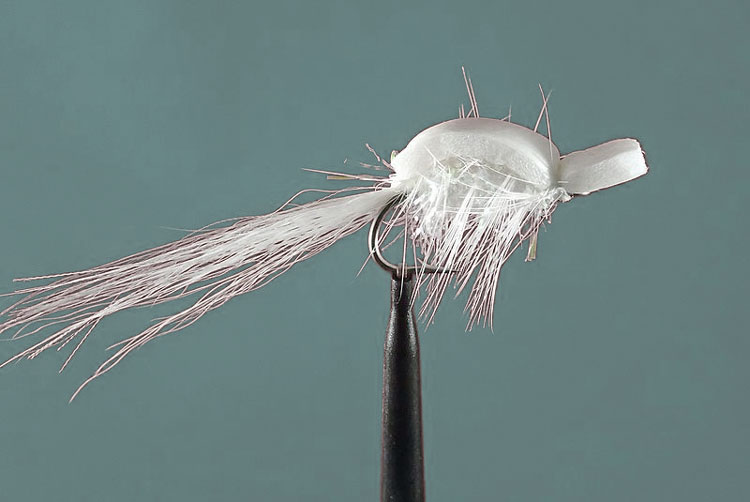
For several years, a side project of mine has been developing a fly construction, leader build, and presentation style that would create a highly erratic fly behavior similar to the best albie soft plastics. My vision was a large profile fly that casts easily, doesn’t foul, has the translucency, flash, and movement of a soft plastic, and a good hookup rate. Although this isn’t a truly finished fly pattern, the “Action Fly” described here meets most of those criteria and has really proven itself to be effective in a wide variety of saltwater fishing situations beyond false albacore.
Some notes on this pattern: I have experimented with a lot of mono-extension style flies, and in my experience, the stiffness, length, and diameter of the material all contribute to the action of the fly and the hookup rate. The material and size used here (30 lb. P-Line Shinsei) helps to elicit the jumpy and erratic action of the fly. I’ve found that the swimming action results from a loop that is short and stiff enough to nearly hold shape, but soft enough to flex a little bit when the fly is stripped with a long, fast pull. Additionally, the water resistance slows down the fly so that the rear shank overruns the front while the fly is still moving forward, pushing the head off track randomly in different directions.
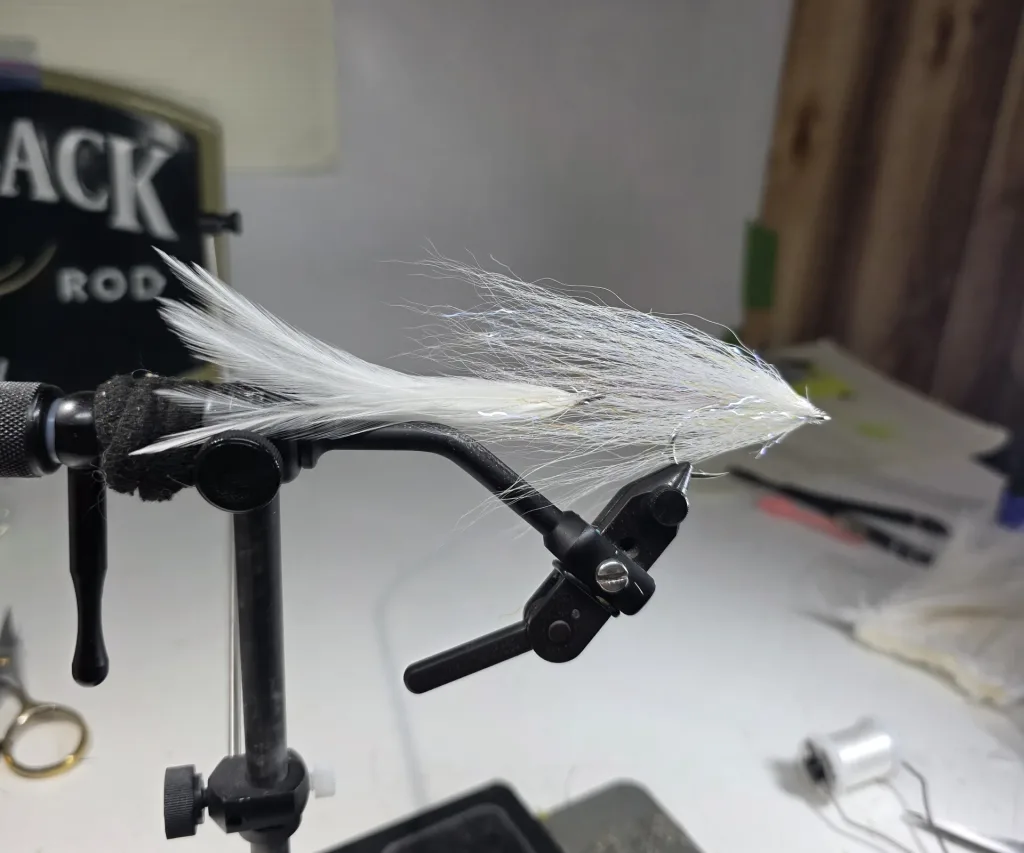
Because of the natural variation that comes from working with natural materials, these flies don’t all come out exactly the same, and they don’t all have the same action. Some are going to be much jumpier and fishier looking than others in the water, so make a couple and experiment a bit with the hair and feathers. Regardless of the tweaks you make, it’s an easy fly to cast and track, and has a suspiciously effective track record. Fish it on sinking or intermediate lines with 20-pound-test leader using quick, erratic strips with short pauses. My retired fly board hosts a lineup of Action Flies in a range of colors, from sparkle white to hot pink, that are beat to death from fish eating them.
Tie the Action Fly (White Pearl color)
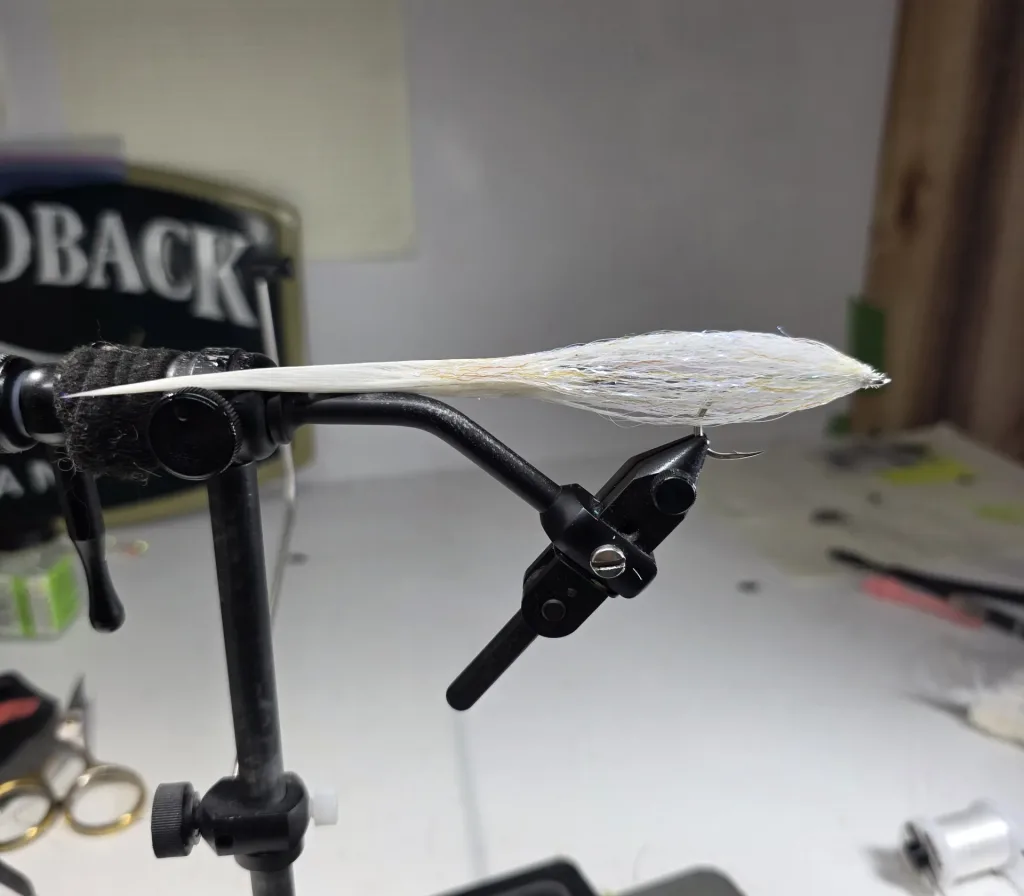
Materials
Hook – 2/0 Gamakatsu SL12S
Rear Hook – Any inexpensive straight-eye silver saltwater hook (gets clipped short)
Thread – White GSP 100D
Tail – 6 to 8 straight larger white saddle hackle type feathers, trimmed 3.5” from tip
Mono – 30 lb. P-Line Shinsei, melted tips to anchor on hook. Cut 3.25” piece
Flash – Lateral Scale Pink
Body – Pink lateral flash, wrapped tight to the shank.
Wing – Krystal Flash UV Shrimp Pink. 5 strands, doubled over (10 total), trimmed at 3”
Veil – White bucktail 3.5”, enough volume to create halo.
Topping – UV Pear Ripple Ice Fiber (sparse)
Directions
Put the rear hook in the vise. Tie in the white GSP at the eye of the hook. Anchor the clump of white hackle together close to the eye. Whip finish and add a glue, like Zap-A-Gap, for durability around the tie-in point.
Use strong cutters like Knipex to cut the shank as short as possible behind the feathers. Then, remove the cut hook from the vise.
Take the 3.25” piece of mono and fold it in half. Pinch it there to make a crease at the midpoint. Slide the eye of the cut shank onto the mono. Melt the ends of the mono with a lighter, forming a distinct rounded ball and edge.
Add the 2/0 hook to the vise. Tie in the white GSP and bring it to the back of the straight part of the shank. Use the edge of the melted mono to position the mono on top of the shank so that 1.25” of mono loop extends past the end of the shank. Tie in the lateral flash flat on top of the hook, double it over so both strands extend over the mono extension, and trim so the flash goes just beyond the loop.
Tie in and wrap the shank with pink lateral flash, up to the eye. Tie in 5 strands of the UV Krystal Flash on the top of the shank, double it over, and trim it at 3”.
Cut a clump of bucktail fibers a little smaller than the diameter of a pencil and pull out all the extra-long or crooked fibers. Measure the length and trim the base end to 3.25”.
Tie in the butt ends at the eye with the GSP, spinning the hair to create an even veil of hair around the shank 360 degrees.
Trim the flared ends tight and add a little UV Pear Ripple Ice fiber on top of the bucktail. Whip finish and glue for durability.
» Joe Goodspeed is a Signature Fly Designer at Fulling Mill, and a Manager and Designer at Diamondback Fly Rods. Follow him on Instagram @teeth_and_trout.
READ MORE