

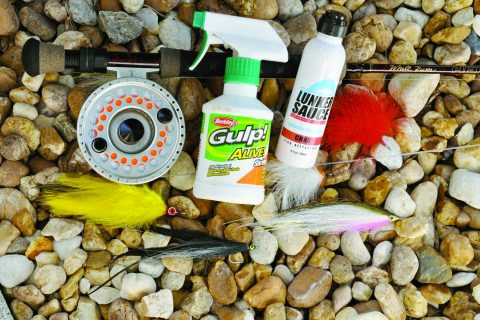
The bite was over, the sun well up in the morning sky, and four of us stood on the Bay Head beach with our ankles still washed by the calm late summer surf. One fly guy, a newcomer, was ecstatic. “I caught three bass,” he said, “and had taps from some others. That Gulp fish scent works great on flies!” The silence was deafening. Someone in our little group made a polite but pointed comment that, “It’s not fly-fishing if you used fish scent.”
I felt bad for the newbie. In a heartbeat, he painfully went from hero to zero, yet he was the only one who’d that caught fish that morning. The rest of us were fishless—and scentless. Funny though, three days later on the same beach, I met up with one of the regular guys who told me that he caught a bass, “But don’t tell anyone I tried some Gulp!”
The question to use scents to spice up our flies has been debated over many a sandy beach, fly-club meeting, and tackle shop, and there’s really no defining answer. It’s neither right nor wrong, depending on one’s viewpoint. For many fly-fishers, the appeal of fooling a fish on a feather-and-hair creation is the ultimate reason for fly fishing. If they wanted it to be easy, they’d use bait! For others, the line blurs depending on the species; striped bass are purist fish, fluke are food fish. For one, it’s okay to use scent, not for the other. And then there are those who just want to pull on a fish after a long week at the job and don’t care if a “sweetener” had to be used to close the deal.
Noted book author, magazine writer and devoted fly-guy Angelo Peluso says. “In my opinion it’s not heresy. Tyers today use all sorts of synthetic materials, epoxies, rattles, spinners and whatever they can find to create a fly, so scent should be fine in situations where it’s appropriate.” Many saltwater fly-rodders have experimented with scents and have drawn their own conclusions. Some use scents in special situations, others say they never do. Let’s see what a few other fly-casters have said about making scents for fly fishing.
Capt. Joe Hughes of Jersey Cape Guide Service put it this way, “I’ve always felt that adding scents to a fly breaks some imaginary fly-fishing rule, and I don’t usually do it. In addition, those times I have experimented with adding scents, I have not produced increased results. To me, fish primarily react to a fly visually. By the time scent might play a role I think the fish has already made up its mind to strike.”
Rick Ferrin of Long Island echoes those thoughts. “When I started out fly-fishing, a buddy of mine was an avid largemouth bass fisherman and got me to try scents on my flies. I can’t say they worked any better, and it’s been over 10 years since I used any kind of scent on a fly. It just doesn’t seem like pure fly fishing. I have to laugh at myself, though, because I don’t think there’s anything wrong in using epoxy and acrylic finishes on flies, plastic fibers for deer hair and rattles to create sound. For me, using scent just crosses a line, and I don’t travel there.”

Capt. Ray Szulczewski of the Tide-Runner out of Cape May says, “I’m from the ‘show me’ camp. Most of the fish I catch are the result of a reaction strike. Stripers, blues and weaks are on the move and if they see something that looks alive they just go for it. Action of the fly is the most important factor. Maybe an angler will psychologically feel better if there’s scent on the fly, and have more confidence, but unless I see a definite difference because I’m not using it, I won’t use it. I’m from the old school and just like to keep it simple. Next thing we’ll be rigging fresh baits to cast, and then what’s the point of fly fishing? I believe a good pattern will out-fish baits and live bait so there’s no need to enhance the fly with a fish scent.”
Sometimes the decision to use scent, or not, depends on the species. Capt. Robby Barradale of the Bayshore Saltwater Flyrodders says, “The purists frown on this, but I’ve been known to soak a fly in Berkley Gulp now and then. Not so much for stripping with fast retrieves for blues and stripers, but for working slow flies for weakies and fluke. The visual attraction of shape and movement is what usually gets their attention, but the scent might close the deal. I’ve also had some success soaking crab flies in crab and/or shrimp oil for early striped bass in the Shrewsbury and Navesink Rivers. Bottom line, is it fly fishing? I don’t know. Does it work? Absolutely!”
Although using scent on a fly for gamefish is a no-no for some fly-anglers, others feel that it’s okay to use scent for “food fish” like fluke. I’ve done this myself by rubbing a drop of Bass Pro 8UP or Carolina Lunker Sauce into the bucktail fibers of a heavy Clouser when fishing for fluke in the Manasquan River. Similarly, some fly-fishers won’t hesitate to use fish scent to catch a mess of snapper blues or croaker for the dinner table.
There are also times when money enters into the equation. A charter customer of mine and an avid fly-fisherman wanted so badly to catch a yellowfin on a fly that we finally soaked his big butterfish-looking pattern in the juicy bucket of soup we were ladling. For some unexplained reason the tuna were refusing his presentation and he was maxed out on his frustration meter. He had paid good money for an overnight canyon trip and was getting desperate. After a few minutes in the bloody chunking broth, his fly was picked up within seconds of sinking into the slick. “Fish on!” never sounded so sweet.
Capt. Jim Freda of Shore Catch Guide Service is another professional that questions the value of fish scent. He says, “I’ve experimented with scents in the past, but I’m not sure if they’re really necessary as I always catch fish with no scent on the flies. To prove if one was better than the other you’d have to do extensive testing over a long period of time to accurately see if hook-up ratios actually do go up. I have soaked bunker flies in bunker oil or BioEdge, but they wash off quickly leaving you with an unscented fly.”
Jim also brings up another important point. Some pastes and jellies are so gooey that they destroy any semblance of the fly’s natural action. Yes, you can make a fly dance and dart, which is important, but the fibers of the feathers and hair get so gummed up they lose all their natural breathing action and motion, and thereby diminish the fly’s fish appeal. If you want to experiment, a watery spray like Gulp! is the way to go.
There is one way to use scents that most fly-fishers will agree on. Rubbing some on your hands will cover up the bad smells that come from gasoline, bug spray and sun lotion. Did you fuel up the boat before launching? Or lather on bug spray to keep the pesky critters away? These smells if transferred to the fly by hand contact can definitely turn off many gamefish, and so does strong, flowery-scented soap and detergent. A small dab of fish scent rubbed into your hands is good insurance.
While most of us don’t fish specifically with the intent to submit a catch to the International Game Fish Association for world-record consideration, it’s important to note that this respected organization, the keeper of records and traditions, does not allow fish scents. IGFA’s comprehensive Fly-Fishing Angling Rules clearly state, “No scent, either natural or artificial, is allowed on flies. The use of scented materials in a fly is prohibited.”
Gary Borger, noted fly-fishing author once said, “Using scent is not ‘cheating,’ it’s just another method of attracting fish to the fly; however, most fly fishers think using scent is no different than bait fishing. Fly-fishers prefer that fish accept the fly by its looks rather than by smell. We must remember that fly-fishing is not a sport developed by fish. It’s a sport developed by human activity with human limitations.” It’s important to consider that the human limitations Gary speaks of are the result of personal opinions. Scent or no scent, rascal or purist, the goal is to have fun while you’re fly fishing.
It never occurred to me to wonder if it was cheating because it’s such a no brainer 🙂
but hey, feel free to get skunked and remain pure!