

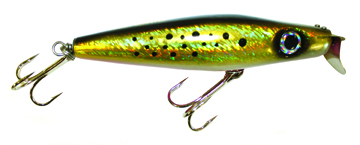
There is something to be said about companies that have maintained, expanded and grown through these difficult recession years. One example would be the Creek Chub Bait Company, which just this year expanded their product line to include a few new wood fishing lures. While that’s impressive, it’s not surprising for a company that had already survived another period of economic hardship – the Great Depression.
According to some sources, the first deliveries of Creek Chub lures reached tackle shops in Garrett, Indiana in 1911, and the lures soon caught on in a big way. By 1932, Creek Chub lures were responsible for not one, but two world record largemouth bass; a 20-pound, 2-ounce monster on a Pikie and the still-standing 22-pound, 4-ounce largemouth record, which fell for a Creek Chub Fintail Shiner.
Creek Chub Bait Company was one of the first to incorporate scale patterns on their lures, which they created by applying paint through the decorative netting of ladies’ hats. This screen-style scale pattern is still widely used on striper plugs today, though I imagine luremakers have since found another method for creating the screen pattern, sparing their significant other’s fancy headwear.
The original Surfster plugs hit the market in 1953. These plugs were made specifically for surfcasting for striped bass, and they were the second striper-specific lure produced by the company after the Striper Pikie came out in 1950. The Striper Pikie was a heavy duty adaptation of the Pikie Minnow, an extremely popular bait for muskies and northern pike that surfcasters had found success with on stripers from the beach. The Surfster differed from the Pikie in that it had a fatter, “pregnant” body, which flared out in the middle, while the Pikies had a straight cigar-like shape.
The original Surfsters were available in three sizes: the Surfster, the Husky Surfster and the Salt Surfster; 4 3/8, 5 ¾ and 7 ¼ inches, respectively. The lures were a huge hit with surfcasters. Though the plugs worked wonderfully and were great sellers, the two larger sizes, the Husky Surfster and the Salt Surfster, were discontinued in 1958, after just a 5-year run. The reason was a shortage of white cedar, the wood used to make the bodies of these classic plugs. It was more lucrative for Creek Chub to use the limited wood supply to make more of the smaller, more popular baits. By 1968, the line had been discontinued entirely and Creek Chub began making more plugs out of plastic than wood. Eventually, their entire line was made from plastic.
Original Surfsters were snapped up by classic fishing lure collectors. Collecting these old plugs is so popular among fishermen that there is a book dedicated specifically to collecting Creek Chub lures, The Collectors Encyclopedia of Creek Chub Lures and Collectibles by Harold E. Smith.
But the wooden Surfster lived on in the surf. Plug builders working in basements and garages from New Jersey to Maine copied this design and kept the Surfster-style plug fresh in the minds of surfcasters for decades after Creek Chub discontinued the bait.
“In my mind,” said Kim Norton, PRADCO Saltwater Division Manager, “the Creek Chub Bait company has always been a brand that is all about wood plugs.”
If PRADCO sounds familiar, it should. Bomber, Heddon, Cotton Cordell, Arbogast and Smithwick are just some of the lure companies owned by PRADCO Fishing, which began in 1960 as a part of Plastics Research and Development Corporation, a custom injection molder. By acquiring brands that have a rich history and continue to produce innovative and effective fishing lures, PRADCO has grown to become the world leader in fishing lure manufacturing. In 1991, PRADCO purchased the Creek Chub Bait Company.
By 2011, Norton felt it was time to breathe new life into the Creek Chub Brand by bringing the company back to its roots – wooden fishing lures.
“Our goal was to make the Surfsters as close to the originals as possible, while still improving certain aspects of the lures,” explained Norton. The new generation of Creek Chub Surfsters feature the same general body shape and stainless steel “tune-able” lip as the original, but they have an improved finish and upgraded hardware, with triple split rings securely holding 3X saltwater grade hooks to the beefed-up through-wire construction.
Elaborating on the “tune-able” lips, Norton explained that these lures are designed for big fish and tough environments. “The lures swim great out of the package, without any adjustment,” Norton said, “but big fish and rocks can bend a lip. By using this lip instead of some of the more rigid, tempered lips, anglers can bend the lip right back into its original form and get the lure swimming right once again.”
With the shape being similar to the originals, the action is pretty close as well. “We actually took some of the original Surfsters out of our collection and swam them right next to the new ones, and they were almost identical,” Norton said. Another improvement in the new Surfsters is that with modern manufacturing techniques, the plugs are more consistent than in the old days, when the actions of wooden lures could vary from one plug to the next.
By pressure-treating the wood, the plugs are sealed and resist becoming waterlogged and swelling over time. The improved finish also protects some excellent new color schemes including an eye-catching bunker and a spot-on mackerel. Another change in appearance from the original is the ultra-large, realistic eyes, which have taken the place of decal or glass eyes on earlier models. The plugs are offered in seven different colors and three sizes: a 7-inch, 4-ounce; a 6-inch, 2 ½-ounce; and a 4 ½-inch, 1 ½-ounce.
Surfsters are best fished with a slow retrieve in areas without a lot of current. The plugs have a wide wobble and can be worked on the surface or just below. They are heavy for their size and cast very well for a metal-lip plug. The smaller size is a great imitation of a peanut bunker while the larger models will mimic adult bunker, mackerel or any larger baitfish.
The next-generation Surfsters were released in July 2011, alongside the Pin Popper – a heavy-duty wooden topwater that Norton describes as a cross between a bottleneck cup-mouthed popper and a traditional pencil popper. “Our focus was on the striped bass and surfcasters when we made the Pin Poppers,” Norton said, “but guys have been throwing them at tuna as well, and knocking them dead!”
And the Creek Chub Bait Company has more in store. Norton said there will be some old lures reintroduced and some new lures unveiled in the next few years. “With a classic company such as the Creek Chub Bait Company, we’re looking to our history yet still looking forward in order to recreate lures that were great fish-catchers years ago, while updating and improving them for fishing today.”