
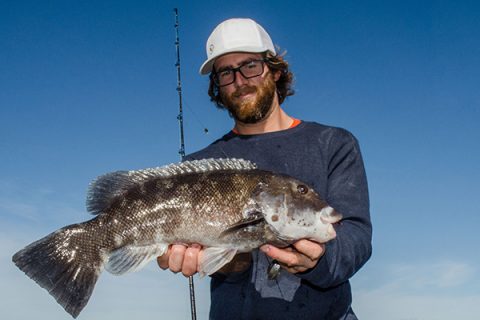
Catch big fall blackfish without taking a boat ride.
Every autumn, fishermen leave their striper gear at home to enact their plans of attack for the new fishing season. When it’s too late – or too cold – to launch a boat, many guys will don waders and wander off into the back bays to target late-season stripers. But the first species that captures my attention each fall is the mighty blackfish, and they make a great target for land-based anglers.

Judging Jetties
All rockpiles and jetties have the potential to hold blackfish in the fall, but finding structures that hold good numbers of keeper-sized fish can be a challenge. Since large fall tautog are destined to migrate, the jetties that border inlets are the best spots for a shore-bound blackfish hunt. Inlet jetties often make excellent tautog habitat as they combine structure, deeper water, abundant forage and moving water.
The prime spot varies from jetty to jetty, but keeping in mind that the biggest tautog will seek out the most dramatic structure will help you put more keepers in the bucket. The tip is often a hot spot on an inlet jetty, but it also gets the most pressure. Holes, ledges and other irregularities in the jetty will also attract big blackfish and will not get as much attention from other fishermen.
Jetty Gear
For jetty tog, I fish longer, heavier sticks than I would use for boat fishing. I like a 7-foot, 6-inch or 8-foot medium-heavy conventional rod teamed up with a conventional reel spooled with 50-pound-test PowerPro braided line. I prefer these long, heavy rods for targeting tog from shore because I’m fishing shallow ledges and need the leverage to hoist the fish away from the structure.
Before you start rigging your rod up, begin by stopping at a local tackle store and picking up a good amount of 2- to 6-ounce bank sinkers along with a couple packs of 3/0 bait-holder or octopus-style hooks.

Because tog hooked from a jetty will rub line against rocks and other debris underwater, I like to fish 50- to 60-pound test monofilament leaders of 10 feet or longer to prevent cut-offs. The only downfall of this system is the “bumpy” uni-to-uni knot that would go through my guides when I cast my crab rig from the rocks. Lately I’ve been splicing my leader into PowerPro Hollow Ace, a hollow-core line that allows anglers to make low-profile line-to-line connections. Offshore fishermen coming into Grumpy’s Bait and Tackle in Seaside Park, where I work, have been using hollow-core lines for some time with great success, and I’ve found that it is just as effective for jetty-dwelling blackfish.
After attaching the leader, tie a dropper loop about 6 to 8 inches above the end, and then snell a 3/0 bait-holder or octopus-style hook on the very end of your leader. Loop your sinker onto the dropper loop and you will be ready to fish.
If you do not like longer leaders, a simple 24-inch leader with a barrel swivel on top and a 3/0 hook on the bottom with a dropper loop 6 to 8 inches above the hook will get the job done. Rigging yourself the right way will put you on the right path to better results.

I have learned over the years that you can never be too prepared when it comes to jetty blackfish. Like it or not, you will end up donating plenty of tackle to the rocky environments these fish inhabit, so to help make sure you land those fish that don’t take you into the rocks, bring along some landing gear such as a long-handled net or jetty gaff. Nothing is worse than seeing a nice bucktooth on the surface with your only hope of landing it being to swing him onto the rocks and hope he does not fly off.
If you plan to take a blackfish home for dinner, make sure you have a measuring tape along with a smaller cooler with ice. When I catch a keeper blackfish, the first thing I do is bleed it and throw it on ice. This will take all the blood out of the meat and give you a better tasting fish.
Match the “Hatch”
The bait of choice for this fishing is crabs, however, sand fleas (mole crabs) or small pieces of fresh clam will work as well. A rule that I go by for any species I fish for is “match the hatch,” so presenting baits the blackfish are used to seeing is key to getting the most action. That is why I catch my own crabs on the fishing grounds.
Catching your own crabs can be a challenge at times, but going at low tide will make the crabs easier to find because you will be able to get closer to the smaller rocks that lie between and beneath the larger jetty rocks. Every jetty is different, and it is important to study the area you are targeting and ask questions at your local tackle shop to fully prepare yourself.
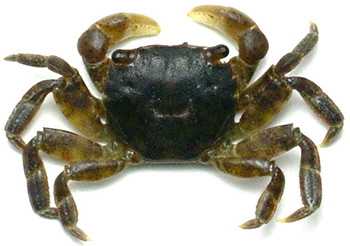
One crab that you will find very abundant in and around local jetties is the Asian shore crab. This predominant crab invades rock piles and structured areas. The Asian shore crab is a smaller crab and can be caught under small rock piles around jetties. When digging for these crabs, it is very important to wear gloves just in case there are sharp rocks or glass nearby. Most often, catching them simply involves flipping over a rock and grabbing the crabs before they can scurry out of reach.
Make sure to bring a five-gallon bucket with you for your crab baits and a pair of heavy-duty scissors. It usually takes me about an hour to accumulate a comfortable amount of crabs, and when I say comfortable, I mean four to six dozen. Blackfish are notorious bait-stealers, and you don’t want to be at the end of a jetty during a red hot bite without any crabs left.
When fishing with Asian shore crabs as bait, I hook them right through the back leg sockets. After hooking them, I take my sinker and smash the top shell. This will let the crab ooze all its good stuff onto the rocky bottom, which will attract any nearby tog. With bigger crabs, I cut them in half and make two baits.
Pick Your Days
I’ve noticed over the years that blackfish can be very sensitive to water temperature changes. Freshwater runoff from big storms, full moon tides and cold air masses can all slow down the tautog bite. Picking your days is crucial if you want to put a good catch together.

In the fall, outgoing tides seem to produce better because they flush out warmer bay water and trigger a more aggressive bite, but I have also caught some nice fish at incoming and even during slack tides. When it comes to weather conditions, I never had a preference. Sunny and cloudy days seem to produce the same, but windier days can affect the bite, especially if the tide and wind are in the same direction. This can make it hard to hold bottom and feel bites. As we all know, April weather can be tricky, so prepare for the worst and hope for the best!
Choosing the best equipment, having a good supply of fresh baits and watching your weather conditions will not only improve your catch but will also make you a better angler no matter what species you target. As Leigh Perkins once said, “There is only one reason in the world to go fishing: to enjoy yourself. Anything that detracts from enjoying yourself is to be avoided.” So grab a rod and some crabs and get out there and have some fun!
This is a really useful, nuts-and-bolts” kind of article, with lots of practical instruction for a fishing pattern that was surprise to me. Nice work! More articles ought to take notice of this kind of teaching content. One strange thing though: The title says “Catch big fall blackfish” but later in the article it reads “April weather can be tricky, so prepare for the worst and hope for the best!” What’s up with that?
I second this! This got into quite a few of the finer details that I definitely have overlooked in the past. Solid work.
Thanks for the help. Will definitely try but never been blackfish fishing though
A little over the top splicing the line when you could use a number of knots that won’t cost you a dime and are faster to tie – Just saying… Otherwise a good article.
I enjoyed reading this. Living in Hawaii now and boy do I miss the taste of Tog
good article some really nice jettys on cape cod bay have wanted to try blackfishing from these jettys i like you match the hatch been using asian crabs for years with good results is there a need to know water temps at what temp does the blackfish bite get hot