

Captain Bob Belekewicz eased back on the twin diesels and dropped the boat into neutral. A pod of false albacore had exploded on the surface in this very same spot just minutes before, and as usual, as soon as we were in position, they were nowhere to be found. We took a few blind casts and scanned the horizon for signs of scattering bait or hovering terns, but deep down inside, we knew we had missed our chance.
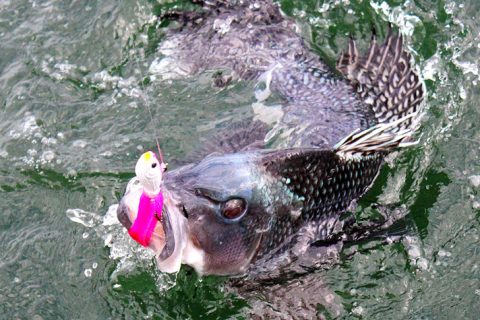
As I looked around for signs of life, a big red blob on the fishfinder caught my attention. The albies had vanished, but the baitfish they were pursuing were still here, huddled up in schools so tight they blocked out the bottom on the fishfinder. Perhaps, I thought, the albies had gone deep, so I quickly flipped my bail open and sent my soft-plastic jig fluttering to the bottom. A few seconds later my line went slack, and I knew I hadn’t even gotten close to the bottom, which was 30 feet down. I set-up quickly, and it wasn’t long before a 3-pound black sea bass was flopping on the deck. It wasn’t what we were after, but a pleasant surprise, nonetheless.
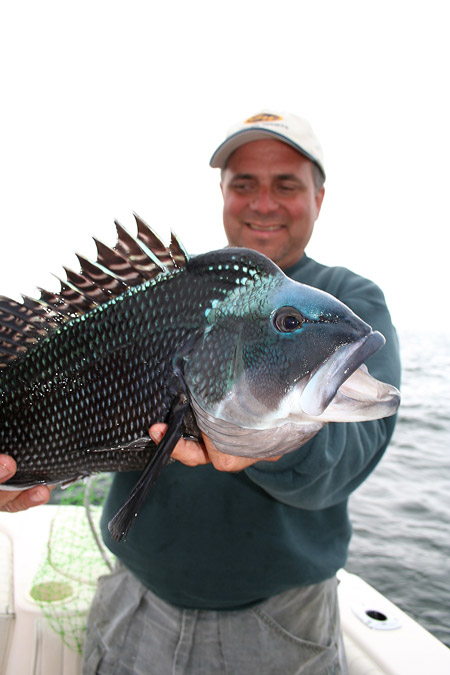
We had stumbled upon a large school of sea bass that was voraciously feeding on the same school of peanut bunker the albies had been crashing. We repeatedly sent jigs down and began pulling in sea bass at an epic rate. Within 15 minutes, we had the cooler half-full, and went back to aimlessly wandering around in search of albies.
This was the first time I had ever targeted sea bass with artificial lures, and it changed the way I perceived the feeding habits of these fish. Black sea bass are aggressive feeders, and aside from crustaceans and mollusks, baitfish are a staple in their diet. While fishing with cut baits such as squid or clams is the most common method of targeting them, more and more anglers are switching over to artificials and catching more, and bigger, sea bass. Here’s why.
Invasion of the Bait Snatchers
It seems to happen every year around the middle of July in the waters of Buzzards Bay and Vineyard Sound. Out of nowhere, millions of juvenile scup flood into the warm, shallow waters and take up residence for the summer. For bait fishermen, it can be a maddening time of year. The sea bass are still around in good numbers, but there are so many small scup around that getting your bait in front of a sea bass becomes a challenge. These little scup are like piranhas and incessantly peck and tear at any bait you send down. Bait fishermen will spend a fair amount of time cutting squid strips, unhooking spiny little scup and rebaiting their hooks. By opting to fish jigs over bait, you will spend more time with your line in the water, and will drastically reduce your bycatch of scup. You will also be able to “weed out” the smaller sea bass (although you will still catch a few) and keep your offering in the strike zone longer, which increases your odds of hooking a larger specimen.


Catch Whatever Swims By
Another bonus of using artificials is that it allows you to take a shot at just about anything that swims by. Have you ever been bait fishing and had a school of fish pop up and start breaking right in front of your boat? By the time you grab another rod and tie on a lure, they will most likely be gone. When using artificials for sea bass, if a pod of albies or a school of stripers just happens to show up, you’ll be rigged and ready to take a shot at them. Generally I use the same jigs and light tackle for albies, schoolie stripers and sea bass.
Pack the Appropriate Jigs
Finding a jig that will catch sea bass is not rocket science. These fish are aggressive, and I’ve yet to find any one lure that greatly out-fishes another. It’s actually very similar to jigging for cod. These fish aren’t particularly tough to fool, so if you find a school of hungry fish, they will pretty much attack anything that will fit in their mouths. Different locations and conditions, however, can dictate using different lures.
Soft Plastics
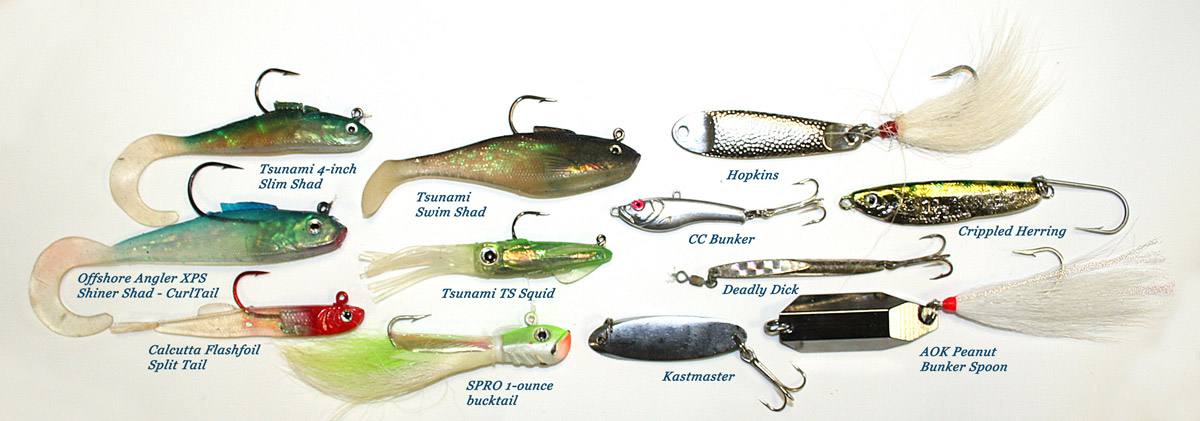
Most of my sea bass fishing is done in Buzzards Bay aboard my friend Captain Bob Belekewicz’s boat, the Lemke Ann. Bob has a knack for finding all forms of bottom-feeding fish, and we never need to stray far from his homeport of Red Brook Harbor in Cataumet, Massachusetts to find fish. We generally target sea bass by drifting in water between 15 and 30 feet deep. The shallow water allows the use of lighter jigs, and my favorite sizes are 1/4- to 1/2-ounce soft-plastic jigs like the ones made by Tsunami, Storm and Calcutta. These baits are incredibly realistic and do a good job imitating local baitfish. The main advantage of soft-plastic lures is that the fish seem to hold on to them longer than they do with metal or hard-plastic baits. Often, the sea bass will hit the jig as it falls, and it can be tough to detect a hit. If given enough time, they will spit the lure and swim away. With the soft-plastic baits, however, the fish hold on longer, and the result is more solid hook-ups.
Another advantage of these jigs is that they feature a single hook that rides above the bait. The single hook makes unhooking fish a bit easier, and having the hook above the bait results in fewer snags on the bottom.
The downside to soft-plastic baits, however, is their lack of durability. Sea bass have small teeth, and over time your soft-plastic jig will look like it went through the garbage disposal. If you can catch 10 fish on a jig before replacing it, you’re doing alright.
Metals
We’ve also had a fair amount of success jigging with metal lures such as the Crippled Herring, Point Jude tins, Hopkins Spoons and others. To fish them simply set your boat up to drift over a likely spot, drop the jigs down to the bottom, and gently jig them up and down, keeping the jig within a few feet of the bottom. A violent up-and-down jigging motion is not necessary; just keep the lure in the zone and give it a little wiggle. Every now and then, pull it up about 10 feet off the bottom and let it flutter back down. We always seem to get a lot of hits when the jigs are in free-fall. If you are fishing in deeper water or in a fast-moving tide, metals get the nod since they sink quickly and stay in the strike zone.
Bucktails
A variety of bucktail jigs will also get the job done, especially if you are fishing in sandy areas. I would recommend going with smaller sizes, lighter than 1 ounce, and opt for bright, flashy patterns. Make sure you constantly keep contact with the bottom, as the sound of a bouncing jig will help attract fish.
Lipless Crankbaits
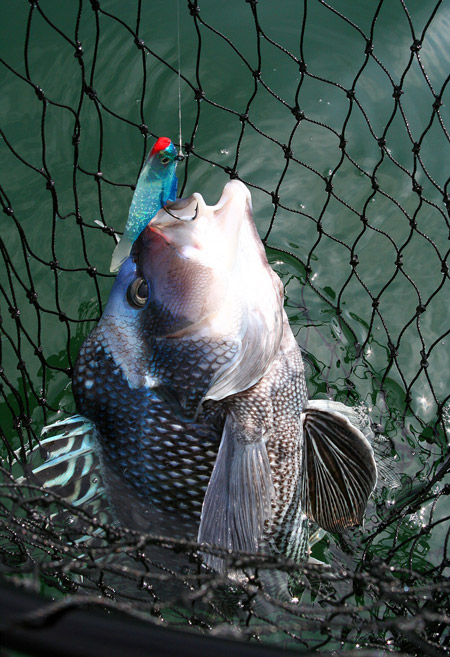
On a few occasions, I have used lipless crankbaits with very good results. This is one lure that has never really caught on in saltwater fishing, but it has been a staple for freshwater bass anglers for years. Because these lures connect at the middle of the bait, they are ideal for vertical jigging. The lure remains in a horizontal position throughout the drift, which I think is a much more realistic presentation.
There aren’t too many companies making saltwater-grade lipless crankbaits. The only one I have used is the Yo-Zuri Live Bait Shallow Vibe. At 2 3/4 inches long and 3/4 of an ounce, this lure’s size and profile closely resemble that of a juvenile menhaden (or peanut bunker). They also emit quite a vibration when they are pulled upwards, and I think this helps attract fish. If you’re fishing in water deeper than 20 feet, it will be difficult to keep these lures in the strike zone, so they are best used in shallower water. They also feature two sets of treble hooks, which can be both good and bad. Obviously, they will result in more hookups, but you will also find they are prone to snagging on the bottom, and the second set of trebles has a tendency to become tangled up in your net when landing fish.
Keep Your Tackle Light
You’re not going to need any specialized gear to catch sea bass. A trophy fish is 6 pounds, and the average sea bass you encounter will be in the 1- to 3-pound range. Any gear you already own will probably be suitable, but if you want to have some fun, keep your gear light. I generally use either a spinning reel spooled with 12-pound-test monofilament or a small conventional outfit with 20-pound-test braided line. If you’re fishing deeper water or in rocky areas, you might want to go with something with a little more backbone. I will often add a short length of fluorocarbon leader in the 20- to 30-pound-test range to the end of my main line. Sea bass have small teeth that can scrape up your line over time. The heavier fluorocarbon will also give you a little more abrasion resistance if you are fishing a hard bottom. You can either attach it to your mainline using a barrel swivel or directly to your main line with a surgeons knot.
This spring, we witnessed one of the best sea bass bites we’ve ever seen in Buzzards Bay. There were acres upon acres of bait, and all forms of predators were taking advantage of it. Terns and gulls were hitting them from above, stripers and bluefish were attacking them just below the surface, and hordes of hungry sea bass were attacking the bait from below. The sea bass were so aggressive, that at times we couldn’t even reach the bottom with our jig without it being inhaled. We even had sea bass chasing our jigs right up to the surface!
There are not many times when artificials will outfish bait, but summer sea bassing is one exception. These fish are not just bait nibblers, they are true predators, and they feed aggressively. The next time you head out for sea bass, think outside of the box of calamari!
Great article. Last fall my wife & I were on Block Islands SW Ledge and we boated probably close to 200 sea bass in a few hours. We were jiggin’ small tins in about 35 feet of water. The fish were not huge but the nonstop action was amazing!
I tried using 4″ gulp plastics after reading your article and hammered them. The great thing was you can catch around 6 or more fish without baiting.thanks for the article . From a squid only user to plastics are great
I just came back from a fresh water bass fishing trip and I used 3″ Berkley Gulp minnows horizontally top half black bottom white.This color combination work the best.Tried white small fish.Sunfish perch white perch.What kind/color weight I know depends on depth/curent.Going on a party fishing boat so I am guessing 30-50 feet ? on current.Have not done much of this fishing.
I don’t exactly use gulp to catch sea bass because they bite tails off the 3 and 4 inch swimming mulets. I d catch a lot of sea bass if the tails stay on.with sea bass season coming up this weekend I am going to use a 3 &4 swimming mulets on a tsunami glass minnow
HI FOLKS being a bait f isherman all my life of 65 years, I must say, this article about jigging, got me really exited ,for a long time ,I told myself that ishould consider jigging for sea bass having seen folks on party boats .and I must say,because of being stubborn and stupid,for I have seen people catch more fish than I . so next time I go sea bassing just look for an old man called jigger.
Have been catching keeper size Black Sea bass on small buck tails for 20 years while fluke fishing in NJ. Usually in 25′ to 60′. White, chartreuse,& pink (in that order) 1/2 oz to 3 oz jigs. Always tipped with squid. But when we specifically target sea bass, we are anchored. This prohibits any casting out because we’ll loose $100 in jigs to a wreck or whatever structure. I drop a hi-low rig of clams. When I get bored of that and feeling daring, I drop an Ava or similar diamond jig. This method produces far fewer fish but they are definitely bigger !
…48 hours until sea bass opens back up in NJ !!!!!!!!!!!!!
Leaving this Thurs@ 10:00pm’m
Fishing lucanus jigs for 3years best jig ever for deep drop sea bass
i use a kalins 12-16 ounce jig head with a pearl white 6inch soft bait in about 180-200 feet of water works amazing biggest sea bass ive seen come from the deep
I have a question. I havw been for a few years but still don’t understand a lot. What does the rig look like. when fishing off a boat they want you to hold bottom with 4 -6 oz weights so what type of rig should i have.
Enjoyed the article, very informative.
thank you.
What type minnow squid etc.color and weight of jig.Going on a party boat.Probably 50’+ depth I am guessing.If this is a duplicate I apologize I saw this blank on the bottom of what people have used and wanted to be sure you received this.
Thanks to captain Peci (hope I spelled the name right) in Falmouth Mass. who turned me on to jigging for sea bass with Spro jigs. What an experience. I nailed them! I’m heading for Connecticut on 10/23/18 and you can guess what will be in my tackle box. T. Sescoe
Well, that trip to Connecticut 0n 10/23/18 was a bummer. The wind blew 10 to 20 and the Captain drifted all day long. My first drop with a 2 ounce white and green Spro Jig with a green swimming mullet with a Gulp shrimp above that tore off on the first drift. Thats $10.00 worth of gear. The Captain yelled “the fish are under the boat” by the time he said that we had drifted off of the fish. That’s the way it went all day. Two Porgies. I figure they cost me over $150.00 each. Oh well, I’m off to Massachusetts in the spring. T. Sescoe
You have very interesting stories and I learned alot about types of bait and lures to use. I would appreciate if you emailed me other stories and litature