
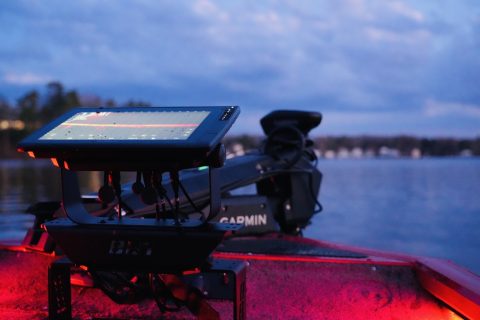
There is no question that forward-facing sonar is the hottest topic in bass fishing, especially the newest edition of the sonar technology, the Garmin LVS34 transducer. If you don’t already know how it works, Livescope is performed from an external transducer that aims forward from the boat, and pings to your unit in real time. You can watch your bait, and the fish, move as they would be if you were looking into the water.
The question I see most around social media and different online forums is, “Do I need this technology?” or “Is the technology considered cheating?”
Having only bass fished using 2D sonar, chart mapping, and recognizing good bass areas with my eyes, I figured that I could form a pretty good answer to those questions myself as I added the Garmin LVS34 transducer to the front of my 2013 Bass Tracker – a cool upgrade to an older boat that I love dearly. The transducer allows for perspective mode and downwards mode in addition to the forward-facing sonar mount. Downwards gives you a straight down look under your boat, great for vertical jigging and drop shotting, and perspective mode gives you a forward top-down view that’s great for locating structure.
I have been using the live scope for about 2 months around New England. I have tested it in shallow lakes, deep lakes, clear lakes, grass lakes, in four different states, with a good chunk of that time spent on my home waters. This was the key for me in answering, can I learn even more about my home waters I have spent so much time on? The answer was yes.
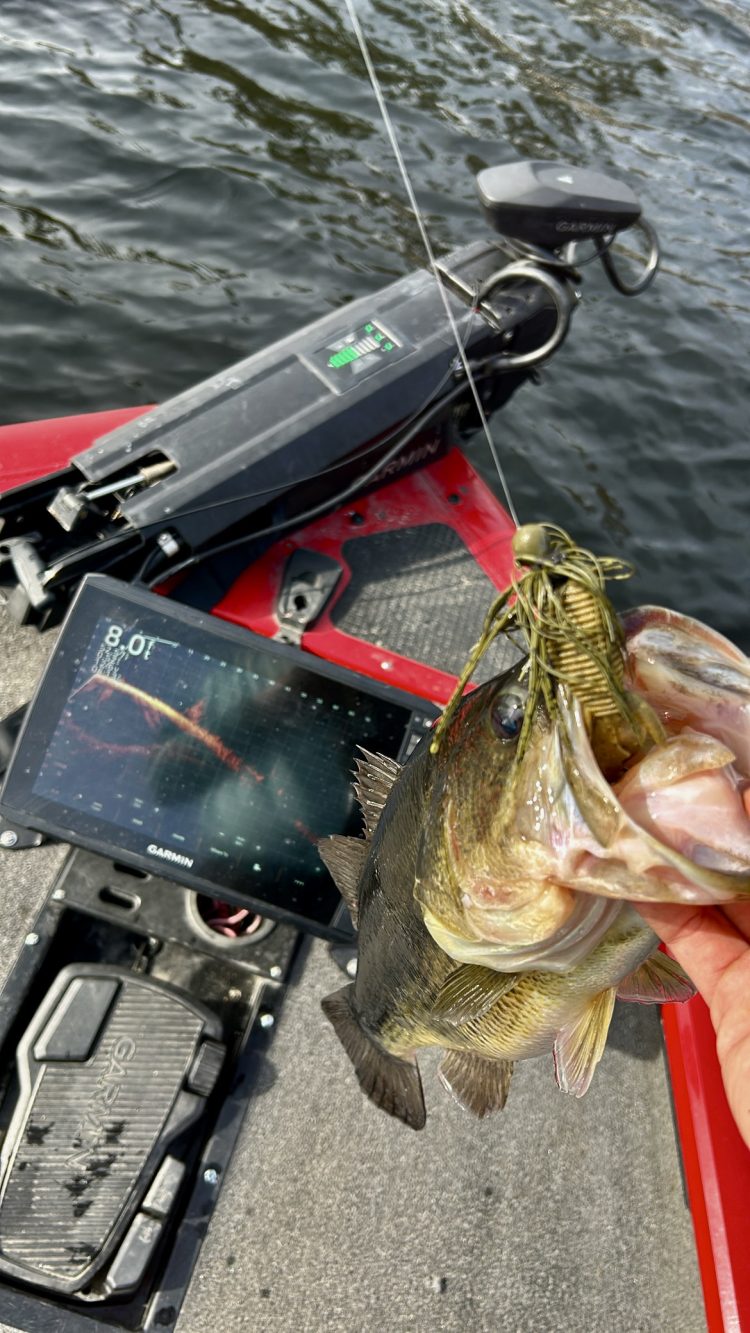
My first day out with the unit on my home lake, I learned of new structure. I went straight to my favorite point, where I knew there was some sort of structure sitting in deeper water that I have felt just dragging my jig through over the years. I lined up my unit to where I believed the structure was, based off where I usually cast, and there was a nice little brush pile sitting right where I thought it was. Then I scanned a bit deeper off the point, where I never usually cast due to it being much deeper. To my surprise, appeared another, even larger brush pile in 22 feet of water. In almost 10 years of fishing this lake, I never knew it was there. I made a cast down into the brush pile, and watched a large “blob” swim right out of the structure and toward my jig. Just moments later a 4-pound largemouth was in my boat.

I had the opportunity to head to southern Maine in prime pre-spawn conditions in late April, with intentions of being able to catch loads of transitioning fish while jig fishing. To my surprise, the first couple hours of my day was very difficult. I was seeing a lot of fish off the deeper drop-offs near spawning flats, right where they should be, but were refusing to eat. Even with seeing them on livescope, I was having a hard time. I left the areas and came back when the conditions shifted. Just an hour later the wind kicked up, and the sun popped a bit. I went down the original areas I was seeing the fish in, but going through the same depth line I wasn’t seeing them. Then it clicked. I slid up into the shallower line and there they were. I had watched the fish transition during the same day from deep to shallow. I went down the shallower contour line and saw a bass every 50 yards or so, each of them actively swimming on livescope. I got every single fish I saw to eat. I didn’t land every one of course, but damn it was fun. I felt like I was stalking and hunting bass. Seeing them, throwing up ahead of them, and watching them swim to the jig and eat it in real time on the screen. Incredible stuff. An ode to forward facing sonar’s ability to help you stay on top of the fish especially during transition periods.
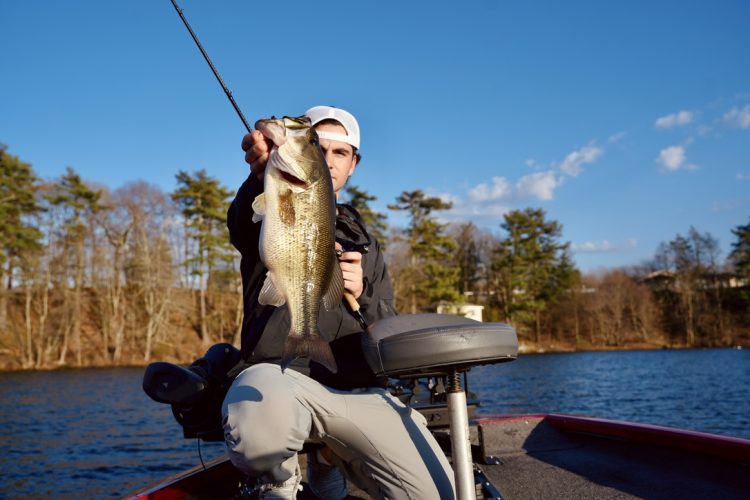
Do I think live scope is cheating? No. Do I think it gives you an advantage over those without it? Yes. In turn, I don’t always find myself using it. It allows you to adjust your presentation, make adjustments, develop a pattern and locate fish more efficiently. It really gets dangerous when the technology is paired with an experienced angler who can find bass with no technology at all. My advice is, fish to fish, continue to hone in and grow your skills as a raw angler, then when ready, make the investment. Add the tool to your arsenal and enjoy the technology for what it is. Some of the most fun I have with it is taking my friends out that have never seen it before, and coaching them to a bite while they watch in real time. It’s priceless. A shoutout to the guides who use the technology to put their clients on a great day of fishing. You can either be very aggressive with the technology, or you can use it as a way to learn more about bass fishing, as well as your chosen body of water.
Related Content
Catch Big Bass Without Forward-Facing Sonar
Berkley Fishing Shares New Forward-Facing Sonar Optimized Baits
this technology will ruin fishing because it’s a means for irresponsible fisherman to catch but not take the care and time to release the fish with no harm. it’s human nature, look how we depleted both animal and fish populations when you rely on humans to police themselves.
fish are doomed and for those of us who have learned from thru the school of hard knocks, makes us just shake our heads.
This technology is pretty difficult to use, and takes time to learn. I know many long time tournament anglers that still struggle trying to use it. Even with the technology, you have to know where to search for bass. It doesn’t drop pins on a lake where there is fish. Are there issues? yes. Deepwater fish that have never been targeted before are now being caught, among other things.
To go along with your comment on fish handling, anyone who has the ability to actually fish the technology, probably knows how to handle a fish. Believe it or not, the guy with a bobber and worm is more likely to hurt fish with handling than the dude with the bass boat and livescope. It goes full circle.
I agree with you!