
Put the “sport” back in offshore sport fishing.
Light tackle. Those words most commonly conjure images of striped bass on the Monomoy Flats, false albacore off Montauk, or sailfish in Costa Rica. While those fisheries are all true to the concept of light tackle, there is another one that is almost never, if ever, thought of here in New England – the Canyons.
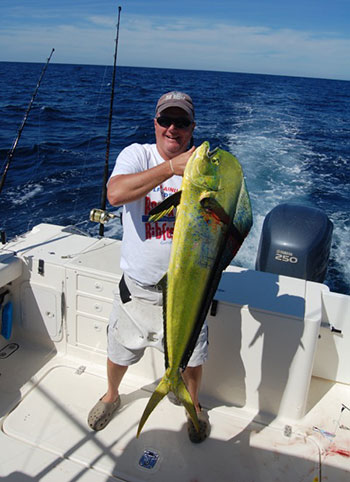
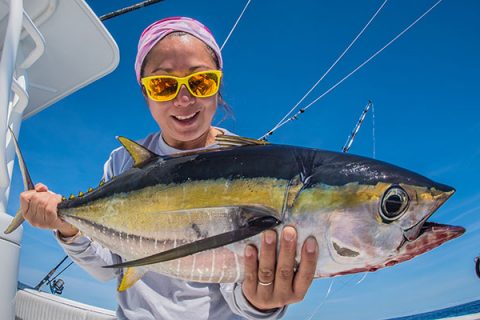
When the Northeast Canyons are mentioned, most folks think of bigeye and yellowfin tuna, white and blue marlin, and mahi. These days, most canyon boats are outfitted with 50-wides spooled up with thousands of yards of braid topped with another couple hundred yards of 100-pound monofilament. While it may prove to be beneficial in the event you hook a nice blue marlin, it is way over the top for most of the fish you encounter.
If you want to really have a good time tussling with these pelagic game fish, I suggest scaling down your gear to 30-pound and 50-pound line. Your first response to this suggestion probably is, “I won’t have enough line and may get spooled.” My response is straightforward: You will not get spooled. In fact, you can even land a blue marlin with 30-pound monofilament without being close to spooled.

Light-Tackle Trolling Setup
For your 30-wide setup, I recommend a lightweight reel, such as the Shimano TLD or Tyrnos models. Spool the reel halfway with 30-pound-test Dacron backing, followed by 30- or 40-pound-test monofilament from your choice of manufacturer (I prefer Sufix or Momoi). Tie a short, 2-foot Bimini twist into the mainline and affix an 80- to 100-pound wind-on leader with a cat’s paw knot. The same setup should be repeated for the 50-wide setup, using 50-pound Dacron, 50-pound mainline, and a short Bimini to a wind-on leader of 150- to 200-pound test. Because of the small diameter of the line, I prefer to use “Hi-Vis” colored lines to make it easier to see the position of the baits in the water.

Once you have the reel and rod together and line strung through the guides, crimp on your swivel (a dolphin or sailfish-size snap swivel is perfect). Using a drag scale, set your strike drag for 8 to 9 pounds for your 30-pound setup and 12 to 14 pounds for your 50-pound setup.

This system will allow you to fish the light main line and light leaders to your hooks or lures while still maintaining the ability to leader a larger fish. The drag setting will not cause your main line to break while the fish is running and it will allow you have fun battling the fish.
Light-Tackle Rigging

When it comes to rigging your dead bait rigs and lures, continue on the pattern of scaling everything down. When light-tackle trolling, bait and lures should be rigged on 60- to 130-pound leader material leader; the lighter leader will allow the small baits and lures to swim properly and display the best action. Remember, we are running a lighter drag that will prevent any sort of breakage upon strike. When rigging your ballyhoos, circle hooks work best to prevent chafe, decrease the percentage of pulled hooks, and leave the fish that release in the best shape. Many fishermen think that when trolling for tunas, mahi, and other hard-striking fish, you will not get hooked properly if using circle hooks. On the contrary, you will be pleasantly surprised at the success rate, provided you keep the strike drag light. Catching “meat fish” on circle hooks is the same as J-hooks when trolling: If your drag setting on the bite is too tight, then you will miss fish.

Circle-hook-rigged ballyhoo can be skirted or naked. I prefer to have a mix of them out there, with the naked baits running in the flat line positions so that they double as pitch baits in the event you raise a white marlin into your spread. When skirting the baits, I prefer to rig them with soft chugger heads from Mold Craft or Fathom Lures. The heads give the baits a nice popping action and are easy to rig with the hook leading in front, just as with the naked baits.
Lures should be small trolling-class lures, like feathers, cedar plugs, and swimming plugs. Leaders of 100 to 130 pounds are sufficient and 7/0-8/0 hooks should be the largest used. Some of my favorite choices are white feathers, natural cedar plugs, small bullet lures, and small swimming plugs with cupped or slant faces from Fathom Lures and Canyon Gear Tackle.

Light-Tackle Trolling Spread
The trolling setup and spread is the same as any other for blue-water applications. A spread consisting of 7 to 8 rods and a combination of lures and dead bait is ideal. Our preferred spread has always been: Two flat lines with naked ballyhoo, or a single ballyhoo, single cedar plug combination. Short riggers are great positions for light daisy chains or spreader bars. The long riggers should have swimming lures, chugger-head ballyhoos, or a combination thereof. Center rigger or shotgun is a great position for a bullet or small feather. Trolling speeds are no different, with 6 to 8 knots being ideal, but pay attention to sea conditions as you may need to change to keep the baits performing.