
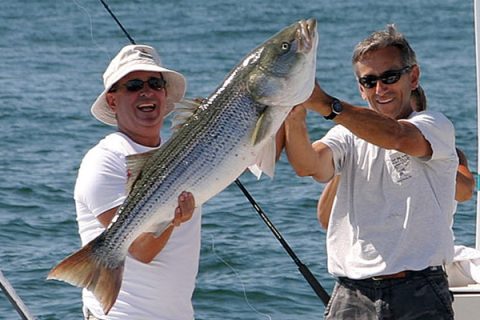
Pictured above: Captain Steve Roland and a bunker-chunk-caught, 44-pound East End striper.
Catch monster summer stripers off the end of the east end of Long Island
Known locally as bunker, the Atlantic menhaden is an abundant big-bodied, filter feeding baitfish. By filtering zoo- and phytoplankton out of the water, bunker convert microscopic organisms into a major food source for a large portion of the Northeast’s gamefish, like bluefin tuna, sharks and, especially, the striped bass—making live, dead or chunked bunker one of the very best baits for catching big striped bass.

The waters off the East End of Long Island rarely hold large schools of bunker because there is too much current in the area. Bunker can be found within Gardiners and Peconic Bay, but this is long way from the productive fertile fishing grounds found off both the North and South Forks. However, there are many bait shops on Long Island’s West End that do their best to have fresh bunker in stock on a daily basis. This means you may have to bring the fresh bait out east with you, but this is a small price to pay when the end result is a big striper. Keep in mind, fresh bunker chunks always produce best.

Once you have gathered fresh bunker, place them in Ziploc bags, and keep them cool by placing them on top of ice in a good cooler. It’s also a good idea to pour some bunker oil into the bag of bunker. I use BioEdge Menhaden Potion to add extra scent to my chunks. By all means, avoid laying the bunker directly on or in freshwater ice, as this is a sure way to remove the slime from the flesh of fresh bunker. Often, this “slime,” is the key to fooling wily stripers.
If only frozen bunker is available, I’d pass on the bunker and instead purchase frozen mackerel. I have found that frozen mackerel is much more productive than frozen bunker. I like to buy the mackerel before hand and let them thaw slowly. When they are half thawed, I cut some of the mackerel up, put it in plastic bags, and pour in some BioEdge Mackerel Potion.
Productive structure off the East End comes in many forms such as point, mussel beds, boulder fields, wrecks and rocky reefs. Areas like this abound off both Orient and Montauk Points, and also off Plum and Fisher’s islands. More good structure can also be found further to the east off Block Island, as virtually any rocky outcroppings around Block will hold stripers at one time or another during the season. Famed chunking spots such as Great Eastern and Shagwong Reef can easily be found on a nautical chart.

There are also many “secret” spots that will also produce stripers. I have found that all good chunking spots have a few common characteristics. Most importantly, a good spot needs a decent running current. Stripers use current to find baitfish that ball up for safety while the force of the current is pushing them about. Combine a good current with a boulderfield or rocky reef, and you’re well on the way to catching lots of stripers. Also, the water over the structure should be deep enough so that big bass are not skittish. Structure in at least 20 or, better yet, 30 feet of water, is where you should concentrate East End chunking. In addition, if you can position the boat right on the edge of a rocky reef or drop-off, you will be located right over a “striper highway.” Let the games begin.
Understand, not all structure will produce on all tides during the season. Some chunking grounds will be more fertile during certain parts of the season. To set you on the proper course, I’d suggest concentrating efforts off the stronger spring tides that occur for about 2-weeks each month, and July and August are prime times to be set up over a boulderfield with fresh bunker chunks dangling off the hooks.

Once you have decided on a piece of structure to fish, keep in mind that action always seem to be best when you’re on the spot before the rest of the fleet is out on the water. I have found that “dueling” chum slicks on a spot are not very productive for anyone. So, whenever possible, get on a piece far away from the competition. I know this is easier said than done, but you would be surprised just how un-crowded the East End waters can be on weekdays.
Once the anchor is set, make sure the boat is close enough to the structure. When comfortable with the location, toss some bunker chunks over the side of the boat in order to “seed” the area. It’s important to do this right, and it is a fine line between chunking the right amount and chunking too much or too little. Too much chumming and most of the bass in the area will stay way back in the slick and feast on the easy pickings and mostly avoid the chunks on hooks located closer to the boat. Too little chumming will attract few bass, and also result in no hook ups. I like to get a good slick going during the beginning of a tide stage in order to “call” in some fish. Then, I’ll slow the chumming down when the bites start coming. However, don’t stop chumming completely, as the school can lose interest and move on.
For chunking, don’t go under-gunned with your tackle because this technique offers a very good chance of tangling with a monster striper. I prefer the Lamiglas Tri-Flex BL7030 with a Fin Nor OFC 20 conventional star drag reel for my chunking set up. I like this reel because it’s proven to be durable and strong, with a silky smooth drag. The reels are spooled with 40-pound-test monofilament—I prefer monofilament over braid because the mono stands up better to the sticky structure common on the chunking grounds.

My chunking rig is made up of a fish finder above a barrel swivel and a 36- to 40-inch 60- to 80-pound test monofilament leader, ending with an 8/0 Gamakatsu circle hook. I keep my leader relatively short because I often cast my rigs away from the boat to spread them out in the slick, and longer leaders makes casting cumbersome.
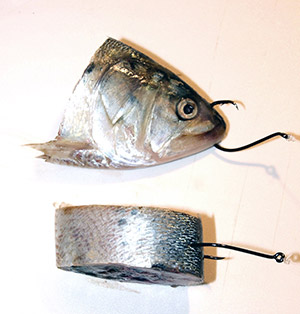
I cut my bunker (or mackerel), so I get three meaty pieces from each whole bait. I always discard the tail section for chum because this piece of bait spins like a propeller when it’s on a hook. The head is the prime piece for attracting a trophy sized striper. When I hook the head I like to thread my hook point through the lips, so the gap of the hook keeps the mouth closed. If the mouth opens in the current, this destroys the presentation. The two pieces of the bunker that make up the stomach cavity and guts are also excellent baits, but be sure to get as much of the guts on the hook as possible. This piece creates a mini chum slick as the entrails drift away in the current. I normally hook my chunk bait by passing the hook point one time through the meaty back portion. I make sure the hook point protrudes through the skin. I always make a final inspection to insure there are no scales from the bait clogging my hook point.
I change baits often to keep the freshest offerings in the strike zone. After 15 minutes in the slick without a bite, I change out my baits, as in that time, the current has usually washed out the baits. The old baits that I replace are cut up and tossed over the side as chum.

Remember, when using circle hooks don’t set the hook at the first sign of a pick-up—wait for the line to come tight, and once it feels like the rod is going to be ripped from your hands, simply turn the reel handle a few times to set the hook. Truth be told, you’ll hook more stripers by putting the rod in a holder with the drag set correctly. Stripers can be very fussy when they are taking a chunk, and many times they will mouth and drop the bait several times before deciding to eat it. If you are holding the rod during this cat-and-mouse game, there is a chance you will set the hook at the wrong moment and miss the fish. I am a big believer in putting the rod in a holder and letting “Captain Dead Stick” do the hooking for you. I only touch the rods when changing baits, or fighting a striper.
If the tide is right (moving, but not moving too fast), I give a spot 20 minutes to produce a few bites. If within that time span nothing happens, I re-anchor the boat on the same piece of structure, but on another part of it. If bites don’t come after this move, I’ll usually move on to another nearby piece of structure.
Most striper action usually occurs on the first two hours of a current stage for “the spot” you are fishing. During the peak of the current, bites will usually slow down for a while. This is also the time to ease up on the chum because the strong current is simply pulling the chunks too far away from the boat. However, if you were on the fish earlier in the tide, bites will normally again pick-up as the current slows down, and this is the time to increase chumming, just a bit.

During the entire tidal period play around with the sinker weights. It’s okay if the baits float off the bottom a bit in the current. It’s also a good idea to occasionally walk the baits back in the current by letting out some line. This presentation is normally more productive than having the baits stay securely anchored to the bottom with a very heavy sinker. Also, when the current is slow, I have had great success by free floating my chunks back into the slick with no sinker at all. I simply let the chunk float back in the current, and lightly thumb the spool. Once I feel a pick-up, I keep slight pressure on the spool to avoid an overrun, count to five, and then lock up the reel to set the hook.
Bunker chunking is a simple, time-proven method for catching big stripers. Always remember to let a few of the big cows go to live another day, so other anglers can also enjoy tangling with a whopper striper.
Do you set your drag very loose while your rods in the holder so when a bass picks it up they feel no resteince?
Yes