
It is amazing how popular ice-fishing has grown over the past few years. Even here on Long Island, where I once had just about any lake to myself on a January or February weekday, you’ll see a few anglers scattered about on the more popular waters once the surface is frozen solid.

SAFETY FIRST
It’s all about safety when you head out ice-fishing—especially in our area where the surface rarely freezes more than 8 inches thick. Carry along a tow rope and a set of ice picks to help you claw out should disaster strike. You’ll also want to wear creepers of some sort for a solid footing. Boots just don’t cut it unless there is several inches of snow on the surface.
Dressing warmly is also important, of course. Layer your clothing, wear extra socks and a wool-knit hat, bring along some “Hot Hands” or similar warming device. Dress for the coldest temperatures and most wind you are likely to see on any day. You can always peel off some items as conditions grow more tolerable.
No matter where you fish, four inches of ice is the minimum on which to venture and be aware that areas around inflows, outflows and standing structure are easily compromised. Fishing with a buddy is a good idea, too, but be sure to spread apart to disperse your weight as you head onto new or unfamiliar ice.
Here’s a rundown of Long Island’s perennial ice-fishing hot spots. The season can get started as early as Christmas and sometimes lasts into March. Either way, keep in mind that first ice is often best ice so get out there as soon as you can once Old Man Winter takes hold.
Victory Drive, Smithtown

Interestingly, Long Island’s biggest lake may be its most underrated ice-fishing hotspot. Going back as far as most of us can remember, this lake had a reputation for being full of stunted yellow and white perch, which didn’t do much for anyone with hardwater passion. Today, thanks to the state, adjoining towns and the Department of Environmental Conservation, runoff in these one-time resort waters has been greatly reduced. The waters appear cleaner, and the perch often run medium to large since an introduction of walleye seems to be keeping their populations in check.
You would think that the walleye would be the prime target here – the DEC has deposited tens of thousands of them over the past decade – but most anglers I see on these waters are still looking for simple action and thus fish for whatever they can catch. That includes largemouth bass, bronzebacks (both must be returned as they are in the no-kill part of their seasons), sunfish and the perch, all of which fall to small jigs tipped with waxworms on a regular basis.
For the walleye, you’ll probably do better to jig a 2-inch soft plastic or a Northland Puppet Minnow, or fish live shiners—even a fresh-caught white perch—just a few feet below the surface. The legal size limit for walleye here is 18 inches, but some weighing more than 6 pounds have been taken both from open water and through the ice.
Walleye roam in search of perch schools, so it can be tough to pin them down. I’ve had my best success in 8- to 12-foot depths, but other anglers have reported doing well both closer to shore and in water as deep as 40 feet. At 234 acres with a maximum depth of 60 feet, this is both Long Island’s largest and deepest freshwater haunt, yet on a calm, mid-winter morning you’ll likely see fewer than a dozen anglers spread from shore to shore.
As a rule, the western and southern ends of Lake Ronkonkoma see the most action, which is due to the easy access from Victory Drive launch ramp. The southeast corner of the lake, between Brookhaven and Islip Town beaches, also sees some pressure. Generally, the best catches of panfish and bass are made in 8 to 12 feet of water.
Wading River Road, Wading River

This 33-acre slice of heaven is fully embedded within the pristine grounds of the John M. Schiff Scout Reservation in Wading River. As part of a Pine Barrens purchase of 147 acres of the reservation back in 1996, the DEC acquired easement rights from the Boy Scouts that allows fishing on a limited basis through the fall, winter and spring.
Like Lake Ronkonkoma, this is a glacial kettle-hole type of lake with a maximum depth of about 40 feet. It doesn’t have much in the way of largemouth bass or bronzebacks to note, although a few of each species have been noted in recent years. Instead, it features excellent action with brown trout, sunfish and big yellow perch—a few of which will measure over 14 inches. It also has a reputation for producing big pickerel but populations of the toothy predators seemed stressed here in recent years, so the DEC has instituted a catch-and-release-only provision for this species. Also, be aware that there is a 12-inch minimum size limit on brown trout here.
Deep Pond takes a while to freeze. Often, the east end of the lake hardens before the west end so you might need to trek all the way around to find safe and solid footing if it is early in the season. The lake bottom on the east side slopes from the shore out to about 20 feet near the center, then drops again to 40 feet at the deepest part of the lake.
Since Deep Pond offers the chance to tangle with big pickerel, nice trout and big yellow perch, you might want to work live minnows or fresh strip baits here. The lake holds a large population of killifish and golden shiners, which all the predators target, so minnows seem to be a logical choice. This is also a great place to try jigging with a Northland Buck-Shot Flutter Spoon, Swedish Pimple or small, lead-head grub tipped with a waxworm.
Access to Deep Pond is provided for fishing only. That means you can’t wander around the campground, hike, bike or do anything else without special written permission from the Theodore Roosevelt Council of the Boy Scouts. To fish here, you’ll need a DEC State Lands Access Permit. Entry is allowed from dawn to dusk on Monday through Thursday, and from dawn until 3:00 p.m. on Fridays. No weekend access is permitted, and access is available from September 15 through June 15 only. State Lands Access Permits are free and can be obtained from the DEC Web Site at www.dec.ny.gov/outdoor/7815.html.
Route 25, Mattituck

Although much smaller than Lake Ronkonkoma at only 26 acres, Laurel Lake still rates as Long Island’s second deepest freshwater retreat, maxing out at 47 feet. As is the case at Lake Ronkonkoma, smaller fish will make up the bulk of one’s catch here, but there is always the potential of hooking into something substantial. Yellow perch and sunfish seem to be the most willing to feed under a frozen surface, but bullheads and bass will also oblige from time to time. The real bonus, however, are brown and rainbow trout, which average just under the minimum size limit of 12 inches but can push the tape to 16 inches or more. You’ll also find some big picks patrolling the cove mouths.
As a winter rule here, panfish, bass and perch prefer to hold in 6 to 10 feet of water just outside any of the obvious coves. The trout, on the other hand, tend to prefer more open water, usually toward the west end or middle of the lake in 10- to 16-foot depths. Try for the pickerel in the shallows and allow your minnow baits to swim just beneath the ice.
The bass, pickerel and panfish like to set up over some kind of structure, but the trout seem to like a clean bottom and move around much more than their tightly schooling counterparts. One way to cover the trout, bass, pickerel and panfish all at the same time is to align your fishing holes from shallow to deeper, more open water. Start with one hole at a depth of about six feet, just outside one of the coves, and work your way out to 20 feet of open water.
Route 25, Middle Island
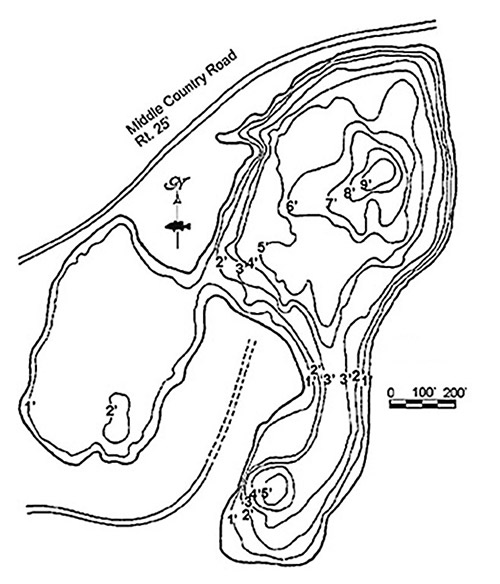
Here’s a lake that is perfect for beginners. It’s relatively shallow, a short walk from the car in case young feet get cold, and is full of crappies, bluegills, yellow perch, pickerel and largemouth bass. Best of all, you can almost always find one or two local anglers fishing here. If you are new to the game, this small environment makes it easy to observe what’s working, or even ask for advice, thus cutting the learning curve.
Most of the better scores here come from the middle of the lake, straight out in front or slightly east of the main parking area. The southeastern cove is also a good bet if the ice is solid and you don’t mind the hike.
At one point, this was one of Long Island’s premier crappie hotspots. The specks still feed well here, but catches these days see more of a mixed bag with a few bluegills, a couple of crappie and, perhaps, a largemouth and pickerel or two. The lake does see fairly heavy pressure, so catch and release is a good credo if you fish here regularly.
One tip for fishing at Artist Lake is to move around until you find an area that doesn’t seem too weedy. These will often turn out to be hotspots, although the best of the bite will be at first light and just before dark as the fish slide out of the vegetation.
Be sure to use a sufficiently heavy leader because the pickerel here often exceed 20 inches and some of the bigmouths will bust the 4-pound mark. Crappies and yellow perch can also run large with both species occasionally measuring over 12 inches. Because the fish are pressured and the water is clear in the winter, a 10- to 15-pound-test fluorocarbon leader is a good idea when using live minnows for bait. If you would rather jig your specs, a Northland Buck-Shot Slider Spoon makes a great choice. Tip it with a couple of waxworms.
Route 27, Montauk

This is often the last of the big lakes to freeze on Long Island because there is a lot of deep water here that holds heat well into the winter. Once the surface solidifies, however, it this has the potential to be Long Island’s top hardwater hotspot.
Yes, it’s a long drive from anywhere, but Fort Pond offers smallmouth bass, walleye, white and yellow perch, plus bluegill and largemouths. Look for all of these species to be mixed and tight to the bottom off the eastern shore in 8 to 10 feet of water.
If you really want to target walleye, move a little deeper and suspend your minnows or jig a 3-inch curly-tail grub, Rapala Jigging Rap or Nils Master Baby Jigging Shad from a foot off the bottom to mid-depths.
The walleye fishing here is especially good but rarely makes the papers – locals seem to like it that way.