

I awake to a steam bath. Well, at least that’s how it feels at 10:00 a.m. after only four hours of sleep. It’s the deep summer and its beginning to be a real scorcher, with temperatures in the 90s forecasted for the next several days. After dressing for my morning routine, I step out of the darkness and I feel like a vampire as the bright sun engulfs me. Despite my dark polarized sunglasses, the brightness makes vision a challenge.
As my eyes adjust, I’m greeted by the regulars of what I affectionately refer to as “Camp Northbar.” Awaiting my report of the night’s fishing are Jimmy, Frankie, Bob and Cookie.
“What ya get?” Frankie barks in his craggy Staten Island accent.
“A couple,” I respond. Frankie and Jimmy aren’t convinced. They continue to eye me, pressing for more information. “Alright,” I give in, “two in the twenties and one in the mid-thirties.”
Frankie throws his arms in the air and growls, “I didn’t get a bump all night!”
After bidding my farewells, I am off to Paulie’s Tackle Shop, my usual hangout during the heat of the day, along with Herb’s Market where I’ll get an egg sandwich and iced coffee. Herb’s also serves as a gauge for just how town will be. The longer the breakfast line, the crazier the hordes of summer tourists will be.
I arrive at Paulie’s and see the usual suspects are already lined up in the row of beach chairs, taking in the ocean breeze and seeking the shade of the tackle shop’s roof. I grab a seat just in time to hear the bantering of Gary “Toad” Stevens, Paul Melnyk the Skisher, and Jack Yee. This petty squabble is the norm among the crew at Paulies – it’s more like a form of bonding. Suddenly, out steps Paulie, calling for an end to the bickering. Paulie lights a smoke and gulps a drink of lukewarm coffee that he left outside while he attended to customers and the phone.

Most fishermen descend on Montauk to fish the blitzes in the fall. Montauk in late September and October draws hundreds of people that line the beaches near the Lighthouse, eager to catch striped bass. But unbeknownst to the fall crowds, there are seven months of striper fishing in Montauk, sometimes more. “Off-peak” times are when I do my fishing.
The heat of the summer months is not usually your best time to fish for striped bass, yet at Montauk, the short hours of darkness in July and August afford some of the best opportunities to catch quality bass. The nights, seven hours at most, are cut to even less when you calculate productive tides and moon phases.
I fish the cool ocean side of Montauk. As well-known Montauk surfcasting guide Bill Wetzel says, “deep, deep south for summer bass,” referring to the long walks required to reach the hot-weather striper action on Montauk’s rocky south side. Striper fishing is not just limited to the rock-strewn area of Montauk, however. Good fishing extends onto the sand beaches right in the village of Montauk as well as the bay side of Napeague.
The trick is learning the patterns of bass during the summer. These are not blitzing schools but large lone fish or small packs of fish that spend their summers in Montauk, dining on crabs, eels, fluke, blackfish and other summer fish at night. They slip inshore under the cover of darkness and root out their meals in a slow, easy manner. Stripers will not expend much energy during these times and simply take an easy swim, eating snacks along the way.
The bait of choice for summer bass in Montauk is eels because of the ease of transporting them. I do know several anglers who fish squid or worms on open beaches and score big time on large bass, but I lack the patience to fish bait on the bottom – I need to be casting and casting! Eels are my weapons of choice and rocky beaches my preferred venue.
The choice eels are the ones that are heavy enough to cast, but not so big that you need to lob them and lose casting distance. I’ll use a slow to extremely slow retrieve, lifting the eel out of the bottom cover and letting it swim back to the cover.

I use a wetsuit to help me gain access to rocky platforms a bit farther offshore. This allows me to cast my eel into rips that would be out of range if I were in regular waders. Since hooking a squirming eel while in the water is a challenge, I carry my eels in Ziploc sandwich bags stuffed in a pouch. When I need to bait up, I hook the eel through the bag and tear it through. I make sure every empty baggie gets to the garbage pail. You don’t want to be littering your fishing spots with trash. Baggies work fine if you are wetsuiting and are in the water; wader fishermen can use more traditional means to transport their eels, such as a bucket or mesh bag.
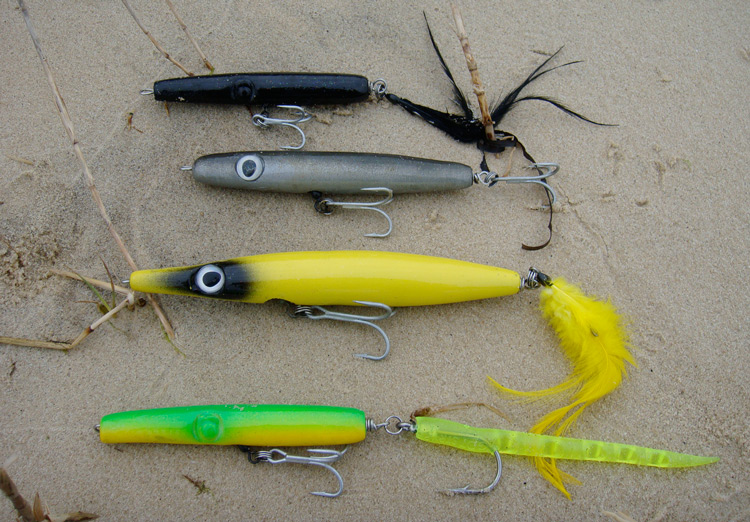
This is not to say I don’t use plugs. As with any fishing, you’re wise to mix up your presentation. Many nights, plugs have out-fished eels. Just make sure to give your plugs a very slow presentation. Summer bass are opportunistic feeders, targeting what’s easiest to capture. Metal lips can be just as deadly as eels when tuned to swim deep or shallow depending on the area you’re fishing. Two metal lips I always carry are a deep diver and a topwater. The deep diver is a blackfish imitation I have made. The object with this plug is to hit rocks. Yes, hit rocks. I fish deep divers with just one VMC treble in the belly. As you slowly retrieve through the bolder field, when you hit rocks, stop reeling! The wood plug will rise tight to the rock, looking like a small blackfish that darted for cover. After letting the plug rise and swimming it past the rock – making it look like a blackfish that has left its cover – the hit will come. The single treble reduces the odds of getting stuck.
The other plug is the surface swimmer. I like the Atom 40 tuned to swim with a heavy rolling action. Aided by an old flaptail blade, the plug imitates struggling bait fish. The trick is to pop the swimmer ever so lightly make it splash, which seems to annoy the fish. The hit seems to always come just as you’re about to take it out of the water.
Sudden weather changes like low pressure systems can often trigger unbelievable blitzes as seen during several past summers in Montauk, with only a handful of anglers in on the action. I’ve been in on summer blitzes that have seen multiple catches of bass in the 30- and 40-pound range.
The Napeague bayside offers a totally different scene, but several anglers score there through the summer with live bait and worms fished along the grassy banks of this highway to the Peconics. When I mention worms, I am talking about a meal’s worth, not just one. For live bait, anglers turn to porgies, lafayettes (spot) and bergalls.

While relaxing at Paulie’s in the hot summer sun, I drift off to thoughts of the upcoming night’s tide. Maybe I’ll push a little further west to a spot where I can swim out deeper into the cool ocean where the bass have been laying all day. As I formulate my plan, the summer sun becomes too much to take. It’s off to Camp Hero to catch a nap and enjoy the southwest breeze.
In the darkness of night, I gear up for a long hike deep into the rocky shoreline. The beaches are quiet and dark under the new moon sky. My walk seems endless as I gaze at the star-studded sky. I am ready to battle like Orion in his distant constellation. Equipped with my Lamiglas 120-1M custom-built rod and a Van Staal VS 250, I feel ready to catch some large stripers tonight.
Arriving at my destination, I line up a long, flat rock off the beach a ways, in about ten feet of water at low tide. This rock will put me just on the edge of a rip forming by the flooding tides. Perfect! I wade out through a field of slippery rocks, until my wetsuit’s buoyant neoprene floats me over the boulders, and I’m able to swim freely. The cool water runs down my back sending shivers up my spine despite the hot, damp air around me. Compared to the heat of the day, the rush of cold water really feels good.
An hour passes without a bump. I change up my offering several times and return to the eel. Several more casts without a bump. Should I try farther west, or back east where I had fished the prior tide? Suddenly, a slight double tap. I drop my rod tip down to the water, waiting for the line to come tight. When it does, I lift quickly, striking hard, twice, to make sure the hook is set deep. The line rips from my reel, as the fish swims off into the clear, dark waters. Several more short bursts and she is finished, a nice fish in the low 30s, I estimate as I release her.
The eel is beat-up but still half-alive eel. I adjust its position on the hook and make a cast uptide, letting the eel sink down in the rip. Bump, bump. Another hit. It’s going to be another hot mid-summer Montauk night.
Great stuff!!
I really like your writing and enjoyed this piece. Good fishing tips as well, of course. Thanks!
Got to love it
I can smell the salt air after reading this piece. Good job.
I feel as tho’ I’m right there with you !
Extraordinarily beautiful !
boy I want go fishing. thats your artical makeme feel, like right there.
I enjoyed your story as much as the ones from the montauk’s regular old timers, I have fished at Montauk this year(2016) for the first time, twice the south side during incoming tide and once the north side during the outgoing tide but didn’t get lucky. I’ve never fished at night before and only have been fishing for three years but I can’t wait to experience something like this. Great stuff!!!