

Want to catch a 50-pounder? Try these proven trophy strategies.
The pressure was on. My partner and I were booked to take a very important guest fishing, and he was flying in from Japan. I had been scouting an area and was feeling confident that it would give up some big bass, but the night before the trip, I was lying awake at 3 am, going over the game plan in my head. Our guest had never caught a striped bass before, and I wanted to give him a memorable introduction to our fishery.
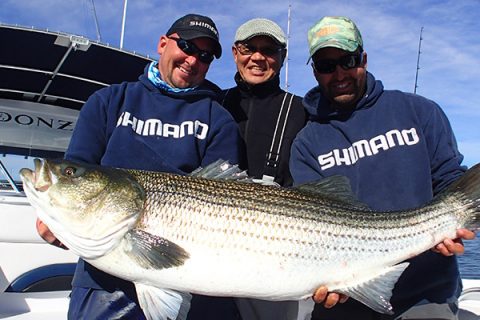
I shouldn’t have been worried. Twenty minutes into the trip, I positioned our guest in the bow and started a bow-first drift so that his eel would be the first one seen by any fish hanging on the structure. It worked as planned. I saw him set the hook, and immediately recognized the head shakes of a big bass in the bend of his personal Shimano Tescata rod, which was paired with a reel that looked like something I would use for freshwater bass. I started the boat and chased the fish as it began dumping line, the drag screaming as the fish streaked away from the boat and the 30-pound-test braided line started to disappear.

The Japanese angler had plenty of experience fighting big fish, but this was his first time hooked up to a striped bass. In 15 minutes, he had his first bass to the boat-all 63 pounds of it!
“Don’t bother striper fishing ever again,” I told him. “You just won the lottery on your first fish!”
But he was hooked on striper fishing, and wanted to keep going. We continued to fish that same area for the next four days, and each day it produced at least one fish over 50 pounds!
Since I was 12 years old, I have had a fascination with striped bass. In those days, it was all about quantity, and seeing how many I could catch in one night. I couldn’t get enough, and would catch and release hundreds of bass, my thumb bleeding because I’d worn the skin off lipping so many fish. Eventually, I saved up enough money to buy my first boat and venture out to famous bass grounds like Block Island. Fifteen years later, I’ve turned my obsession into a job, running the 40-foot center console Hot Reels out of Point Judith, Rhode Island. Now, I specialize in putting clients on big, trophy bass.

Location
The most important piece of the trophy striped bass puzzle is location, and the two factors that make a location hold trophy striped bass are structure and current.
Understand that the needs of large striped bass are different from smaller, 18- to 30-inch fish. The “school-size” fish are fast and agile, and patrol the coast in numbers. I have seen marauding hordes of smaller striped bass swim along the beach in 2 feet of water. It’s a great scenario for light-tackle surfcasting or getting into some fly-fishing action, but you’re not going to connect with a big bass targeting schoolies in shallow water.

Big bass like structure. Stout fish with large tails, big bass are better suited to using structure to launch attacks with short, powerful bursts of speed. They are not suited to chasing down prey over distance—they prefer to ambush their food.
If you are fishing from a boat, start by studying the structure of an area, first by using charts and GPS and then by using sonar to get a finer picture of the bottom topography. Think like a big bass would. Where would you position yourself to wait for bait to come to you? Look for deep holes behind rock piles, large boulders, drop-offs and dips in the ocean floor. Big bass will stay in position to feed because current allows them to do so. Moving water is very important; it concentrates wandering fish and triggers their feeding instinct. I have found that the majority of the trophy-sized fish I’ve landed strike when the tide is close to its peak flow. In the areas I fish, a drift speed of 1.5 to 2.5 knots is ideal. Current carries baitfish past these ambush points and creates the perfect scenario for a big predatory bass to use its wide, sweeping tail to lunge and strike.

When I’ve located an area I think will hold fish, I simply place a waypoint on my chartplotter up-tide of the structure and begin to make drifts using the waypoint and my drift tracks as a guide. On my trips, we are fishing from a 40-foot platform, bow to stern. To cover the most water, I will position the boat side to the tide and spread out my clients from bow to stern, with four or five rods fishing. I call these first few drifts “prospecting.” It creates a 40-foot wide spread of targets being washed over the structure. As you dial in the areas where the bass are holding, you can get more precise and specific with your drifts and how to position the boat. And, as you get to know certain locations, you can quickly make about a dozen drifts over a target area near the ideal (peak) tide flow before quickly moving on to the next target area, until you locate the fish. This strategy of making short drifts to target specific pieces of structure over the course of a tide works for finding fish both day and night.
Presentation
I believe larger, older bass are much smarter than smaller, immature bass. That is why fishermen using heavy 60-pound-test monofilament leaders and huge snap-swivels are at a disadvantage. When fishing for big bass in the daytime, stealth matters. Stripers have better eyesight than most fishermen realize, so I spool my reels with 40-pound braided line, specifically dark green Power Pro. For a leader, I use 30-pound-test Seaguar Blue Label fluorocarbon, which is thin and very abrasion resistant. I simply tie a uni-to-uni knot to connect a 7-foot piece of fluorocarbon to the braid, neatly trim the mono part of the uni and leave a 4-inch tag end on the braid section of the knot. This tag end is where I’ll connect a 2- or 3-ounce bank sinker, snugged with about 1 to 2 inches off the main line. This eliminates a swivel, which I believe is just one more thing that can create unnatural noise or shine. For the same reason, I never use a shiny new lead sinker, and often paint new sinkers matte black before I fish with them.

For a hook, I use a black 5/0 Gamakatsu octopus hook, and bait is almost always a lively eel. Most fishermen assume they need to use the largest eels they can find to catch big bass, but it doesn’t require an 18-inch snake to produce a 50-pound striper. I have caught multiple bass over 50 pounds on small eels—the key is not the size of the bait, but that it is presented as naturally as possible over the right structure in a moving current.
In a fast tide, I tell my clients to hit bottom once as we start the drift, then lift the rod tip toward the sky. I tell them not to drop back to the bottom or scope out line; this keeps the bait 2 to 4 feet off the bottom and reduces the chance of snagging the rocks and losing gear. With the rod tip pointed at the sky, the bump of a striper picking up an eel is unmistakable. When it comes, simply drop the rod, allowing the bass to inhale the eel and the hook, reel up slack and set the hook. The fish will almost always be hooked in the mouth when using a J hook and setting the hook in this fashion.
Success
Many more monster bass are lost than are landed. The most important thing is to adjust to the lighter, stealthier rigs you are using to fool the big bass into biting. For example, one mistake that most guys make is to set the drag too tight, especially on the hookset. Once you hook a large bass, its initial reaction isn’t to run, it’s to shake its head violently in an attempt to spit out the bait. This is when most large trophy bass are lost, just seconds after the hook is set. If the drag is too tight, the lack of stretch of the braid will give the fish plenty of leverage to pop the hook out or to snap the leader material.

I’ve found that 30-pound fluorocarbon is very abrasion resistant, as long as you don’t put too much heat on the fish at first. I’ve tried stepping up to heavier leader material, but I believe that the number of hook-ups decreases. Keep in mind that modern reels can hold more than enough thin-diameter braided line, so being spooled shouldn’t be a concern. At the same time, you don’t want the fish to scope too far out in the current, especially if you are in close quarters with other boats, buoys or lobster gear, so be ready to start the boat and give chase. By following the fish, you can reduce strain on the gear and keep the bass under control and out of the structure.

Believe it or not, on the days of fishing with our guest from Japan, we never once marked a fish on the fishfinder. However, we relied on our electronics to pinpoint the structure and target it with short, precise drifts, using the same techniques I’ve described here. As I always tell my clients: visualize the structure, and then visualize bait washing up and over the structure… and then be ready for a 50-pound striper to eat it.
Captain Louis DeFusco runs Hot Reels Sportfishing out of Point Judith, Rhode Island;
Great article and specific detail for this technique!
I enjoyed this as I like to go striper fishing.
Does this work fishing from shore? What adjustments would be made to adapt, pump, reel, drop, wait?
Thanks for sharing detailed information on RI techniques! It’s great of you to pass on hard earned knowledge.
-Dave
Smart Bass
Beverly, MA