

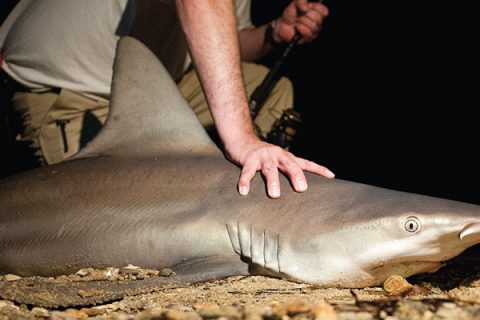
The run-off was slow, but deliberate. Something out there in the dark had taken the big chunk of fresh, cut fish and was swimming away with it. AJ Rotondella had an idea what it might be when he set the hook and the reel began to scream. Digging his heels into the soft sand, he leaned back on the stout rod and offshore trolling reel, turning the head of the 8-foot sand tiger shark and fighting it toward the Jersey Shore beach.
Targeting sharks from shore is a favorite summertime sport for surfcasters looking for a battle from the beach after the stripers and blues have moved north. AJ is just one of the growing number of dedicated land-based shark fishermen in New Jersey. A life-long fisherman, Rotondella was attracted to the adventure of targeting sharks from shore, and his guide service, Apex Anglers, introduces other anglers to the excitement of fishing the surf for sharks.

Sandbars and Sand Tigers
Most of the sharks that enter the New Jersey surf—excluding dogfish—are sandbar sharks (sometimes called brown sharks). They show up before the stripers leave in the late spring and head south a little after the mullet run in the fall.
Sandbar sharks enter the surf to feed on bluefish, kingfish, dogfish, skates, and crabs. They’ll also stalk bunker schools, ripping through them on the surface. Most measure about 3 feet in length, but sandbars to nearly 7 feet have been pulled out of the New Jersey surf.


Sandbar sharks are great fighters and hit a bait hard, usually picking it up on the run. My first one grabbed an eel I was casting for stripers off the north end of Ocean City. The eel had just hit the water, and I hadn’t had the chance to flip the bail before line began flying off the spool. I flipped the bail, set the hook, and was nearly pulled off the tip of the jetty. When that first run finally ended, I was pretty sure it wasn’t a striper I was attached to, and I got my confirmation when a triangular fin sliced the surface behind the first breaker as I walked down the jetty to try to land the shark on the sand.
Sand tiger sharks, despite their more menacing appearance, are much more docile on the end of the line. They don’t have the speed of brown sharks, but they are larger, and they use that size to hunker down and make slow, unstoppable runs.

“A four to six foot sand tiger will put up a decent fight, but nothing crazy,” Rotondella said. “When they start approaching nine feet, they are very impressive looking sharks, but the fight is mostly just a heavy weight, and some really powerful headshakes.” Sand tigers are bottom feeders and scavengers. They eat crabs, fluke, and skates. They have also been known to hunt wrecks, where they feed on sea bass and blackfish.
Sand tiger sharks are far less numerous than sandbars, but Rotondella has been encountering more sand tigers each year. In 2014, Rotondella landed four, all longer than 8 feet, and by July 2015, he’d already landed several smaller sand tigers and one monster. Both species of sharks are protected and must be released.
Rays
Soaking a big chunk of cut fish in the warm summer surf is bound to attract more than just sharks. Rotondella also catches two large species of rays during the summer.
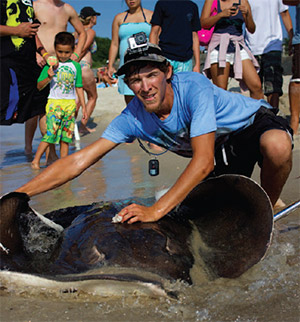
The roughtail stingray can weigh more than 500 pounds and measure more than 4 feet across. It feeds on sand eels and bottom-dwelling invertebrates, such as crabs and lobsters.
Butterfly rays can have a wingspan of more than 6 feet. They feed on clams, crabs, shrimp and some fish. There’s usually no mystery about what is on the other end of the line when a ray takes the bait. Instead of the headshakes and sprints of a hooked shark, rays produce a steady, unstoppable pull, like a tractor.
“A big roughtail stingray can keep you busy for hours,” Rotondella said, “but don’t confuse a long fight for a good one.” Roughtails will lay their whole weight on the bottom, and landing them is a matter of slowly inching them toward the beach.
“Butterfly stingrays are a different story,” Rotondella explained. “They spend less time on the bottom and actually put up a pretty impressive fight.” Two smaller species of rays, the cownose and the bluntnose, will also take a bait intended for sharks.
Gearing Up for Beach Monsters
same rods you use to fish bait for stripers and bluefish can work for surf sharking. A 10- to 12-foot spinning or conventional rod rated to throw 8 ounces will do the trick. If using spinning tackle, a reel with a bait-feeder feature is essential. There can be a long time between hits, so most surfsharkers elect to spike their rods. The bait-feeder feature will allow a shark to take the bait with minimal resistance while preventing your rod from being pulled into the surf. Conventional reels can be left in free spool with the clicker engaged.
Targeting really big sharks from the sand, like Rotondella’s 8-foot sand tigers, requires a more specialized approach. To fish extra-large baits on stout, 80-pound-class offshore tackle, land-based shark fishermen use kayaks to deliver the baits past the breakers. Many fishermen elect to use both tactics, casting smaller baits on their surf gear, while paddling out one extralarge bait on an offshore rod.
Big baits include whole false albacore and bonito, tuna heads, bluefish racks, and even dead skates. Casting baits include chunked bunker or bluefish, whole dead kingfish and croakers, and large dead eels.
Rigs don’t need to be complicated. On the casting rod, a fish-finder rig with a 12- to 18-inch piece of single strand wire above an 8/0 or 10/0 circle hook and a 6- to 10-foot, 80-pound-test shock leader will tame just about any shark you encounter. On the offshore setup, fishermen use longer wire or even cable leaders above a 12/0 or larger shark hook.
Quality sand spikes are essential to shark fishing. Serious surf-sharkers bring rubber mallets to pound the spikes into the sand to make sure their tackle is secure.
[…] of New Jersey, whose land-based sharking excursions were featured in the August, 2015 article “Monsters of the Surf “. […]