
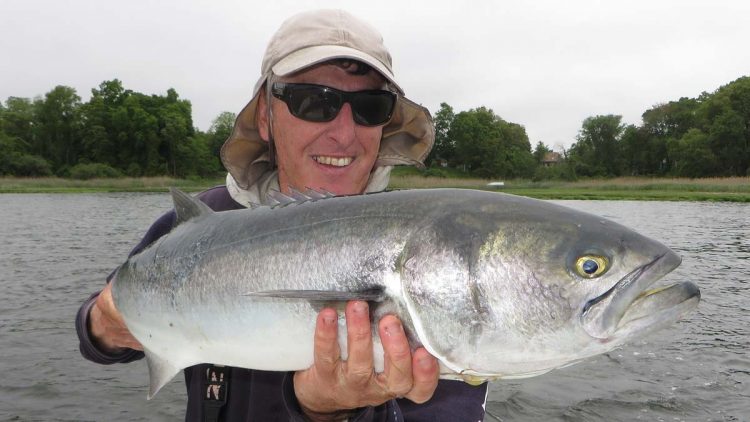
In late spring, when the focus of most boat fishermen on Narragansett Bay is chasing down keeper stripers, large bluefish are also invading the bay. Last year, I landed some of the biggest bluefish of my life during the early season and, best of all, hardly anyone else was targeting them.
My first brush with monster blues happened in mid-May in a shallow cove that had produced stripers in previous seasons. Motoring through three feet of water, I saw subtle swirls along the surface here and there, usually a sign of stripers delicately picking off small bait or spawning worms. My Slug-Go was struck as soon as it hit the water and was instantly cut off. I immediately knew what was there—and they weren’t stripers.
My brother Steve and I switched to surface plugs and had an afternoon of amazing fishing for big blues. They were in such shallow water that I had to stand in the front of the boat to keep one eye out for rocks and the other on my spook as it danced back and forth on the surface. We could see the wakes of big blues following the plug back to the boat on just about every retrieve—and they were all big, “‘gator” blues of 10 pounds and up.
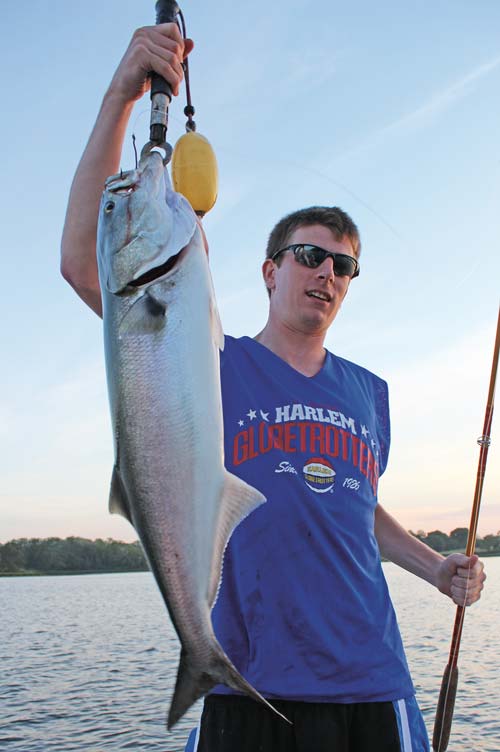
Steve hooked into a fish that we initially thought was a large striper. It hit and then immediately peeled line out. It was almost unstoppable, a far bigger fish than those we had already landed. We both had visions of his spool of 12-pound-test mono being emptied out. I was about to start the motor to go after the fish when it slowed and shot out of the water like a missile. That’s when we realized it wasn’t a striper—it was a huge bluefish.

Steve inched the fish toward the boat until I was able to clamp the Boga Grip over its lower jaw. This Mother of All Bluefish measured out at 40 inches and I guessed it was in the mid-20-pound range, not far off the Rhode Island state record, a 39-inch 26-pounder.
That day delivered dozens of bluefish in the 10- to 18-pound range along with that monster fish. It made for fantastic topwater action with light gear and small plugs. In the following weeks, we went back to this location as well as other shallow areas in Narragansett Bay, and we continued to catch a mix of stripers and large blues on topwaters. It proved to be the best fishing for large bluefish that we would experience all year from either shore or boat.

Big spring blues migrate into Narragansett Bay in early to mid-May, depending on water temperatures. I take a two-pronged approach to finding these fish. Sometimes, I find them under schools of menhaden in deeper water; other times, I find them sunbathing and eating small bait in shallow water. Many fishermen catch blues around the menhaden schools while fishing for stripers, but few anglers venture into shallow waters intending to target bluefish.
Going Deep
While targeting large stripers in years past, we found large bluefish. This tends to happen in deeper water, primarily along the shipping channel edges of the bay that run from Conimicut Point in Warwick to Providence Harbor, where menhaden tend to school. Boat fishermen who fish with live menhaden are likely to find both keeper stripers and large bluefish under these schools. Your fishfinder will tip you off as to whether larger fish are lurking under schools of this big bait. In this situation, I use a snag-and-drop technique. Simply snag a menhaden and hold it as the boat slowly drifts away. Large stripers or big blues will key on the menhaden being dragged away from the school. When a fish hits, you’ll feel a bang on the rod tip as a predator grabs the bait. Lower the rod tip as the fish runs and pull back hard, just as you would do when fishing a live eel from shore. I don’t open the spinning reel bail and let the fish run off line because this often results in a gut-hooked fish. If you find a school of bait with bluefish on it, add a wire leader to your rig before snapping on a snag hook.

When targeting bluefish, I use a double-hook setup on the dead bait. One hook runs through the nose of the pogy while the rear hook comes off a short wire leader hooked in the rear of the bait.
Another technique when fishing large menhaden is to snag several them, place them in a livewell, and motor off to fish them elsewhere. I do this on occasion when I can’t find large fish under the schools of bait. I’ll put two rods off the back of the boat – one is set up with a live pogy while the other has a dead one.
When targeting bluefish, I use a double-hook setup on the dead bait. One hook runs through the nose of the pogy while the rear hook comes off a short wire leader hooked in the rear of the bait. The two-hook setup is far more effective for big blues since these gators tend to take the back of the bait. Fishing this way has produced catches of large stripers and big blues from the 15- to 20-foot-deep flats off the shipping channel in spots such as Sabin’s Point, the Rhode Island Yacht Club, and Barrington Beach.

Staying Shallow
My most effective approach for catching large spring bluefish is to fish shallow water with plugs. Though the bay can be loaded with big menhaden in deeper water, many of the arriving large blues still seek out the warmer water of the shallows. The temperature gauge on the boat often reveals a 5- to 8-degree temperature difference in surface water temperature from the shallow areas of the bay to the deeper areas in the early spring. On sunny days, the difference can be even more dramatic.
Protected coves and bays with water less than 10 feet deep will warm quickly, making these prime spots to find large bluefish. We’ve even landed alligator blues in waist-deep water while fishing from shore.
Many of these locations have worm spawns and large populations of small baitfish. Bay anchovies are moving into the bay at this time and they are often found in these shallow areas. Well-known spots such as East Greenwich Bay, the East Providence Bike Path, and Conimicut Point are all good bets for early-season action.
Don’t expect the early choppers to be as aggressive as they are at other times of the year. The water, though warm in shallow places, is still cold, which slows their metabolisms. The bait is also small, so the blues tend to be fussy and tentative on the take. Because of that, small offerings are more effective at drawing strikes.
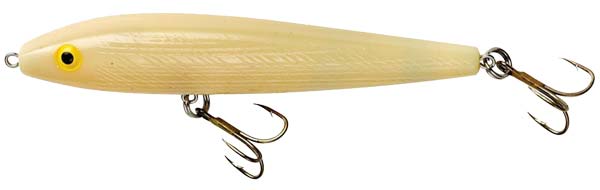
Small topwater lures are the ticket when fishing from the boat. I like walk-the-dog lures that skim and dart across the surface with pulls of the rod tip. One of my favorites is a Rebel Jumpin’ Minnow in white or blue—it has super action and is just the right size to get fussy bluefish to hit. Before casting it, however, I change out the split rings with heavy-duty ones and replace the hooks with VMC’s 4X size 1.
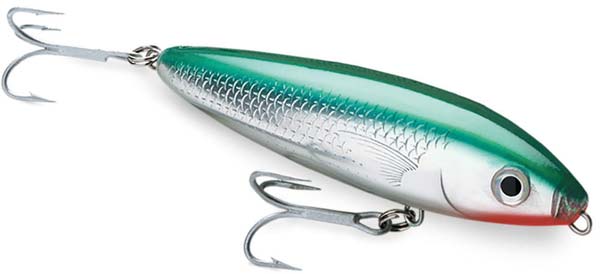
Another effective plug is the Super Zara Spook. It looks about the same as a Jumpin’ Minnow, but it is slightly bigger and casts a little better. I change out the hooks and split rings on this lure, too.
Finally, the ol’ reliable popper works well on these fish. I find that a 4-inch white one does the trick, though fussy blues will sometimes whirl but not take a popper. If that happens, try a spook. With all the plugs, I set up a wire leader at the end of my monofilament leader to prevent bite-offs.
I use fairly light gear when plugging from the boat for early-season bluefish. An 8-foot St. Croix Mojo and Van Staal VS150 spooled with 30-pound-test PowerPro braided line is perfect.
When fishing from shore, I use almost the same equipment and plugs as I do from the boat; however, there are times when I see fish swirling way out. On those occasions, you might want to break out a 9- to 10-foot rod and larger plugs for greater casting distance. I keep a bigger outfit in the truck and a couple of long-cast pencil poppers in my bag just in case I run into this situation.
Last year’s early influx of big bluefish wasn’t an anomaly. My logs tell me that the early part of the year has delivered good numbers of alligator blues in the past. So, don’t be surprised if you catch the biggest blue of your season, or even your life, this spring.
May 24, 2018- 32 inch blues trolled up in Greenwich Bay on a Crippled Herring. They were in water 4 degrees warmer than rest of bay.
good to know when I next get down there.
Your blog shows a pic of your first blue of the year – Photo of the day from 5/28/18. This On The Water article was written 5/24/18 where it seems you caught many blues. What am I missing?
I caught a 41” blue at the wind farm late summer 2019. It was a monster Blue and gave a great fight.