
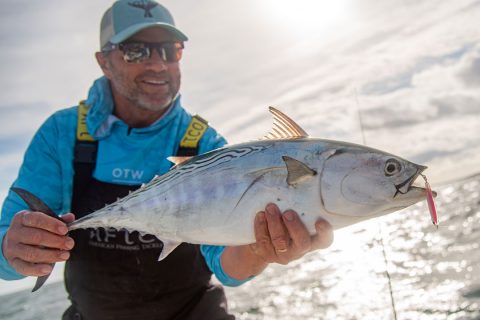
Massachusetts has approved new regulations for false albacore and Atlantic bonito, two increasingly popular species among recreational anglers in southern New England that previously had no size or bag limit restrictions. The Division of Marine Fisheries’ (DMF) is expected to a 16-inch fork length minimum size and a five-fish per person possession limit—applicable to both species combined–for the 2025 season.
The new rules are aimed at protecting the future of these fast-swimming pelagic fish, which have become central to the region’s late summer and fall inshore fishery. DMF’s approach reflects growing concern over the absence of formal stock assessments for both species and the increasing pressure from recreational fishing. The regulations are also intended to constrain the development of targeted commercial fisheries. While some fishermen pointed out in public comments that the new rules are not based on any scientific data showing that regulations are needed, others supported the precautionary approach.

Who’s Affected and Who’s Exempt
The regulations apply broadly to recreational anglers and commercial anglers. However, two commercial sectors are exempt: weir fishers and those using mechanized mackerel jigs. These exemptions reflect the historical bycatch nature of false albacore and bonito in these fisheries, where sorting and releasing live fish would be logistically difficult and potentially harmful.
Why 16 Inches and Five Fish?
The minimum size of 16 inches corresponds with the estimated length at which both false albacore and Atlantic bonito reach maturity. The five-fish possession limit is designed to reflect current recreational harvest levels, ensuring the vast majority of anglers will not be affected while still limiting the potential for overfishing or the expansion of new, targeted commercial efforts.
A Precautionary Path Forward
While these new limits are not part of a larger federal or coastwide management plan, they represent a growing recognition of the need for conservation in rapidly evolving fisheries. Massachusetts is encouraging other states to enact similar regulations.
Regulate everything till it’s not fun anymore…stop the regulations
If you are eating albies you are a menace, and have a fine palate for trash. If your lucky enough to catch 5 bones in an outing, good for you. Why you would need to keep more than 5 is beyond me. Go catch another 5 the next day or bring a friend. These regulations are put in place for a good reason. I trust the people that choose quantity and slot size over the googans that fill a cooler with fish and let it rot in the back yard.
There is absolutely no reason for this regulation…same with shark fishing from shore…screw these unvoted on regulations
who kills Albies?
As Rhode Island and North Carolina consider adopting similar regs on bonito and albies, I am looking back at this article and the comments below. Who kills albies? Thankfully, many of us appreciate that albies are much more valuable alive than dead. But one of the most memorable stories from my 20+ years as a charter captain involves this very question. I booked a trip with a fellow charter captain from the North Shore. He said he wanted to target albies, because they didn’t get any of this great species north of the Cape. So I was looking forward to sharing a day of light-tackle fishing with a fellow angler who shared my appreciation for one of the Vineyard’s favorite gamefish, the magnificent false albacore. When I pulled up to the dock in Falmouth where we had agreed to meet, I saw a group of guys equipped with a giant cooler and a gaff! The first thing they said was “We need to fill this cooler up with albies. They make the best shark bait.” What went through my mind in that moment was “Please, God, don’t let any of my colleagues hear about this. I’ll be ostracized!” However, I didn’t feel like I could refuse the charter, so off we went, to search for albies. After a couple of unsuccessful hours of searching, I suggested a change of plans, as I knew that we could fill the cooler with bluefish at another nearby spot. (This was several years ago, when that spot was still a sure bet for bluefish.) They agreed, saying that “bluefish are the second-best shark bait.” It was a win-win, as I avoided having an albie massacre on my conscience, and they went home with a cooler full of (the second-best) shark bait.