

Big schools of bunker make July fishing hot and heavy off Long Island’s South Shore.
For most of my fishing life, I’ve considered July the beginning of the summer doldrums, at least as far as striped bass were concerned. Off western Long Island and New York Harbor, the water gets uncomfortably warm for stripers in July, particularly in backwaters such as Jamaica Bay. Even on the ocean side, the fishing tends to slow down. Sure, there are spurts of surface activity at dawn, but they never seem to last very long. As a result, I’ve always shifted gears in July, focusing on offshore fishing or bottom-bouncing for fluke.

Yet the paradigm has shifted significantly during the last few seasons. In fact, I’ve witnessed dramatic changes in both the inshore and offshore fishery. The forces responsible for such changes are way beyond me, and likely beyond even the best of scientists. It could have something to do with water quality, ocean currents, water temperature, climate change, shifting abundances of forage, or some sort of ecosystem factor that is so many times removed that we will never know. While we can certainly speculate, only Mother Nature knows the answers.
The Magic of Menhaden
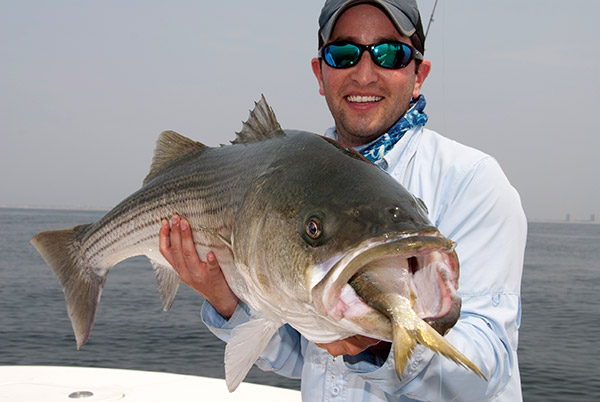
The noticeable and welcome change I’m referring to is the influx of Atlantic menhaden into the waters off the Rockaways in the unlikely month of July. The area has been packed with bunker from the beach to 5 or 6 miles out, especially during the early part of the month – acres and acres of them. And of course, with such concentrations of bunker on the ocean side, you can expect to see stripers no matter what the water temperature is. Not just stripers mind you, but large ones. In this case I’m talking about really big ones. In fact, I’ve seen more 40- and 50-pound fish in the last two years off the Rockaways than I’ve seen in my entire life!

While we are seeing some extraordinary big-fish days, these bites very localized and happen infrequently. In other words, the existence of such schools of bunker off the Rockaways does not mean you will find bass on them every day. There were many days when there simply weren’t any bass on the bunker schools. But there were other days when there were all-out blitzes with 30- to 50-pound fish galore. And I’m not exaggerating! Just a day or two before July 4th last year, there were large schools of bunker tight to the beach from Breezy Point all the way to Debs Inlet getting crushed by some scary-large stripers. We must have caught 30 fish before calling it quits in the early afternoon while the bite was still going strong. The smallest fish that day weighed in the mid-20s, and the largest was close to 50. Pure insanity! And when I went out the next morning, full of expectation, there were absolutely no stripers on the same schools of bunker.
Sometimes you’ll turn the corner of Breezy Point and it’s an all out feeding frenzy. Of course you’ll know when that happens as you’ll see bunker spraying out of the water, large boils behind them and big splashes. In those situations, it’s time to get out the big swimming plugs, sliders and poppers.
Menhaden Mimicry
I usually start with a popper as I really love the violent surface strikes they draw. The noise and commotion a good popper makes will certainly draw attention, and that can be half the battle when you are competing with hundreds of real baits. Despite the fact that one rarely sees a bunker making a commotion on the surface like a popper does, big stripers are always compelled to see what all the commotion is about, and usually they’ll strike first and ask questions later.
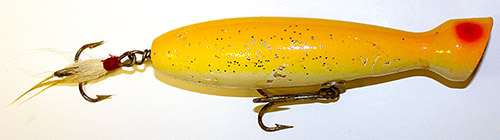
3-ounce Gibbs Polaris, really get the attention of big fish.
Captain Gene Quigley of New Jersey’s Shore Catch Guide Service, one of the best Captains out there for putting folks on big bass while they are on bunker, turned me onto the 3- and 4-ounce Pajama Plug Pencil Poppers and the 3-ounce Gibbs Polaris Popper. These are big, nasty wooden plugs. They have great action and make a ton of noise. Big metal-lipped wooden swimmers worked very slowly will sometimes be the key when fish won’t hit a popper. All these lures are quite large and are tough to fish on light-tackle, but they are sometimes necessary when the bass are totally keyed in on big menhaden. If the fish are really fired up and not terribly picky, I like a 2-ounce Cotton Cordell Pencil Popper. Although these plugs aren’t as good of a bunker imitation as the aforementioned wooden plugs, they aren’t prohibitively heavy, cast far and can be fished on relatively light tackle. I generally like to use a 7-foot medium to medium-heavy stick with a Van Staal VSB 150 spooled with 30-pound-test PowerPro. Those big wooden plugs can be thrown with this set-up, but it’s much more compatable with a 2-ounce plug.
Don’t forget your soft baits. In many cases they will work better than plugs. The 9- and 12-inch Slug-Gos will draw ravenous strikes when worked along the edges of the bunker schools. While these baits look and act nothing like a bunker, the darting and squirming action is so enticing that stripers keyed in on adult bunker don’t care. I’ve also had success with 10- or 14-inch Hogy soft-plastic baits.

While the general line of thinking with big bass is that they are usually down deep, I find that assumption to be entirely false. I’ve had more big bass strike surface plugs or soft plastics fished just under the surface than I ever hooked deep in the water column. Still, if I see bass harassing bunker off the Rockaways, and I’m not getting any love with the surface stuff, I’ll clip on a 7-inch Tsunami Deep Shad, which is probably the best bunker imitation out there.
Also, early July off the Rockaways may actually be the best time and place to stick a 30-plus-pound fish on a fly. I saw Captain Bryan Goulard stick not only one 30-plus-pound fish last July but a second one that looked a lot closer to 50.
To do this you’ll need at least a 10-weight rod, a 450-grain sinking line and some large 9- to 10-inch wide-profile bunker patterns. The weighted line is not necessarily to get it down, but simply to give you the “umph” to cast such large flies. Unfortunately getting it out there in front of a feeding fish will not be easy, so for the most part, unless I have an extraordinary caster, I try to have the angler get the line out away from the boat as we drift close to the school and let the fly sink down with the drift before retrieving it in fast, erratic strips.
Snagging And Dropping

Of course there are often times when the bass on bunker simply won’t eat an artificial. In fact, that seems to be the case more often than not. Don’t worry about bringing a cast net to get livies. In fact, don’t bring a cast net! You’ll only scatter the bait school and spook the bass. In this case, a weighted treble is the preferred way to acquire bunker. Believe it or not, the conventional 3-way rig for live bait doesn’t seem to work well under these bunker schools – and I know as I’ve fished these rigs quite a bit. It can be a challenge to get a live bunker into the strike zone without drifting over the baitfish and stripers. The easiest way to get a live bait right into the mix is to snag a bunker out of the school with a weighted treble and leave it swimming. Keep enough pressure on the bait to make it struggle and appear wounded. Big bass will seek out such distressed baitfish. This happens to be the tactic of choice for surfcasters as they can often cast to a school of bunker from the beach, particularly when the bunker are getting corralled onto the beach by big bass.
One might assume that a weighted treble would result in a lot of gut-hooked bass, but my experience is that this is not the case at all, provided you set up on the fish as soon as you feel it grab the bunker.
With a method as effective as snagging and dropping bunker, it’s tempting to load the boat with a limit of trophy-sized bass. However, please consider photographing and releasing them to fight another day. Remember that the more fish we release, the more fish we’ll have returning in following seasons – when they’ll be even bigger.
The gear I use for this type of fishing is actually the same stuff I use to jig tuna in the summer – 6-foot, 6-inch to 7-foot medium-action heavy spinning gear. You really need this heavy gear because sometimes, the bunker themselves are 2 pounds. Sure we’ve done this with lighter gear, but it’s awkward fishing such a large bait on lighter tackle.
You’ll likely get bitten off more than once while targeting stripers in these bunker schools. This kept happening to us last year no matter how much wire bite tippet I put on. I just didn’t get it – until I set up on a good strike and a 10-foot thresher shark came leaping out of the water not 20 feet from the boat! Without a doubt, all that bunker in the area attracts a good number of thresher sharks as well.
Once you start getting bitten off, it’s time to move onto another school of bunker because if there’s a shark or two around, you can be sure the stripers have skipped town.
Finding the “Right” Bunker
When you encounter one bunker school, there are bound to be others in the vicinity. You’ll actually find many schools of bunker out there, not just off the Rockaways but from Debs to Long Branch and certainly in New York Harbor as well. If you don’t catch fish on one school after 15 minutes or so, simply move on to another one. I found that the bunker schools that hold not only the most, but the biggest fish are the schools close to the beach. Indeed this bodes well for the surf guys. The largest fish on my boat last year was caught in less than 15 feet of water. Usually if bunker get that close to shore, they have been pushed there by predators.
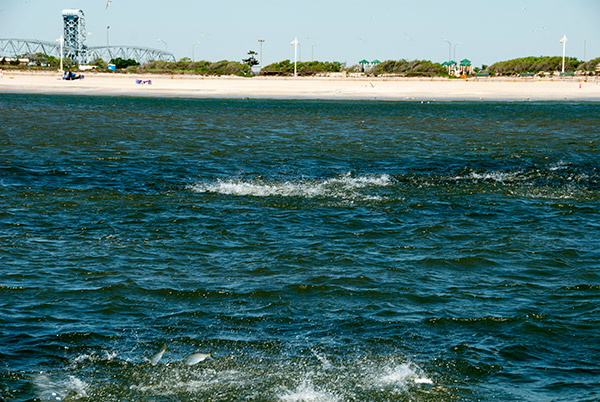
As I’ve come to learn from many a painfully boring and time-consuming experience, it really pays to be perceptive. You can work an acre-wide school of bunker for hours without a touch. By knowing what to look for, you can select those schools that are likely to have feeding stripers beneath them.
The first rule-of-thumb is to find smaller, tightly packed schools. The large spread-out schools are what I call “happy bunker,” meaning that they are unbothered and thus not worth spending much time on. Of course, if you see any sudden movement, most obviously bunker spraying out of the water in succession, but also sudden changes in direction of the school or other indicators that the school is “nervous,” then it’s probably a good idea to spend some time working those bunker. But, there are more subtle indicators as well. A tightly packed school is packed tightly for a reason. The menhaden’s only survival technique is to swim in numbers. When there are predators in the vicinity, menhaden will constantly jockey for the middle of the school while those weaker and less lucky fish on the outside get picked off. Thus, the more tightly those fish appear to be grouped, the more you can assume there are predators around and that the bunker are trying to save themselves and leave their brethren on the outside to get eaten.
Sometimes you can see this happen in broad daylight as stripers attack the edges of a school on the surface. Thus, instead of working an artificial or live bait through the school, you will increase your odds of having your offering noticed by fishing baits or lures around the school. The best way to do this is to cast beyond the school and then work your soft plastic or plug so it approaches the edge and works its way just to the outside of the pod of bunker. Likewise, snagging a bunker on the perimeter of the school and trying to keep it swimming there (easier said than done, of course) will also work.

Lastly, I should mention the time of day these fish seem more prone to eat. Believe it or not, it’s been a much better afternoon bite. That’s another pattern that completely changed in recent years. Twenty years of experience taught me that the best striper bite was always the hour before dawn and the hour after. That’s simply not the case anymore as the feed on these bunker off the Rockaways and northern New Jersey is unmistakably in the mid- to late afternoon. Why that has come to be the case, I have no idea. I can’t even manage a guess.
July has really taken on a new meaning to me. Who can think about fireworks when the biggest bass of the season are likely to be right off our coast! These days, I’m thinking about big, big bass, and scoring a 50, or even a 60, and July is the time for anglers in the New York Metro area to do just that.
Fantastic reading Captain Rob, Thanks!
I’m a new skipper to the Fire Island Inlet area, and I’ve been trying
very hard to get my buddies on the fish.
For the most part, we’ve been skunked so far this spring.
We see some, but not a tremendous number of bunker schools out there, but they all seem “Happy” as you put it. From what I read, the bass are still west and/or south of Fire Island, but I’m beginning to wonder if they have
indeed moved on?
In your opinion, is there a particular “drop everything and head out there”
scenario of weather, time or tide state?
Thanks again for all the great info!
Tight lines…
Jeb