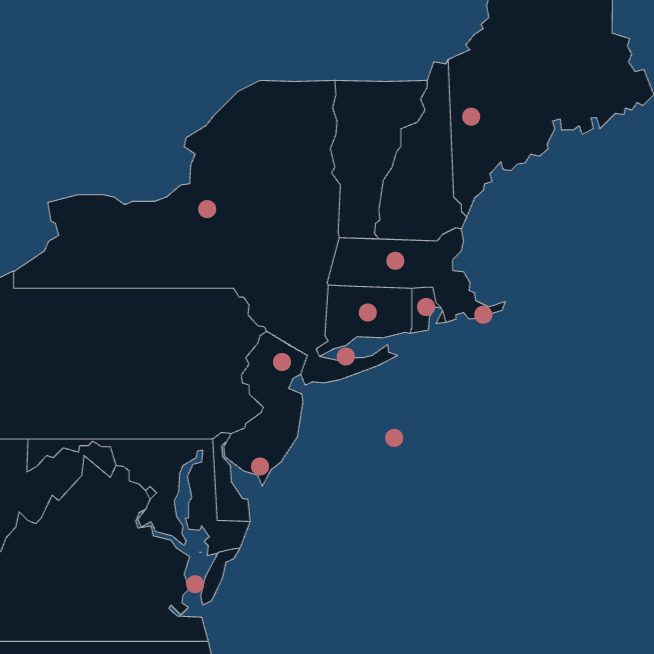



It’s a big ocean out there, and when you make the commitment to head offshore to chase big game, you’re limited by your time and your fuel budget. If you want to make the most of your limited resources offshore by spending more time fishing productive waters and less time burning fuel crossing areas devoid of life, don’t leave the dock without a good Sea-Surface Temperature (SST) chart.
Over the years, the basic sea-surface temperature service has evolved into a multi-faceted data cornucopia with providers offering many different types of graphical information and additional ocean data for both recreational and commercial fishermen. Membership to some professional sites costs thousands each year, but less expensive and even free services are available.
Sea-surface satellite data was developed for meteorologists, oceanographers and other scientists to study ocean currents and their impacts on climate, weather, ecology, economy and defense. It didn’t take long for some clever fisherman to

get a hold of the data and use the information to discover changes in water surface temperatures that attracted and concentrated baitfish, which in turn brought the marauding apex predators riding along the Gulf Stream to within reach of recreational fishing vessels.
What are you looking for on SST Charts?
The Gulf Stream pumps warm, tropical water from the Gulf of Mexico around Florida and along the East Coast, veering off toward Europe just south of Cape Cod. This ever-moving slug of water meanders about 250 miles off our continental shelf for much of the winter, but as spring approaches, pockets of warm water from the Gulf Stream “spin off” toward the

offshore canyons in the Northeast. These warm-water eddies rotate as they move inshore, carrying large baitfish and predators within their waters. Locating these eddies is critical to finding and catching pelagic gamefish such as longfin, yellowfin and bigeye tuna, white and blue marlin, mahi-mahi and wahoo.
These eddies appear as a round pocket of warmer water on an SST chart. A counter current to the Gulf Stream, the Labrador Current begins south of Canada and works its way from north to southwest along the same offshore shelf. Early in the season, a large water temperature break occurs where both of these currents meet somewhere near our 100-fathom line east of the Hudson Canyon. When these two bodies of water clash, there is a mixing of cold, nutrient-rich water that feeds the base of the food chain and warm, cobalt blue Gulf water favored by pelagic gamefish and baitfish.

This happens year after year, but the location and intensity of the “clashes” between warm and cold currents varies. Typically, anglers can expect a warm-water eddy to bring fish from the Gulf Stream to within 100 miles of the New York Bight sometime in the middle of May. These eddies will continue to form throughout the fishing season. Early in the season, temperature breaks can be as severe as 20 degrees, but the air and water temperatures warm, these breaks narrow. The purple-blue Gulf water gradually mixes with blue water, which in turn mixes with the inshore “green” water creating fingers of mixed or blue water. Temperature breaks along these boundaries are identified by SST imagery and provide a clue as to where the fish might be.
It is important to find the smallest temperature break along these lines during the summer season to enhance success. There is also another vertical temperature break, about 50 to 80 feet down, called the

thermocline. Locating the thermocline is especially important during nighttime tuna and swordfishing, since these fish will lurk just above or below this sub-surface temperature break.
Many of these services provide information beyond water temperature that is useful to fishermen including chlorophyll levels, altimetry and bathymetry. This satellite data is captured by several satellites rounding the earth on different timetables taking shots several times a day. This information is then made available to any company wishing to grab the data and convert it into usable graphical information. The degree of accuracy and detail can vary from one service to another, and this is usually reflected in the price. Many of these services will offer a sample or short trial period to for a quick look-see.
Some services even offer a private weather service. An accurate weather forecast is vital to offshore anglers
since ultimately, this is what will determine whether they head for the deep or stay at the dock.
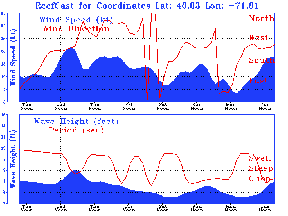
Ocean weather information comes from an array of government-owned anchored weather buoys spread out all along the entire U.S. coast. These buoys provide 24/7 sea conditions.
NOAA takes the data from these buoys and uses complicated algorithms to create
a forecast that many of us use to aid in our decision making. However, many anglers have been caught in unpredicted storms or nasty seas and see the value in having another forecast to compare to NOAA’s. Therefore, some SST services offer private forecasts for those willing to pay for this additional source of data.
Ultimately it is our own eyes and senses that will provide the real “data” that results in catching fish. Feeding birds, baitfish marks on the sounder, surface disturbances, and the smell of baitfish are sure-fire ways to locate fish, but it’s a big ocean out there, and evaluation of Satellite Sea Surface data is a necessary first step to point us in the right direction.

About the Author – Jeff Yapalater is an avid offshore fisherman, lover of observing the deep blue and a member of Maracoos, Mid Atlantic Coastal Ocean Observing System. He was a champion of the Texas Tower 4, 44066 buoy deployment. Special thanks to Rutgers COOLROOM and mentioned SST services for their input.
Know the Lingo
The more advanced services provide more information
than the average angler can digest, but understanding the data and how it will affect the fishing will help you narrow down which area offers your best odds of success.
Chlorophyll
This refers to the amount of phytoplankton (microscopic aquatic plants) that is found in the water. An abundance of phytoplankton may indicate a more favorable place to fish since this forms the base of the food chain.

Altimetry
This describes the height of the water, related to upwelling and downwelling, which can bring nutrients from the bottom waters to the surface, kick-starting the food chain. These edges you see on the charts are generally the best to fish.
Bathymetry
This is the multi-dimensional underwater view of structure. Many experienced captains like to mentally overlay bathymetry charts with temperature, chlorophyll and altimetry data.
Turbidity
The more suspended solids in the water, the murkier it appears and the higher the turbidity. This can include phytoplankton offshore but also includes debris, silt, and other organic material coastally.

Choosing an Ocean
Forecasting Service
Choosing a SST service is like choosing a watch. You can get a Timex for basic timekeeping or can get a Breitling chronograph with all the bells and whistles. So it is with SST services. Some are free with basic surface temperature shots with simple contour and temperature ranges. Others offer enhanced graphics and detailed analysis with all kinds of additional data designed to further aid in finding the fish. A couple of high-end services also allow satellite phone calls to get updates while on the water.
Choose the service that best suits your budget, available fishing time and particular style of fishing, but remember, the seas and fish are in a constant state of flux, so no report, no matter how sophisticated, is a guarantee of success.
SOURCES:
Rutgers – www.coolroom.com
Stevens Institute Technology – www.stevens.edu/maritimeforecast
Terrafin – www.terrafin.com
OceanTemp – www.oceantemp.com
Offshore Satellite Services – www.offshoresatelliteservices.com
SST Online – www.sstol.com
SST Charts – www.sstcharts.com
RIP Charts – www.ripcharts.com
Roffs – www.roffs.com
SST-Offshore – www.sst-offshore.com
Hi i’m a commercial longline fisherman in the Caribbean (Grenada). which website would u best recommend (yellowfin tuna)?