
by Tom Cece
It might sound like a stretch, but I view bass fishing as being similar to mixed martial arts—to be consistently successful, you need to be well rounded. If you are new to bass fishing, or if your fishing skillset is a bit one dimensional, it can be helpful to force yourself to incorporate some new ideas and techniques each season. With this in mind, I’ve pulled together a list of important bass-fishing fundamentals that can help round out your skills.
1. Check the Clarity
One of the first things to consider when you start fishing is the water clarity. Water clarity affects how bass relate to cover, how deep bass will hold, and what lure styles and colors will be most productive. Usually, the dirtier the water, the shallower the bass will be and the closer they will relate to cover or the bottom. In clear water, bass tend to hold deep and will often suspend in open water or over structure. Use dark or bright colors in dirty water and natural colors in clearer water.
2. Master the Jig
The jig is the most versatile bass lure. It can be used in all water clarities to catch fish in shallow or deep water, with horizontal or vertical presentations. You can swim it through open water, pitch it into deep cover, or drag it along the bottom. You should always have a jig tied to one of your rods.
3. Bring the Noise
Whenever possible, add the element of sound to make your presentation more attractive. If you’re fishing a plastic bait, insert a glass rattle. Take it out only if the bite slows down on a particular spot or if you’re getting no bites at all.
4. Make a Stink
Get in the habit of using scents on your plastics. Not only will the scent attract more bites, but fish will hold on to the bait longer, allowing for better hooksets.There are many scent products available to anglers, including Bang, Dr. Juice, Megastrike and BioEdge.

5. Keep Changing
Ever notice how often you catch fish on your first few casts in a new area or with a new bait? When you are using the right lure in the right location, the fish respond immediately. For this reason, keep a constant eye on the clock and change either your tactic or location every 10 minutes. Keep a minimum of four rods rigged, and cycle through them quickly while trying to determine what the fish want.
6. Make a Commotion
Add a technique that will take bass in one of the most difficult scenarios: cold, off-color water. Toss a thumping Indiana or Colorado blade spinnerbait and a plastic trailer to create commotion that will help bass lock in on the bait. The plastic trailer will also help to slow down the spinnerbait; often, retrieving the lure as slowly as you can is the key to getting bit in cold water. Run the bait into and through fallen timber to elicit strikes.
7. Embrace the Breeze
Bass bite best when the wind is blowing. Wind creates current, increases oxygen, cuts down on light penetration and moves baitfish. Strong winds can also create a nice current through a lake. Bass will position behind current breaks such as points, fallen trees or brush. If the wind is blowing, you can always put fish in the boat. The wind is something to embrace if you want to get better because it’s one of the variables out of your control.
8. Howl at the Moon
For the best shot at a trophy bass, fish three to four days before and after a full or new moon. Larger fish are more aggressive and more likely to strike a lure during these periods.
9. Fish in the Rain
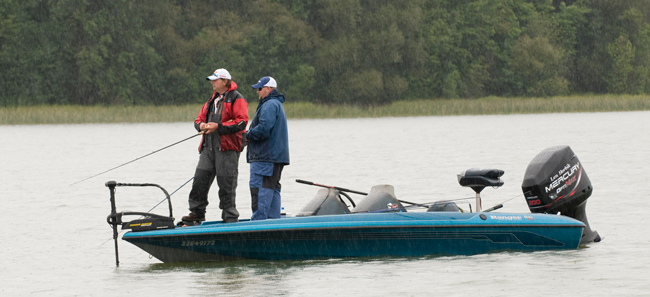
Always fish during overcast and rainy days (except, of course, if there is lightning). Large fish are often on the prowl on foul-weather days. Though the majority of days I fish are sunny, I would estimate that about half of all my 5-pound-plus bass during a season come during overcast or rainy conditions.
10. Find Isolated Cover
Cover, such as wood or rocks, on an otherwise featureless bottom acts as a fish magnet. Plus, since isolated cover can be hard to find, it is usually overlooked by other anglers. You can find isolated structure by scanning an area with your electronics or dragging a jig along the bottom. If you can discover a piece of isolated cover out in the middle of the lake, be sure to check it on each trip. It may not hold fish every time, but at some point, it will.
11. Fish Around Downed Trees
When fishing a fallen tree, make sure to search beyond its outside edges. Parts of the tree may have broken off and drifted some distance away or slid into deeper water, providing seldom-fished bass-holding cover.
12. Get to the Point
The fastest way to locate fish most of the year is to concentrate on shoreline points. Around or during the spawn in the spring, pockets and coves will probably be a better option, but the rest of the year shoreline points will save your day, especially ones with bait, weeds, timber or a drop-off into deeper water. If you can find more than one of these features on a prominent point, there will definitely be fish nearby.
13. Stalk Steep Drop-Offs
Particularly when water is on the cold side, look for baitfish schools off points or sharp-breaking banks. Throw a suspending jerkbait with a jerk-pause retrieve. The colder the water, the longer you should pause the bait. A jig fished very slowly is also part of a reliable one-two punch. Tossing a football jig in rocky areas where bass feed on crayfish gets the job done.
14. Have an Awesome Autumn
The fall bite is every bit as good as the spring bite, yet you’ll rarely see other fishermen in the fall. While spring bass have spawning on their minds, fall bass are strictly eating as much as possible before the winter. Look for baitfish schools in the fall, because if you can find the bait, you’ll find the bass.
Caught my first two largemouth today!!totally ready for season!!
Curly tail worms 7″-12″, black or dark green on spring bass, have always brought me excellent results. I basically use some of the tackle combos, described here: http://hummingbirdfishfinderreviews.com/how-to-catch-largemouth-bass-largemouth-bass-tackle
Hey there I’m paul and yes I say bass are the most creative sport and I say its easy for poeple to go and catch bass with earthworms dam come on make it real and catch it like we do with spinners or flukes plastic worms aneything bud life bait then u can say u catch bass I just thought ill say it if seen some realy nice bass and caught n few nice pounders myself as I always say as I get to the dam I first off all grab n spinner bait quickly through n few places to c aney movements then ill jump to rapalas and then ill go for plastic flukes or worms and yes I think the best are still blue ,black and green pumpkin tanks