

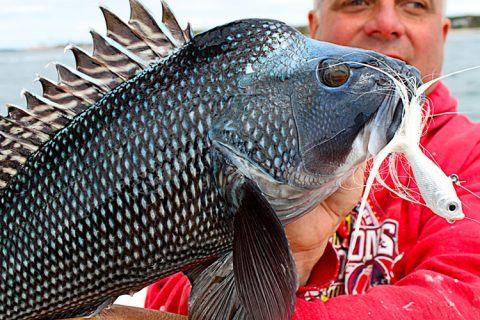
The Division of Marine Fisheries (DMF) is enacting new recreational regulations for fluke (summer flounder), black sea bass, scup, and tautog for the 2018 fishing season. The fluke, black sea bass, and scup regulations are being implemented by emergency action; a public hearing will be held in June prior to implementing final regulations.
| Fishery | Open Season | Possession Limit* | Minimum Size |
| Fluke | May 23–October 9 | 5 fish | 17” |
| Black Sea Bass | May 19–September 1 | 5 fish | 15” |
| Scup | >May 1–December 31 | 30 fish | 9” |
| (45 fish allowance on for-hire vessels May 1–June 30) | |||
| Tautog | |||
| April 1–May 31 | 3 fish | 16” | |
| June 1–July 31 | 1 fish | ||
| August 1–October 14 | 3 fish | ||
| October 15–December 31 | 5 fish | ||
| (10 fish maximum per private/rental vessel, year-round) | |||
* Possession limits are per person per day, unless otherwise noted.
Fluke: DMF is allowed to liberalize the MA recreational fluke regulations to increase projected harvest by 17% relative to 2017. The 2018 rules increase the possession limit by 1 fish (previously 4 fish), and add 15 days to the open season (previously May 22–September 23).
Black Sea Bass: DMF is currently allowed to liberalize the MA recreational black sea bass regulations to increase projected harvest by 4.6% relative to 2017. The 2018 rules add four days to the open season (previously May 20–August 29). Note that Massachusetts has submitted an appeal to the Atlantic States Marine Fisheries Commission seeking additional access to this abundant resource. If the appeal is successful, additional rule liberalizations will be announced in a subsequent Advisory in early May.
Scup: DMF is allowed to liberalize the MA recreational scup regulations to increase projected harvest by 27% within our region (MA–NY). The 2018 rules reduce the minimum size by 1” (previously 10”).
Tautog: DMF is amending the MA recreational tautog regulations to better align with RI (also changing), per a new regional approach in the interstate management plan, with negligible projected effect on overall harvest. The 2018 rules establish variable bag limits on a seasonal basis (previously 3 fish year-round), and place a cap on vessel-based harvest by private anglers.

For more information, please contact DMF at 617-626-1520.
If you increase the harvest on every species where populations go up, won’t that assure populations never really recover.
Fish populations abundant compared to what? Compared to when?
Certainly not compared to when the country began and people joked about walking on the backs of cod and herring.
Yes I fish a lot and I know the Seabass are everywhere.
There’s less fish, every generation that goes by..
I respectfully disagree Richard; the limits were a joke to begin with…way too conservative.
Quick story: I was fishing several miles out of Hyannis in May of last season and there were so many black sea bass that you could see them schooling and blitzing on the SURFACE of the water, up 70 feet from the bottom (some of you reading this may have witnessed this same phenomenon). Fishing was so stupid and easy, even catching jumbos, that it was easier than scup – fish were inhaling jigs as soon as they disappeared from view, seemingly no matter what we dropped. And speaking of scup, how crazy would it have been a decade (or less) ago to say that we had to move the boat while scup fishing to avoid catching more black seas, which took 6 guys all of 20 minutes to max out on our limit of only jumbo sized fish?
My point is that while biomass assessments may not be 100% accurate, I have seen, over the past several years actively fishing for this species, that there are way more fish out there, and way past the previously targeted population biomass for this species…and these fish are eating everything. When you open their stomachs there are crabs, squid, other fish, etc., and you would be awestruck by how big some of these are. That can’t be too good for other marine life out there that is now being pounded but what I perceive as a marine ecological imbalance.
In fact I remember when the limit was 20 fish a person (back in 2013), and it took my wife and I no time, on a half day trip, to max out on sea bass and fill and entire 48 quart cooler on a half-day trip out of the Cape. And there seem to be many more now. But it doesn’t end there.
Wouldn’t you know it I was on a Cruise out of Charleston, SC this past February and I bumped into a local recreational fisherman out of the area one night. A recreational fisherman himself, he said they have the exact same situation of their coast, ridiculous amounts of sea bass and even more ridiculous amount of restriction on bag limits (same as ours). Of course there as well the commercial sector gets the vast majority of the seasonal quota.
Point being that 5 fish at the present size is way too restricted, 10 fish sound like a more realistic limit for recreational anglers. But I’m of the opinion that even that won’t put a chip in the population boom of this species. Great for fishermen who love black sea bass and fishing for them, but maybe bad news for other species.
Amen brother, I am afraid we will never learn.
I understand what you are saying and I mostly agree. Personally, I’d rather have an over-abundance of fish than tightrope walking the fine line of just barely enough fish.
The objective is to balance the public’s “Right” to fish versus the availability of fish. The problem comes with the poor science/data. They do assessments and based on the mortality models determine a benchmark. If they underestimate the number of fish and their mortality, it will be easy to catch fish, in abundance. However, that will cause the official designation of “overfished” to be applied. That causes them to decrease limits. This keeps happening until the next benchmark. The same happens in reverse. In MA, they are able to catch more because they didn’t catch enough last year. However, the reason they didn’t catch enough is because the fish weren’t there. Increasing the limits will further deplete the stock until the next assessment.
To me, it seems, they would set the limits low and only raise them marginally when they can show consecutive stock increases. If they keep having stock increases, they can keep making marginal increases. As soon as the biomass drops, they would have to back off the last 2 increases until they showed consecutive increases again.
No Comment
Why must the State tempt honest fisherman? Somebody somewhere in MA on that first weekend of Sea Bass fishing is going to catch a doormat fluke that will be legal in a few days but must be released. Why can’t we adjust the increase in days, which we have for both species, to open simultaneously?
Hi Mike, that was one option – to line up the opening days – but it would have required closing the fluke season earlier. The state took public feedback and decided that opening the fluke season a few days later in May in order to stretch the season into October was the way to go.
Way to many black seabass out there they are destroying the lobster and crab industry if you catch one open it up all you see is baby lobster and crabs N
Way to many black seabass out there they are destroying the lobster and crab industry if you catch one open it up all you see is baby l hm obster and crabs