
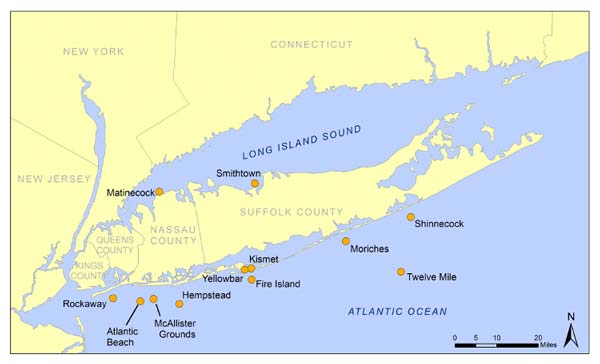
Governor Andrew M. Cuomo recently announced the largest expansion of artificial reefs in state history to improve New York’s diverse marine life and boost Long Island’s recreational and sport fishing industries. In New York’s first ever, comprehensive program to construct artificial reefs, the Governor has launched an initiative to deploy materials including tug boats, barges, and scows, as well as concrete and clean, recycled materials from the demolition of the former Tappan Zee Bridge. These materials will support the development of six artificial reefs on Long Island at sites off the shores of Smithtown, Shinnecock, Moriches, Fire Island, Hempstead, and Rockaway.
Launched during Earth Week, this initiative builds on the Governor’s record $300 million Environmental Protection Fund investment, $2.5 billion Clean Water Infrastructure Act, more than $2 million NY Sea Grant program to mitigate Long Island brown tide, and actions taken to ban off-shore drilling along New York’s coastline.
“The sustainability and health of New York’s marine resources is critical to communities along our shores, and by constructing these reef habitats, we are investing in a stronger more diverse marine ecosystem,” Governor Cuomo said. “As the largest artificial reef construction program in state history, these efforts will increase New York’s marine biodiversity, provide new habitats for a variety of coral and fish, and support a growing tourism industry that brings thousands of anglers and travelers to Long Island’s pristine waters every year.”
At the Governor’s direction, and with unprecedented, multi-agency coordination, recycled materials from the Department of Transportation, Canal Corporation, and the Thruway Authority will be used to develop New York’s artificial reef sites and increase the biodiversity of these habitats for a variety of fish and lobsters. Construction of New York’s first artificial reef dates back to 1949, and this latest initiative marks the state’s first coordinated effort to stimulate the full environmental and economic benefits of artificial reefs.
New York’s marine resources are critical to the state’s economy, supporting nearly 350,000 jobs and generating billions of dollars through tourism, fishing and other industries. More than 500,000 anglers in the region will reap the benefits of this new initiative, supporting the region’s growing marine economy which accounts for approximately 9.7 percent of Long Island’s total GDP.
“The sustainability and health of New York’s marine resources is critical to communities along our shores, and by constructing these reef habitats, we are investing in a stronger more diverse marine ecosystem…”
Governor Andrew M. Cuomo
Beginning in May, state agencies will start to deploy 33 barges of Tappan Zee Bridge recycled materials and 30 vessels that have been cleaned of all contaminants. A total of 43,200 cubic yards of recycled Tappan Zee Bridge material, 338 cubic yards of steel pipe from DOT, and 5,900 cubic yards of jetty rock will be submerged and added to six reef sites as part of the first phase of this initiative. The six artificial reefs that will be developed include:
Smithtown Reef
Three canal vessels and one barge of steelwill be deployed to expand the artificial reef between June 8-15. The 3-acre reef is located 1.6 nautical miles from shore with a depth of 38-40 feet.
Shinnecock Reef
One barge of the Tappan Zee Bridge material, one barge of steel pipes and two canal vessels will be deployed to expand the artificial reef beginning Wednesday, May 2. The 35-acre reef is located 2 nautical miles from shore with a depth of 79-84 feet.
Moriches Reef
Two barges of Tappan Zee Bridge material and two canal vessels will be deployed in July and August to expand the artificial reef. The 14-acre reef is located 2.4 nautical miles from shore with a depth of 70-75 feet.
Fire Island Reef
Ten barges of Tappan Zee Bridge material, 11 canal vessels, one barge of steel and four barges of jetty rock will be deployed to expand the artificial reef between June 26-28. The 744-acre reef is located 2 nautical miles from shore with a depth of 62-73 feet.
Hempstead Reef Twelve barges of Tappan Zee Bridge material and 11 canal vessels will be deployed in July and August to expand the artificial reef. The 744-acre reef is located 3.3 nautical miles from shore with a depth of 50-72 feet.
Rockaway Reef
One barge of Tappan Zee Bridge material will be deployed in July and August to expand the artificial reef. The 413-acre reef is located 1.6 nautical miles from shore with a depth of 32-40 feet.
DEC manages New York’s Artificial Reef Program, which includes two reefs in the Long Island Sound, two in the Great South Bay, and eight artificial reefs in the Atlantic Ocean. The major benefits of constructing New York’s artificial reefs include improving the existing habitats in order to increase local marine biodiversity, stimulating more productive and diverse aquatic ecosystems, and promoting environmental sustainability through fish habitat improvement.
The reefs are built out of hard, durable structures such as rock, concrete, and steel pipes, and usually in the form of surplus or scrap materials that are cleaned of contaminants. After materials and vessels settle to the sea floor, larger fish like blackfish, cod, and striped bass move in to build habitats within the new structures, and encrusting organisms such as barnacles, sponges, anemones, corals, and mussels cling to and cover the material. Over time, all these structures will create habitat similar to a natural reef.
Artificial reef construction is part of Governor Cuomo’s NY Open for Fishing and Hunting Initiative, an effort to improve recreational activities for in-state and out-of-state sportsmen and sportswomen and to boost tourism opportunities throughout the state. For more information about DEC’s Artificial Reef Program visit DEC’s website here.
Learn more about New York’s largest expansion of artificial reefs in New York State History!
Let’s move to ban potting of lobster and fish on the artificial reefs .
The reefs were not created so that a few people could profit at the expense of thousands of others