

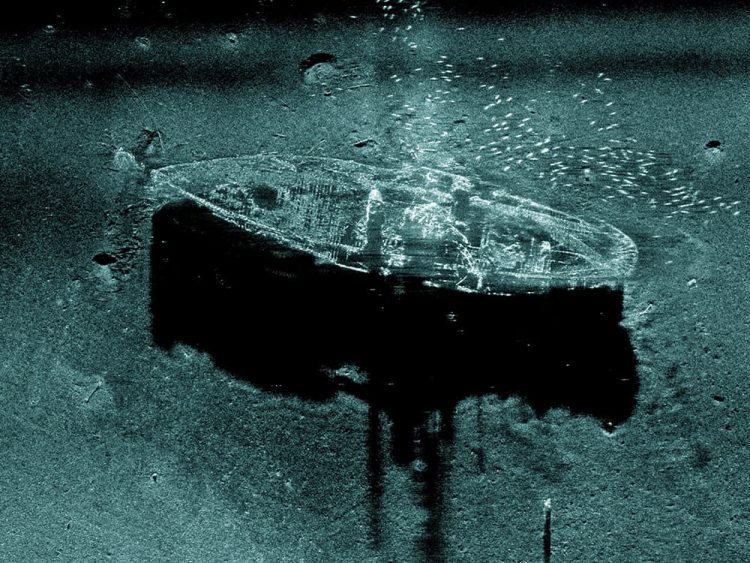
A 3-D digital model of the Portland shipwreck shows that large portions of the bow are draped in fishing nets and lines. Image: WHOI/MITech/SBNMS
Disclosing Locations of Historic Shipwrecks as Part of a Preservation Strategy
The shipwrecks of Stellwagen Bank National Marine Sanctuary have united a variety of stakeholders, from divers and historians to fishermen, over the cause of preserving these irreplaceable historic resources and protecting fishermen and their gear. To accomplish these goals, NOAA is piloting the Shipwreck Avoidance Program (SAP).
Through SAP, NOAA publicized the locations of 11 historic shipwrecks to the public, reversing its previous policy of non-disclosure. In return, NOAA officials request that recreational fishermen voluntarily avoid impacting the designated wrecks with their hook and line gear. During the pilot phase, officials will monitor voluntary compliance to determine SAP’s effectiveness.
Fishing Near Wrecks Can Bring in a Catch at a Cost
Sanctuary archaeologists have located 47 historic shipwrecks in Stellwagen Bank. Historical records indicate that at least 200 more historic and modern vessels that sank within sanctuary boundaries lay somewhere undiscovered beneath the surface.
The wrecks share sanctuary waters with a fleet of recreational and commercial fishing vessels. The National Marine Fisheries Service manages recreational fishing by setting size limits, bag limits, gear restrictions, and prohibiting fishing in certain areas of the sanctuary at different times of the year.
Recreational fishermen have found that fishing close to these wrecks can bring in a profitable catch of all sorts of fish that find refuge nearby. But these benefits are countered by risks to their equipment and the site.
Ben Haskell, Deputy Superintendent of the sanctuary and SAP manager, explains that “snagging a wreck or bouncing a jig off the wreck can damage artifacts and the delicate wooden structure. We have observed jigs, lures, and monofilament fishing lines on wrecks.” Haskell also notes that “if expensive gear gets snagged on a wreck, it’s unlikely you’re going to get it back but in trying to retrieve it damage will be done.”
Protecting a Non-Renewable Resource
The shipwrecks are irreplaceable windows into the past, allowing maritime archaeologists such as Dr. Calvin Mires to learn more about New England’s historic fishing industry and maritime cultural landscapes. Mires argued that shipwrecks are “non-renewable resources” because they cannot be replaced once they are destroyed. From a ship’s exterior, archeologists can learn about historical ship building techniques. From the cargo they carried, experts can better understand New England’s 19th-century economy.
Dr. Kirstin Meyer-Kaiser, a marine benthic biologist at Woods Hole Oceanographic Institute and expert in shipwreck ecology, is also in favor of preserving the sanctuary’s wrecks. Meyer-Kaiser explained that the complex structure of an intact shipwreck “increases biodiversity by creating an ideal habitat for larger marine animals such as the frilled anemone and yellow sponge that would otherwise have difficulty settling on the hard-bottomed reefs that cover the sanctuary’s seafloor.” These isolated communities supported by the wrecks are important areas for marine research.
Entangled fishing gear has posed challenges to marine archeologists and biologists. While studying the Portland with a remotely operated underwater vehicle in 2020, Meyer-Kaiser found new ghost gear covering the bow and stern. The Portland steamship is the sanctuary’s most iconic historic wreck and a memorial site for 192 passengers and crew lost in its sinking. She noted that “abandoned equipment makes exploring the wreck more difficult because it blocks off access to different parts of the site.”
Haskell explained that remotely operated vehicles (ROV) used to document the wrecks have also “ingested monofilament lines into the thrusters which can wrap around the propeller and shaft and burn out the thruster or break the shaft seal, causing the ROV thruster to flood.”
In addition to fishermen, other marine sanctuary stakeholders have reasons to protect the wrecks from further damage. Undisturbed wrecks provide other benefits like critical habitat for diverse marine life. Intact wrecks in some of the shallower waters provide exciting destinations for divers to explore.
Shipwrecks are also memorial sites that are resting places for sailors, passengers, and crews who were lost along with their ships.
Shipwreck Management to Encourage Voluntary Compliance
NOAA officials have concluded that a non-regulatory voluntary compliance program like SAP is the best way to balance the need to protect our nation’s maritime heritage with sustaining recreational fishing. Haskell noted “This program gives the fishermen the opportunity to avoid the costs associated with their gear interacting with shipwrecks while protecting these historic resources without the implementation of an added layer of regulation.”
Avoiding important sites has been complicated in the past because wreck locations and their histories were not disclosed to fishermen. Now that some site locations have been disclosed, recreational fishermen are allowed to fish over them; however, damaging these historic artifacts is not permitted.

The future of SAP and the sanctuary’s shipwreck sites are still uncertain. If the program is successful at encouraging voluntary avoidance, NOAA officials will likely disclose the locations of more sites. By working together towards a shared goal, fishermen, regulators, and other stakeholders can preserve these irreplaceable resources while sustaining recreational fishing in sanctuary waters.
For more information on SAP or to report a shipwreck location contact ben.haskell@noaa.gov.
To view a list of the recently disclosed sanctuary shipwreck sites, visit: https://www.fisheries.noaa.gov/resource/map/stellwagen-bank-national-marine-sanctuary-shipwreck-sites
Ariel Silverman is an ocean sustainability journalist and policy volunteer with Stellwagen Bank National Marine Sanctuary. She is currently on a leave of absence from her studies at Harvard University.