
“Have fun at work!” Jerry Malanga shouted at the commuter car rumbling up the North Jersey Coast Line. I laughed until I saw one of the train’s passengers looking forlornly at us loading Captain Gene Quigley’s 36-foot Yellowfin and realized my average Wednesday morning usually found me behind a desk as well.
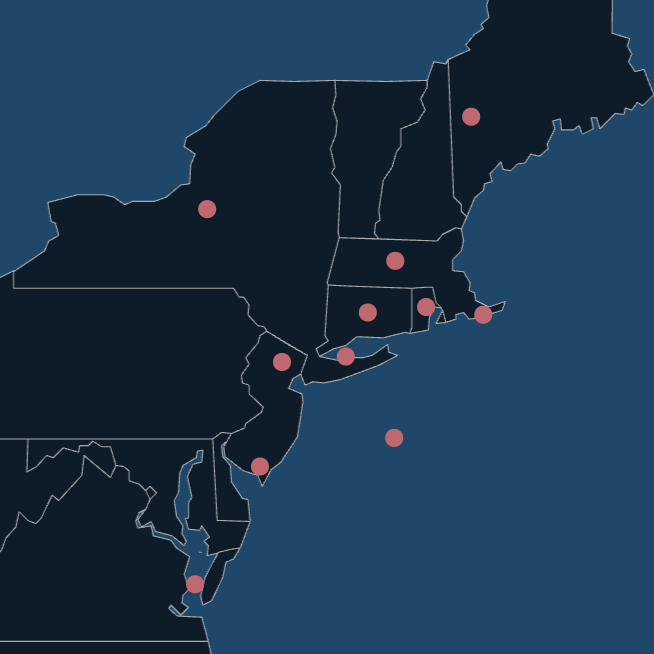
But this wasn’t an average Wednesday morning. This Wednesday morning, I’d be breaking Manasquan Inlet to hunt for the bluefin tuna that pay an annual autumn visit to the New Jersey coast.
(Featured photo by Kyle Arcamano)
Fishermen once called these late-fall bluefin “ghosts.” Captains would see jumping tuna from the corners of their eyes unsure if the light was playing tricks. Confirmed sightings were rare and catches were rarer still, but a dedicated cohort of captains devoted their days in November and December to the pursuit of these fish that would appear without warning and then vanish like smoke.
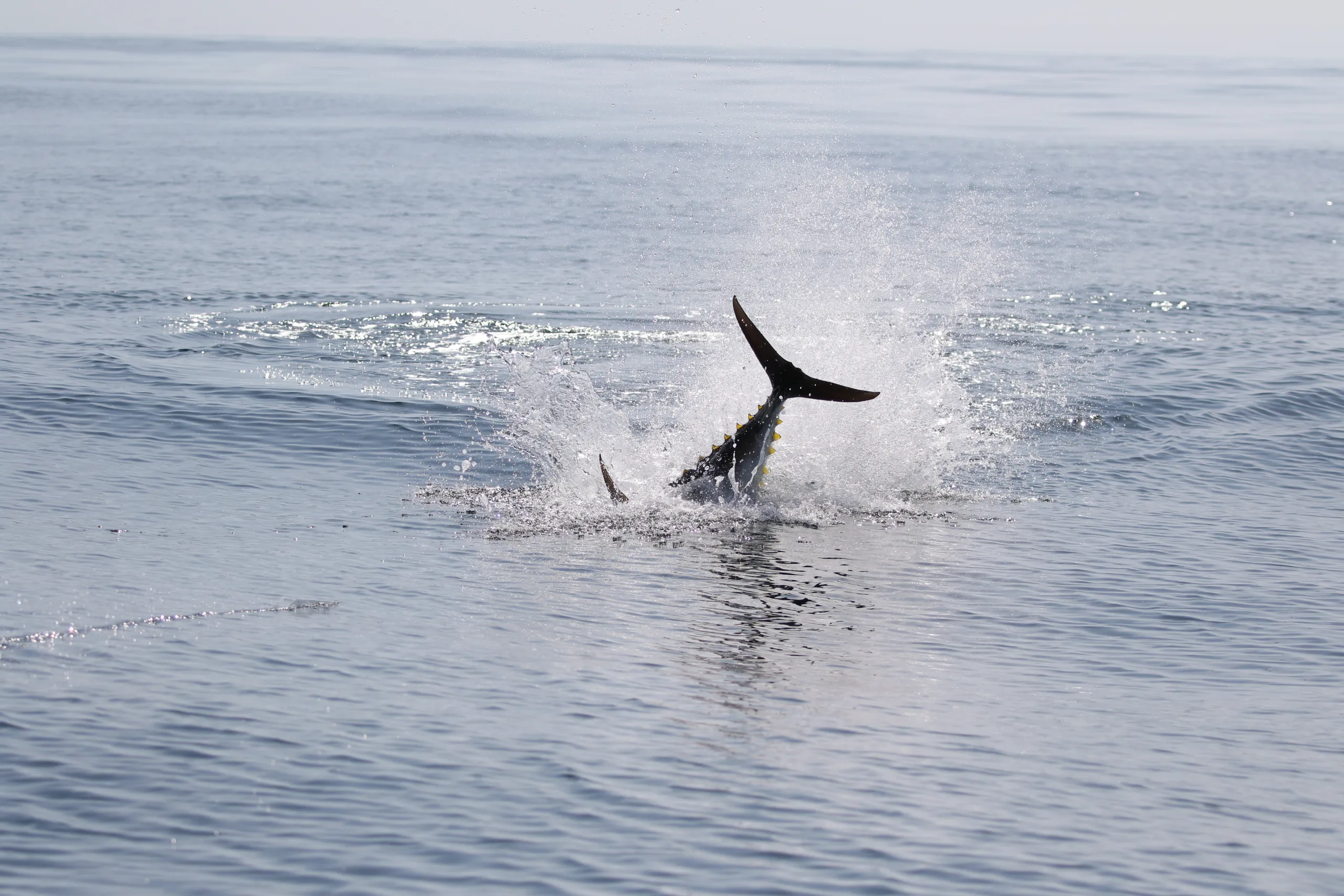
Today, nearshore bluefin are too common for the ghost moniker. Take a boat ride off Ocean or Monmouth County between Halloween and Thanksgiving and you’re likely to see one making a crater in a school of bunker or clearing a path between sand-eel-eating stripers. Even surfcasters spot them and stand there wondering if their reels hold enough line to stop a tuna from the sand.
Captain Gene Quigley has been fishing for bluefin tuna for more than 40 years. He was a part of the spinning rod revolution, when anglers began pursuing tuna with light tackle, and he’s been on the front lines of the more recent arms race to find gear that makes it possible to land 250- to 800-pound fish on spinning tackle.
“Not a lot of people do it,” Gene explained. “Not a lot of people want to do it. You really have to have the drive and the passion to pursue these fish like this.”
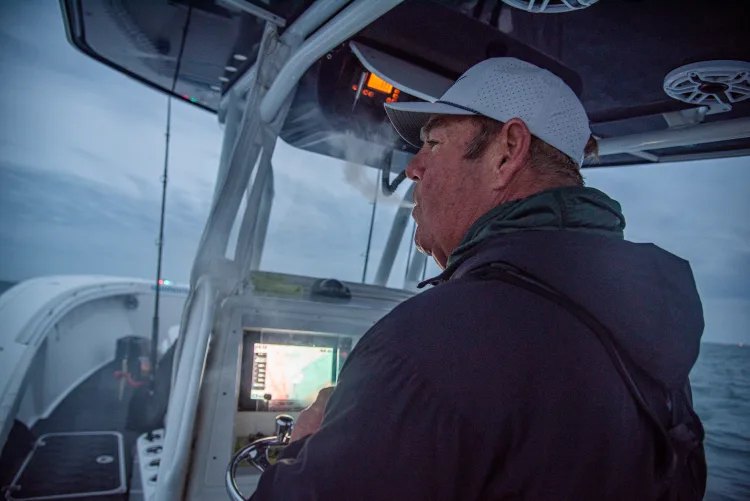
That arms race has found a comfortable, if expensive, spot. By the time the Brielle railroad bridge had reopened, Gene’s boat bristled with high-end Japanese rods, designed to survive high-sticking, and top-of-the-line spinning reels fitted with custom spools and knobs that take them somewhere beyond the top of the line. The lures, however, are the only thing that has become less sophisticated.
One-hundred-dollar custom stickbaits still adorn many rods, but fishermen seem prefer to cast a simple jighead and plastic at the fish. The lifelike profile and supple action of the soft baits draw bites from bluefin of all sizes whether they’re feeding on sand eels or bunker. It also helps that when a fish breaks off—and they often do—it doesn’t dent the wallet quite as deeply.
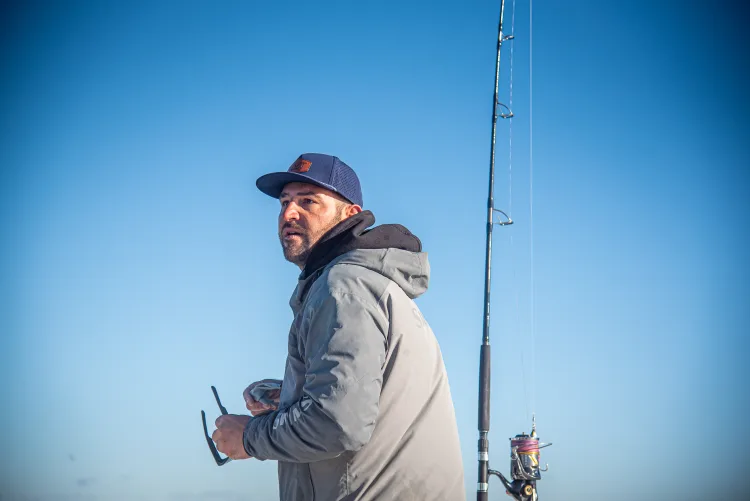
As the giant cement jacks disappeared behind the wake of Gene’s Yamahas, Jerry assumed his position at the bow. Jerry is a captain himself, and a rabid tuna angler, running trips with Gene through Shore Catch Guide Service. As we loaded the boat, Gene had praised Jerry’s ability to spot fish before anyone else on the boat, and I wanted to see if I could spot one first, even though I probably couldn’t. Captains have finely honed instincts about where to look and what to look for that make it nearly impossible to find fish before they do. Once while fishing with Captain Rob Taylor, I puffed up my chest and proudly pointed out a finning white marlin that he’d apparently missed. When Rob reluctantly pulled back the throttles so I could cast, he informed me that he’d already driven past three finning marlin because he didn’t want us getting distracted and reaching the tuna grounds late.
“There they fu—”
The rest of Jerry’s scream was drowned out by the roar of the accelerating outboards as Gene pushed the big center console into the sun and toward the first tuna feed of the day.
“Oh man, they’re nukin’!” Gene shouted as the blitz came into full view.
Blitzing. Foaming. Raging. Nuking. Tuna captains are constantly trying out new and more extreme vocabulary to adequately describe the sight of 300- to 500-pound fish feeding on the surface. Having seen the massive bodies tearing open the water, the scythe of the fins and tails, and the violence in which these finned missiles seem to delight, I’m not sure there is a word to adequately describe that mayhem, but I suppose nukin’ comes close enough.
Gene positioned the boat perfectly to give us the best shot. While I was gawking at the blitz, he swung the boat upwind of the feed, helping to add precious distance to our casts. He also turned us broadside to the fish so that Chris Megan and I could cast side by side and he or Jerry could fire a third volley from the stern.
Even with all that, my first cast fell short. I chalked it up to nerves and put my second one on the mark, onto a patch of ocean that seconds ago contained multiple bluefin tuna and now contained only patches of foam.
“Over there!” Jerry yelled again, and the chase resumed.
This went on for the entire morning, a high-octane game of whack-a-mole, until Chris landed a cast right on the mark. He barely had time to flip the bail and turn the handle before a tuna took. This happens often enough when topwater tuna fishing that captains emphasize the importance of accurate casts. It doesn’t matter how well you work a lure if it lands behind the tuna’s tail and the fish never sees it.
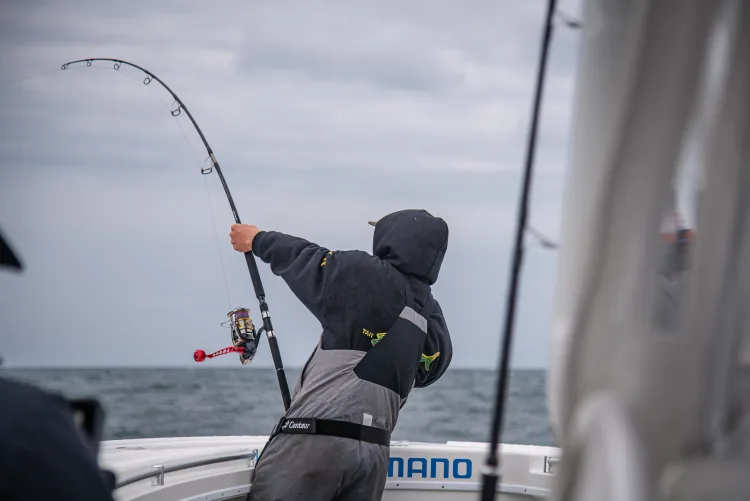
As the bluefin began its long first run, Jerry fitted Chris with a fighting belt. Like everything else in the pursuit of giant tuna on spinning tackle, the belts are more sophisticated. Instead of the standard nylon webbing with a socket for the rod butt, Gene’s belt is a two-piece contraption that leaves a plate over the thighs. This allows the angler to get more of his body into the battle, reducing the fatigue on the arms and back.
While many of the fall tuna off New Jersey are “giants,” the official classification for tuna over 81 inches, the cooling waters and abundant bait have brought a range of sizes inshore in recent seasons. Anglers might find a school of 50-inchers or a pack of 500-pounders, sometimes in the same blitz. As Chris’ fish took a ridiculously long first run, Gene and Jerry determined this fish fell squarely into the giant category.
As Gene steered the Yellowfin in pursuit, he instructed me to put on a fighting belt since Chris was unlikely to land this fish alone. Fights with big tuna often become a relay race among the anglers on board, with the goal of using fresh arms to keep heat on the tuna and prevent it from resting and regaining strength.
When I found the second belt, I discovered it was too tight to cinch. More so than any other species, tuna always find a way to remind me that I failed to keep my promise to hit the gym in the offseason. I loosened the belt, shook out my arms, and waited for my turn.
Chris lasted 20 minutes on his first round before tapping me in. The belt, a Black Magic Equalizer, was a game changer. There was a time when I resisted fighting belts for spinning rod tuna fishing. It was all part of the rebellion against the trolling tradition, back when the pursuit of tuna with spinning tackle put you on the fringes of the fleet. Today it’s much more mainstream, and the notion that a belt would make the catch less macho is laughable.
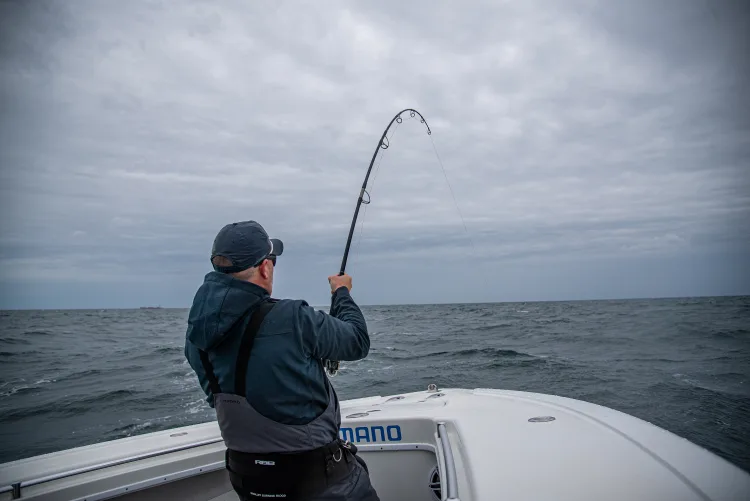
I began gaining on the tuna immediately. I stored line and kept it. I leaned back, nearly parallel to the deck while the rod, belt, and drag worked together to lift the tuna’s head. But tuna have a way of lulling you into a false sense of security, only to snap you out of it with a spool-emptying run just when you think you have them beat.
That’s just what this one did, and soon after, Chris was back on the rod while I rubbed aching arms and guzzled water in the stern. Fifteen minutes later, Chris was flagging again, and as I steeled myself for another round, Gene stepped out from behind the console. A former hockey player and lifeguard, Gene cuts an imposing figure with broad shoulders and a 6-foot, 3-inch frame. When he strapped into the belt and grabbed the top grip of the rod, I almost felt bad for the fish.
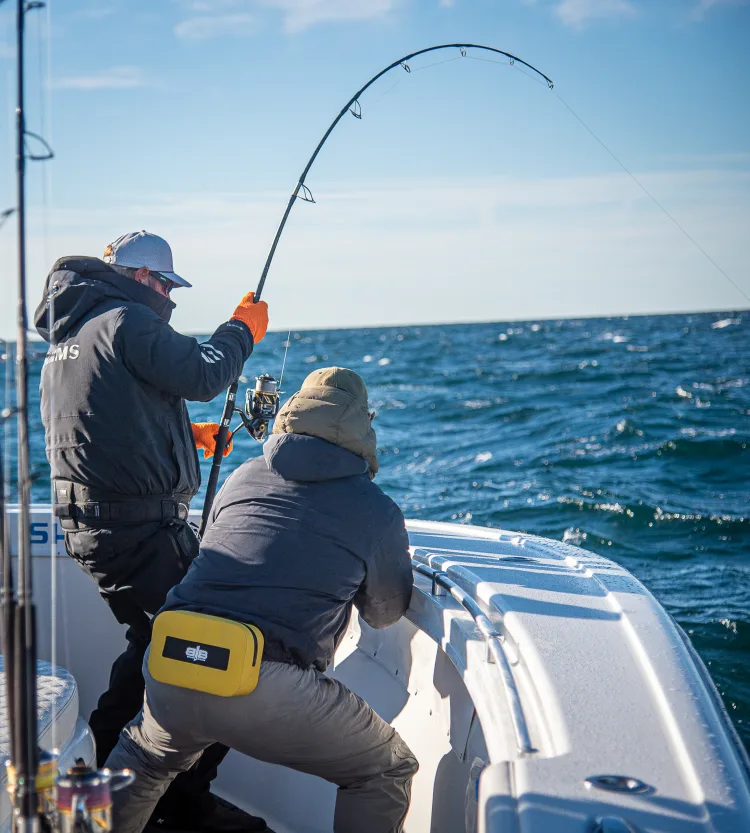
Within 10 minutes of taking over, Gene gave us our first—and what would be our only—look at the tuna. A blue-silver slab appeared in the face of a wave, and the image resolved as the fish approached the surface, and the finer details came into focus. Its great eye, wide and expressionless, held us for a second, showing none of the rage that was in the headshake that threw the jig at the boat.
Gene let out a roar that spooked a school of stripers 100 yards away. He reeled up the slack without a word and began scanning the horizon for more schools of tuna. As far as we’ve come in the pursuit of giant bluefin tuna on spinning tackle, the fish still win most of the time.
The afternoon brought more blitzes, but no more bites. On the way in, we just beat the evening train passing over the Manasquan River, probably carrying some of the same passengers who we’d seen at the start of our morning commute. When the following Wednesday found me back at my desk, my arms still ached.
Watch the Episode:
