
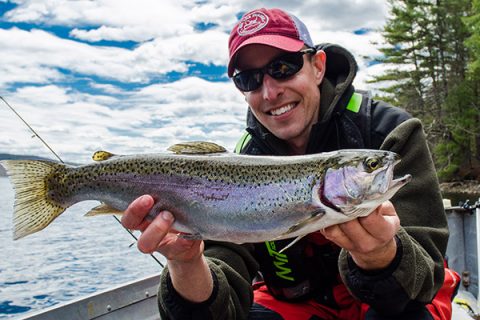
The leaf peepers of autumn may think they have exclusive rights to Mother Nature’s most colorful pageantry, but trout fishermen know better. A brilliant kaleidoscope of colors stirs below the surface of the water in fall and early winter – brookies, rainbows and brownies, ablaze with spawning hues are on the prowl and offer the New England angler a most challenging and rewarding reason to look forward to December.

I used to regard trout fishing as the piscatorial version of preseason football – fun, but nothing to really get worked up about. The real excitement had to do with fish that had stripes and were measured in pounds. And no wonder, the stocked trout that threw themselves at salmon eggs and marshmallows (long before PowerBait) weren’t exactly tackle busters. That all changed about 15 years ago when in late November while soaking a shiner in search of perch or pickerel I hooked what looked like a pink missile that skyrocketed out of the water. It put up with my puny efforts to land it for a while, and I almost had it to shore when it gave a tail slap that broke the leader and left me dripping with water, giving me a new appreciation for these coldwater gamefish.
That last description is key: coldwater gamefish. Largemouth bass descend almost into a stupor as the mercury falls but trout thrive in those conditions, especially wily holdovers that have survived the “fish wars,” and a large number of big trout are caught in late fall/early winter just before ice sets up. The reasons for this are many. First there is the phenomenon of the “turnover.” This is the brief period in early spring and again in late fall or early winter when the surface water temperature reaches 39.2 degrees Fahrenheit. At that point water is at its densest and what some scientists refer to as the “surface zone” sinks into the “deep zone” and warmer, less dense water from the depths rises. This event kicks the trout out from deep lairs, invigorates the fish and makes them easier targets for the shore angler and shallow-water boater alike. Boaters with fishfinders can locate this change in the water column, which may be only a few degrees but is significant. Short of toting along a thermometer, shore fishermen may note a marked change in the clarity of the water or possibly even an unpleasant smell due to the upheaval of detritus from the bottom.

What this means in terms of scales and fins is that the trout of spring that basically did a disappearing act during the summer and early fall, sulking away to deep-water haunts and becoming decidedly finicky, are back bigger than ever and they are hungry. Unlike during the early season when fly-fishermen held a definite advantage as trout keyed in on insects, at this time of the year spin and conventional fishermen rule as the bows and brownies forage for baitfish.
The three components of successful coldwater trouting are temperature, prey and structure. To that list I would like to add an often overlooked factor – the spawning urge, but more on that one later.
While rainbow and brown trout prefer the mercury in the 55- to 65- degree range, trout flourish in much colder climes as well. Nevertheless, one should be cognizant of where on a water body the warmest water can be found. The good news is that this time of the year you can sleep in and not worry about missing out on the bite, since water temperatures and resultant trout activity levels rise during the day, with the most activity often occurring in the evening. Considering that wind direction is often from the north or northwest courtesy of those Alberta clippers, stirred-up, sun-drenched surface water will collect on the southern end of a pond or lake. Factor in the sun setting in the west and the southeast segment of a pond is a good place to start. A boggy, muddy bottom will retain the heat of the sun and will feature water temperatures somewhat warmer than surrounding areas as opposed to a rocky pond bed, which will reflect the sun’s rays. During this time of year a degree or two difference is huge. If you insist on being the first angler at that special spot, you can find warmer water the day after a sustained wind, which will create a parcel of temperate water up against the windward shore that will often last well into the next day.

You don’t have to be all that familiar with a lake to focus on the factors I’ve mentioned so far, but you should also pay attention to shoreline characteristics, which may give insight into what lies below. A shoreline bluff usually indicates a steep drop-off below, fine for summer fishing when trout are deep but not appealing during the big chill. But if a bluff borders a marshy or grassy shoreline it may be promising where the two different slices of structure intersect. A sheltered cove with overhanging trees or brush affords sanctuary to bait and trout and is worth a look-see. Also look for fallen trees or logs; the cover they provide allows predator and prey to go about their business with less trepidation.
Water temperatures are important but don’t mean a thing if there is no forage. At this time of the year the principle forage in most water bodies is pretty small, consisting mainly of panfish fry. Look for small baitfish to be congregating among weed beds and the algae-covered branches of fallen trees or brush. All weed beds are not the same – avoid lily pads since they are most likely dead, not photosynthesizing, not giving off oxygen and probably devoid of life. Coontails are a better choice as is algae clinging to underwater branches or brush. Expect trout to be on the prowl and to be cruising on the edge of this structure picking off wayward victims; if you find all this next to deeper water all the better. Also be on the lookout for an inlet or tributary. These areas are usually shallower than the main water body and their water will heat up more quickly than the pond or lake proper.
Another consideration is the spawning factor. While it is true that few rainbows and browns are able to spawn successfully in New England water bodies, it doesn’t stop the larger ones from trying. I have caught rainbows in early winter that have been swollen with eggs and have landed bows and browns so gaudy during this time of the year they looked like peacocks with scales. This is the reason why one of the better places to find trout in a pond or lake at this time of the year features rubble or gravel close to an inlet or tributary. If the water you’re fishing doesn’t have these attractions, look for culverts or anywhere there is running water.
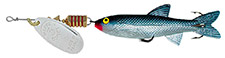
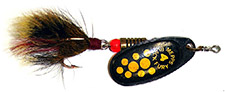

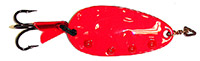
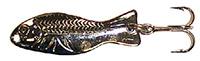

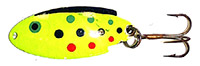

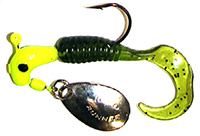

Because the forage is mainly small critters it’s time to downsize. Small spinners, especially those featuring soft-plastic minnows such as the Mepps Comet Mino will work, casting spoons such as the Acme 1/8-ounce Kastmaster and Fish Hawks are trophy- trout tricksters; I’ve always had luck with neon red/gold with those lures. Quarter-ounce Swedish Pimples in copper are a staple in my trout bag as well.
I almost never crank in these lures without a little creativity in the retrieve. Try periodically snapping the rod tip as you bring the lure in and vary the depth of the retrieve to see what works. I also borrow a method that we use successfully for lakers in Wachusett Reservoir, which is to let the spoon flutter to the bottom and then lift it up, repeating the drill until the lure is too shallow to work effectively. This method is prime when retrieving the lure from deep water to shallow, with the majority of hits occurring just as the lure enters the shoal water.
While I, like many other anglers, have been hypnotized by braided lines and have adopted this line for most of my fishing applications, I never use it for trout. Why? Because light leaders are a necessity to dupe a wise old trout and braids with their total lack of stretch offer little insurance against a break off. You will get more hits if you downsize your fishing line. The difference in success between an angler opting for 4-pound-test versus 8- or even 6-pound line is monumental. I recall an encounter that a friend of mine, Carl Hewitt, had at the Stillwater River in West Boylston. The quarry was landlocked salmon, which can be just as easily spooked as any leader-shy trout. Carl was tossing the same lures as a nearby angler and had little to show for it, while the constant “ooohs and aaahs” from next door belied the fact that there was one lucky angler nearby. The difference: the other guy downsized to 2-pound-test line, while Carl had on 4-pound. While I don’t recommend anyone using line that thin because you will break off fish and lose lures, the point is that you will elicit more strikes if you choose lighter line.
Some water bodies consistently give up larger trout than others do. One of my favorites in southern Massachusetts is Plymouth’s Long Pond, where the 100-foot depths, ample bait and a stocking program that allots up to 10,000 stockies a year keeps this place on the short list of big trout producers. Facing the pond from the boat ramp, work the shoreline to your left. This side of the pond is often wind swept and the rapid change in depth in these parts allows fish to make frequent feeding forays into the shallows and then slink back into the sanctuary of the deep stuff. While lures will do the trick, a bait option that works well here is a trolled or drifted shiner. Two colors of leadcore should do the trick or a downrigger with the ball dropped 10 feet down. Rig the shiner with a sliding two-hook rig, which is composed of a single through the lips and a treble through the dorsal. You can fashion one yourself or pick them up at any well-stocked tackle shop.
Elsewhere in the Bay State, Jamaica Pond in the heart of the Hub is a sleeper to all but those that fish it consistently. Locals have been catching big trout out of this pond for years. Spring fed, deep and clean, in late fall schools of big brown trout can often be seen foraging around the points hunting down yellow perch and taking an occasional crayfish. This pond, the only one in Boston that is stocked, has given up the largest brown trout for the Massachusetts Sportfishing Awards Program on more than one occasion. The Jamaicaway side of the pond by the boathouse is a hot spot. Eight-pound brown trout have been taken here by those soaking dilly worms in December. Perhaps you are a Doubting Thomas? Ask Christina who tends the boathouse if you can take a peek at the photos of some of the brownies that have been caught in “JP.” You may be reminded of some of the storied waters of upper New York State until the drone of Beantown traffic snaps you into reality.
Walden Pond in Concord can be one crowded pond, but use drops off dramatically come late fall and early winter. Erudite anglers know that the drop in fishing pressure translates to less-harried fish. This pond has smelt and there is no better calorie-rich bait source to help fatten up the resident trout population. Every year trophy rainbows and brown trout are taken in Walden and this is the time to do it. In the late afternoon, cast a spinner/inline-minnow lure into the cove by the boat launch. An effective bait choice is a mealworm under a float bubble. A slow drag of the bubble will deliver more strikes than a “set it and forget it” strategy.
The wildcard is Wachusett Reservoir, where the most colorful rainbows I’ve ever seen reside. Little wonder as to why, after all this is where many of us get our drinking water. Try Gate 8 in Boylston, soak a small shiner at the edge of the drop-off. Rainbows prowl this corridor looking for chubs, smelt, yellow and white perch fry. Keep an eye on the cove to the right, as you’ll occasionally see mini blitzes as bows corral bait in the shoal water. A gold/red Kastmaster or gold/orange Krocodile has been the undoing of many a big bow here. The curtain closes on Wachusett come November 30, but that’s OK because you can still fish major parts of the Stillwater and Quinapoxett tributaries – a good plan considering the state record rainbow trout came out of the former.
Just remember u can only fish the quinipoxet upstream of the oakdale dam after wachusett closes u nant fish the quinipoxet tribtaries but u can fish the stillwater basin upstream of the railroad bridge