

For years, offshore fishing was strictly the realm of big sportfishing machines equipped with twin diesels, huge cockpits and staterooms for overnight stays. But these days, thanks to developments in fuel efficiency and boat construction, offshore fishing is now within reach of most outboard center consoles. There are some obvious differences between fishing offshore in a 25- to 35-foot center console and fishing in a 40-plus-foot sportfisherman, but with the right planning, those differences don’t have to be a disadvantage.
In our fleet, we came face-to-face with these differences when we added a 32-foot Regulator to join our 48-foot Viking and 60-foot Ritchie Howell. It’s interesting to fish one day with outboards and the next day with big diesels, and the adjustments we’re forced to make day-to-day have taught us a number of tips and tricks. Once you acknowledge the differences between the two approaches, fishing the canyons in a 32-foot center console with twin 350 hp Yamahas can be just as productive as fishing on a 60-foot Ritchie Howell with twin 1015 hp diesels.
Can You Do It?
The first step to getting offshore is determining if your boat is truly capable of getting where you need to go. The number-one question you have to ask yourself is: Does my boat have the fuel capacity to make the round-trip run? The standard rule of thumb is to figure that the maximum distance you can travel would burn a third of the fuel supply on the way out to the grounds, leaving a third for the way home and a third in reserve. Following this guideline will ensure there is enough fuel to accommodate potential changes in the weather that could slow you down enough to drastically increase fuel burn. Today’s offshore saltwater engines are built to efficiently push boats faster and farther offshore. The 350 hp engines on our 32-foot Regulator will burn approximately 32 gallons per hour at 38 knots, so our range can pretty much take us anywhere we need to go while having plenty of fuel in reserve. Make sure your boat’s capacity is similarly up to the task before you even consider making that long run.
Safety and Electronics
The next step is to equip your boat with all necessary safety equipment and electronics. Do not cut corners when it comes to safety! Any boat fishing the offshore canyons should be equipped with a life raft, an EPIRB, flares, survival suits, a satellite phone, life preservers, a basic first-aid kit, a sea anchor and a basic toolkit. Make sure all safety equipment is up-to-date and serviced annually.
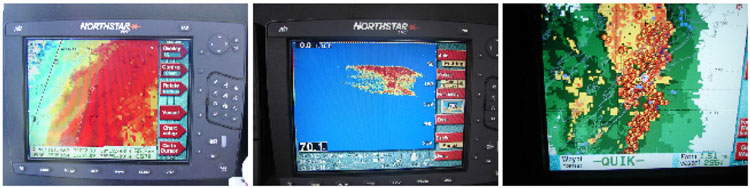
In addition, we recommend bringing two GPS units, two VHF radios and a fishfinder; we use the Northstar 6100i with the 491 sounder and radar, as well as a Simrad Autopilot for long 80-plus mile runs. One of the most important applications Northstar has mastered is their ocean temperature data that overlays their GPS charts. Water temperature is the number-one variable we’ll look to when trying to home in on a hot bite, and having this information at our fingertips has added tremendously to our catch totals while offshore.
Finally, make sure all your electronics are serviced annually and are operating properly before heading offshore. It’s wise to conduct a safety briefing before leaving the dock to ensure all onboard know where the safety equipment and electronics are located and how to use them.
Tackle and Storage

Organization will make your life a great deal easier when fishing your smaller boat offshore. We avoid a cluttered helm station by installing suction cups to the bottom of our satellite phone and rigging boxes. Safety equipment and gear is neatly stowed in waterproof bags. Livewells double as drink coolers and spreader bar storage. We bleed tuna on deck to avoid depleting our ice supply and carry a fish bag in case we boat a trophy bluefin, big-eye or swordfish. Utilize all the space under the gunwale to store your gaff, harpoon and boat hook. Limit your tackle to what you’ll need, but spend every waking moment (especially in the off-season) thinking of new ways to get more equipment on the boat without hampering its fishability.
Comfort Matters
Making your center console comfortable will not only make the trip more enjoyable, it can actually improve your fishing. The extra energy you’ll get from a relaxing ride to the offshore grounds will add to your production, and you won’t have guys nodding off on the troll or chunk. Everyone needs to be at their best when it comes to crunch time, and when you get to the edge, you’ll want everyone well rested and fully functional.
We use wrap-around curtains throughout the season both to block the wind when traveling at high speeds and to keep the crew dry and warm. Marine beanbag chairs positioned at the stern corners allow your crew to get off their feet and relax as you travel to and from the offshore grounds. Don’t forget to don rain gear and dress in layered clothing to stay dry, warm and refreshed so you are on your game as soon as the throttles are pulled back.
Worship the Weather!
Weather is undoubtedly the most important factor when deciding when to head offshore on any boat, but it is even more important if you are going out on a smaller center console. Small-boat fishermen need to pay close attention to weather patterns, wind direction and potential changes. The key is to avoid fishing “weather windows” where there may only be 12 to 24 hours of good weather. Look for three straight days of nice weather, and fish the middle day when at all possible. With the advent of satellite weather forecasts that can be downloaded directly to your electronics, there is no excuse for getting caught off-guard by bad conditions.
Making the Run
Today’s offshore center console boats are built for speed, so you should use it when running offshore. We’ve found that when we get on the troll before dawn on our overnight trips, we rarely put a good catch together before 8:00 a.m. The majority of our bites come an hour after sunrise, so if you’re running offshore for just a day troll, we recommend that you not even attempt to get to the edge at first light. If you do, you’ll be running slow in the dark and tiring out before you get there.
Instead of leaving at 1:00 a.m. as we usually do with our big boats, when we are running our center console offshore, we plan on leaving the dock an hour or two before sunrise. This allows us to jog in the dark for just a short time and then use our speed to arrive at the edge by 7:00 a.m.

Once we are within 15 miles of the canyon, we check our temperature gauge for breaks and scan the water for birds, whales, porpoises, rips and slicks, and we’ll stop to investigate any “fishy” signs that might indicate bait or game fish in the area. Our speed allows us to check over the “inshore” grounds that other boats have passed over during the night and still spend time trolling the canyons in the afternoon. Many times in the past we’ve run over fish in the morning in an attempt to get to 100 fathoms at first light, only to come inshore later in the day and find the bait and pelagics stacked up in 40 to 50 fathoms. We don’t make this mistake anymore.
Troll Big or Go Home

Over the years, we have been able to produce on the troll in our center console by maximizing every bite. That means trolling the largest spread possible and making the most of every opportunity. From our large boats, we’re able to troll a pattern of 11 to 13 rods, and because we believe that less than 7 baits in the water is a waste of time, we strive to troll a minimum of 9 rods from our 32-foot Regulator. If conditions are right, we’ll put out as many as 11 rods.
Selecting the right outriggers is the most effective way to troll big. On our big boats we have the luxury of putting out Rupp double and triple spreader riggers. On the Regulator, we use Lee’s carbon fiber outriggers. These riggers provide a lightweight application with significant strength and little flexing, allowing us to spread out our pattern without adding that much weight to the boat. This is important, particularly above the waterline where adding weight can reduce stability.
From our riggers, we deploy our Canyon Runner spreader bars. Spreader bars are an absolute must-have in any canyon trolling pattern, but even more so when fishing from smaller vessels. One rod transforms into 10 or 12 baits when it is pulling a spreader bar, and this is the number-one way to enhance your presentation and make your small boat troll big. You can create a ton of commotion by trolling up to four spreader bars from a dual outrigger system, but it’s just as productive to troll two from the tip riggers and add daisy chains or ballyhoo from the short riggers.
One of the most successful rods in our large-boat pattern often comes off the center rigger, and we’ve gone ahead and added one to the Regulator – again, a Lee’s carbon fiber rigger. Center riggers are essential to effectively fish a spreader bar down the middle, and some days they are the source of our only bites. If you don’t have one installed or don’t want to make the expenditure, use a gaff or spare rod with an outrigger clip on the tip and put it into your hardtop rocket launcher to elevate your center offering.
Not only do you need a large trolling pattern to maximize each bite, but you should also position your baits/lures in a tight pattern, within 8 to 10 feet of each other, with only one lure trolled long down the middle. History has taught us that we might drive over only one or two hungry schools of fish a day; if a few fish come up to feed and one grabs the first bait/lure it sees, having two or three other baits/lures in close proximity will give the rest of the fish something to jump on. These large and tight patterns provide plenty of options in the immediate area for other fish in the school, leading to multiple hook-ups.
But remember, you can’t just throw out your lures and let them sit randomly in your wake. Position each bait/lure in a clear pocket of water and consistently adjust them to make sure the bars and swivels are out of the water. If you cannot see the bait, chances are that the hungry fish will not be able to locate the offerings either, so maintain constant vigilance to keep your lures in the sweet spots.
Work the Bite

Finally you have your boat rigged and ready to go, you are on the edge, your pattern is out, you’ve run over the fish and gotten your bite – what’s next? Most crews are so wired up to get the fish in the boat that they immediately grab the rod and start fighting the fish. But that’s most crews – not the 10 percent that catch 90 percent of the fish. Instead, these successful crews continuously work the bite.
Once a rod goes off, our crew springs into action by either jigging a flat-line lure or reeling in a spreader bar. We don’t go anywhere near the fish that first hooked up. A short-bit skirted ballyhoo is useless when left tracking straight, but it can be deadly when jigged. This movement mimics a fleeing or injured baitfish, which entices other fish to feed. At the same time, we’re careful to maintain our speed, as it is our belief that the direction and speed of the troll is what enticed the fish to bite in the first place. We continue trolling with the same speed and direction until nearly two-thirds of the spool has disappeared, all the while jigging and working other rods in the pattern until we pull back to fight what is hopefully multiple hook-ups.
Way too often I hear folks with center consoles complain that having several rods in the pattern is too hard to handle and they don’t have big enough crews to fight four or five fish at the same time. Well, if there is only one thing you take from this article, know that it’s crucial to fish big, even if you’re fishing with a crew of only two or three. Be equipped to go where the big boats go and fish side-by-side with them all day. Break out your nine-rod pattern, and don’t pull back on the throttles until you have more than one fish on. There is no reason why your center console can’t outfish the bigger boats on a consistent basis – and with a 40-knot cruise on the way home, you’ll have plenty more time at the dock to celebrate.
Hi, ive been reading your mag. on/off for a few yrs. I do enjoy it & read the articles for any tips i may use when fishing by shore or @ sea. I am a weekend fisherman & do not understand some of your terms, lingos in some articles. Is there any way you can highlight some words so when i touch it i will then get a brief definition on that word/phrase ? Im sure theres many greenbloods like me who would be thankful. Thanx for the good reads and FISH ON !!
I go about 30 miles out from New Hampshire to Jeffrey’s Ledge with my 18 foot center console “Parker”. It has a 40 gal. tank and I use about 18 to 20 gal. for round trip w/ 115 hp Yamaha. In the article “Troll Big or Go Home” NOAA regulations for recreational fishing in federal waters “you can only have one line ( rod) per person with as many hooks as you desire.” This has been only my second year to venture out to federal waters. I really enjoy it (when I don’t get sea sick) and I am eager to learn more about fishing for the big game fish.
I have a 1980 21 mako great condition ,200 evinrude .Safety wise what do you guys think on its offshore capability? And I don’t mean canyon runs!
If the evinrude starts don’t shut it off until you’re home enjoy the trip. Wish I was with you.
2015 will be my third year to fish federal waters. I sent for a HMS permit and I am trying to learn all the regulations for recreational rod & reel fishing. I’ve never caught a tuna or shark so I purchased identification charts so I can learn the different types and what is legal. There is so much I have to learn, WOW. OH, am I correct that we can not keep COD this year ??
come guys ….come and fish with us offshore in the Bahamas. When you are ready to come over let me know…
what kind of fishing we talking about let me know. thanks.
big game fish including Tunas you name it we have it here
What does it cost for a trip with you?