


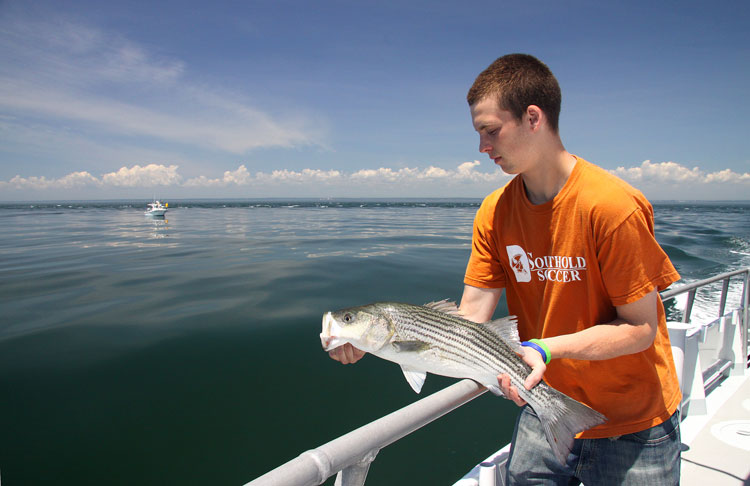
Captain Rob Spitzenberg broke into a grin as he held a keeper striped bass aloft in the shadow of Orient Point lighthouse, known locally as “The Coffee Pot.”
“The real monsters, cows that may top forty pounds, won’t be here for a while yet,” said Spitzenberg while removing a large white bucktail from the fish’s jaw, “but there sure are plenty of schoolies to enjoy and these are the perfect size for taking home.”
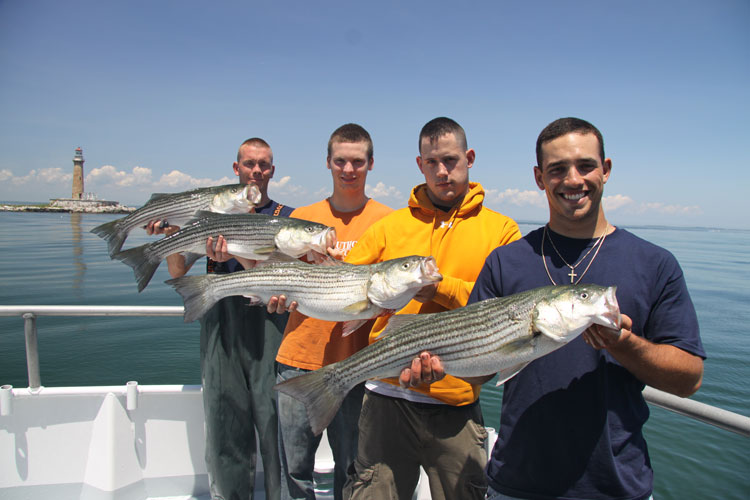
Indeed, the chunky 12-pounder was part of a limit catch of linesiders caught last spring as May rounded into June aboard the Greenport open boat Peconic Star Express. In a flurry of action that peaked with the top of the ebb, every angler on board hooked-up at least once during a half-hour span that saw a mix of shorts and keepers to about 15 pounds. It was striper fishing at its early-season best and it was happening under sunny skies with anglers wearing t-shirts and light sweatshirts. What a pleasure it was to hook-up on a daytime shift with a warm spring breeze and, later, a westward drive home that found the sun still high in the sky and fresh fillets on ice in my cooler.
North Fork Bass
“You’ve got to love this place when it comes to spring bass fishing,” said Spitzenberg as he set up for another drift in the hard-pushing waters slightly east of the lighthouse. “People talk about stripers at Montauk all the time, and the South Shore and western Long Island Sound see some great catches when the fish are on bunker, but the spring action at Orient Point, Plum Gut. The Race and the Sluiceway can really be sweet during May and June, and it’s also usually very consistent.”
Indeed, the stripers do set up well each spring in the roiled waters that roar through these hallowed bassing grounds, plus many lesser-known smaller rips found between Orient Point and Fishers Island. During May and early June, when the spring action is at its peak, linesiders migrating up the coast from their wintering grounds off North Carolina, along with some fish from the Hudson River stock, are drawn to the area by a combination of rocky and varied bottom, the confluence of currents from Long Island Sound and Block Island Sound, plus plenty of bait trying to push into calmer, more shallow water along the Long Island and Connecticut coasts. The entire combination makes the predators extremely aggressive.
“These fish want to eat when they first arrive,” explained Captain Phil Kess, who runs the Orient Point charter boat Fishy Business out of Orient By The Sea Marina. “They come here chasing squid, alewives, bunker and assorted smaller baitfish. As more and more bass arrive, they get really worked up seeing their quarry struggle in the powerful currents. It makes for some pretty impressive action. You don’t have to beg the bass to feed here, that’s for sure.”
Spitzenberg agrees with that assessment, noting also that during the spring season the bass are just as prone to feed during daylight hours as they are to feed after dark. “All you need is moving water in the spring,” he noted, “and the bass should respond. It doesn’t really matter if the tide is ebbing or flooding. As long as the current is bossing those baitfish around, the stripers will come alive. The key is all in the speed of the moving water. You need two to two-and-a-half knots of current to kick the action into high gear.”
Although some private boaters and a few of the local charter boats specialize in chasing stripers and blues on light tackle or even with the long wand, the majority of this fishing is done with stiff rods, strong 4/0 conventional reels and 40- to 60-pound-test lines. That’s a concession to the possibility of big fish, but more a reflection of dealing with the heavy currents, weighty sinkers and generally deep water where the best of the action takes place. Most skippers prefer bucktails for working the stripers here once the tide begins to push. During slack water, and on the slower beginning and end stages of the tide, diamond jigging can also be very effective.
Break out the Big Sticks
There is a perception among many anglers that bucktailing for bass at Orient Point is difficult and requires a lot of experience to get just right. While veteran bassers do have an edge, that’s the case just about anywhere you fish along the striper coast, and despite the heavy gear used here, most anglers can figure out the basics in a couple of drifts – especially with the help of a sharp charter or open-boat skipper and crew to guide you along. Sure, the rigging is a little different than “up Island,” where anglers target stripers in shallower water with less current, and the tackle is heavier and the bottom is strewn with boulders that want to eat your bucktails as much as the bass do, but don’t make more of all that than necessary. Stick with the standard set-up, follow your crew’s instructions and be ready to strike at the slightest bump. Stay focused and limit catches should be the rule rather than the exception.

Orient Point bucktailing begins with a standard three-way-rig. Start by tying a 50-pound-class three-way swivel to the end of your main line via a clinch knot. Attach a 3-foot length of 50- to 60-pound-test monofilament to the bottom eye and finish that line with an end loop large enough to accommodate an 8- to 12-ounce bank or diamond sinker. To the middle swivel eye, tie a 5- to 8-foot length of 100- to 150-pound-test monofilament leader material and add your bucktail.
“The leader length for the bucktail depends mostly on the current strength,” explained Kess. “The harder the tide is pushing, the longer you’ll want to make the leader. The long leader helps keep the lure away from the sinker, allowing it to maintain good action, and it provides the fish an extra second to react once the sinker comes past on the drift. At least that’s how it all works in theory. Choose a size seven-ought bucktail that weighs three-quarter to one-and-a-quarter ounces and tip it with a standard five-inch strip of pork rind.”
As a rule, you’ll want to use light-colored bucktails during the day and darker tones after sunset. The same holds for the pork rind trailer. White and chartreuse are the standard daytime offerings, while black, blue and maroon work well on the graveyard shift. With any of these combinations, you’ll want to get your line all the way to the bottom¸ then crank up five to seven turns of the reel handle to keep the leadhead out of the rocks. Most Orient Point regulars fish with braided lines, adding an 8-foot shock leader of abrasion-resistant mono ahead of the leader.
Keep it Steady
“The bottom out here is very hilly,” explained Spitzenberg, “so you’ll really need to pay attention when working bucktails. Usually, the boat will work up a slope, so you’ll feel your sinker touching bottom every few seconds. Each time it hits bottom, crank up three to five turns of the reel handle to keep your rig from snagging.”
As the boat drifts over the top of a hump, you’ll need to reverse the process. If you don’t feel bottom for more than a minute or two, let out enough line to tap the sea floor and then re-engage your reel. Keep letting out and re-engaging as your rig works back down the slope. Since the fish can be found in anywhere from 30- to 160-foot depths, you really need to stay on top of this.

Anglers everywhere are taught that varying the retrieve and adding plenty of action to their lures is a trigger to predatory fish strikes. That may be the case most places, but here you’ll do best if you simply concentrate on feeling for the bottom and keeping your lure moving along at a smooth and steady pace. In other words, there is no reason to add an exaggerated jigging motion to the process. With the boat rocking and rolling in the strong currents here, your lure will show plenty of life as it glides above the sea floor just out of reach of the snaggy bottom.
Although some days the fish simply crush the bucktails, most trips find hits registering as a simple “bump.” Because there is a slight learning curve to consistently distinguishing between a strike and the rough, varied bottom, you’ll want to set the hook anytime you feel anything that is out of the ordinary. Strike hard and get your rod tip up high right off the bat to help turn your trophy away from the snags.
Diamonds also Shine Bright
The bucktails seem to lose their luster just a bit when the current slows below two knots, so that’s when anglers here turn to tubeless diamond jigs. Lowered to the bottom, cranked up ten turns, then lowered again, these slender slabs can keep you catching when the bucktail bite begins to wane. As when using the leadheads, you’ll want to stick with heavy gear. It takes a diamond jig weighing 4 to 6 ounces to effectively stay close to the bottom in most of the deeper spots.
“We had a blast with the diamonds last spring,” recalled Spitzenberg of a steady run of bass that lasted nearly six weeks between May and June. “We would hammer the stripers on the bucktails, then switch to the diamonds as the current began to slow. It was a lot of fun for our anglers to be able to catch keepers using the different techniques.”
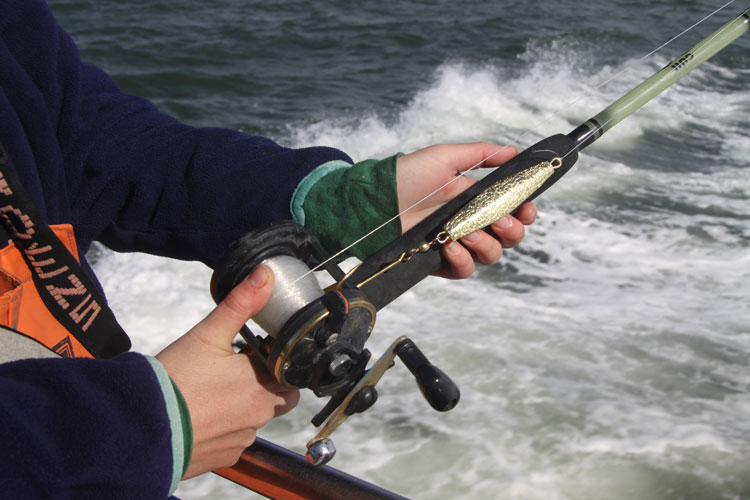
Silver is the favored diamond jig color along the striper coast, but last year gold actually reigned supreme around Orient Point. Anglers using jigs with broken or scaled patterns also seemed to score a little better than those using diamonds with a smooth finish. Perhaps the broken patterns did a better job of mimicking the larger baitfish in the waters here as opposed to the sand eels, anchovies, spearing and various “rain baits” that predominate in Long Island’s more western quadrants. It’s probably a good idea to bring a few of both jig styles and colors along just in case.
The Time is Now
Of course, no one can promise that the bass will arrive on time and in the numbers anglers hope to see, but the spring striper fishing at Orient Point has been amazingly consistent over the past several years, so any date during May and early June should be fine. Still, it’s always a good idea to get out as soon as reports of solid catches begin to filter in because there are no guarantees that the bait will hang around long enough to keep the bass tightly concentrated. It’s also a good idea to hit this run early because May sees most of the big bluefish in the area packed into Peconic Bay chasing bunker schools. That means, most years, you can have two or maybe even three weeks of catching the stripers almost exclusively without worrying about being cut off by a big-headed hungry chopper.
Because these waters can be treacherous for small boaters, especially when the tide stands against the wind, private boaters need to be extremely cautious here. This is especially true on your initial few trips. Don’t even think of fishing night tides here on your own boat until you’ve given the area a thorough once-over during the day. In fact, it’s a good idea even for experienced skippers to head out on a charter or party boat that fishes this area to get acquainted with these rocky and often turbulent waters before trying it alone.
Also, make sure to choose your days carefully whenever you head out to Orient Point for spring bass, opting for warming and gentle breezes over stiff, cool winds. Remember, this is spring fishing and the bass are hungry already. You don’t need a nor’easter to light them up.
I am really looking forward to a spring stripper fishing trip on the Peconic Star Express. I would like to know when your season starts. looking forward to go out early May mid June.