
FERDINAND, VT – Vermont Fish & Wildlife Department and Trout Unlimited recently kicked off work on a cooperative, multi-year stream restoration project in the Paul Stream watershed aimed at improving riverine habitat and boosting native brook trout populations.
The project, which will consist largely of strategic woody habitat additions to six individual streams, as well as stream crossing replacements, will ultimately result in over 6 miles of restored habitat.
“Similar to the adjacent Nulhegan River watershed, the Paul Stream watershed suffers from problems caused by the log drives of the late 1800’s, and repeated clear cutting cycles through the 20th century,” said Joe Norton, project manager with Trout Unlimited. “Based on the similarities of the two watersheds and early success we’ve seen from habitat work in the Nulhegan River watershed, we’re optimistic that we can restore various sections of stream in the Paul Stream watershed that are critical to supporting brook trout and other native species.”
Vermont Fish & Wildlife and Trout Unlimited identified the Paul Stream watershed project after examining its likeness to the Nulhegan River watershed, and reviewing results from a study implemented to determine factors limiting native brook trout abundance in northeastern Vermont.
“The study found that water temperature and instream woody habitat were the two most important factors affecting brook trout abundance in this area,” said Jud Kratzer, fisheries biologist with Vermont Fish & Wildlife.
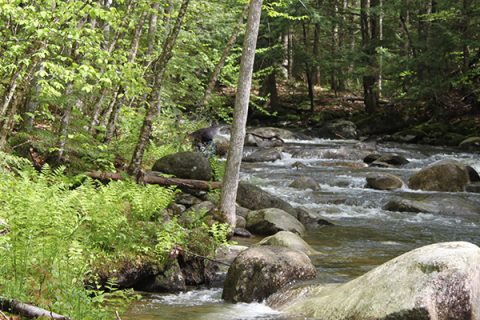
In response to these findings, Vermont Fish & Wildlife and Trout Unlimited, with support from Plum Creek Timber Company and the U.S. Fish & Wildlife Service, and grants from The Upper Connecticut River Mitigation & Enhancement Fund, have begun the strategic habitat additions using chain saws and a grip hoist to place large woody material into the various stream sections.
“Our innovative use of a grip hoist, which is like a come-along on steroids, allows us to strategically position trees where they can do the most good,” said Kratzer. “This process increases the stability of added structures, creates better fish habitat and more positively influences the stream channel.”
In addition to felled trees, root wads are also being added to the streams to create improved habitat in select locations of the watershed. Paul Stream, North Branch Paul Stream and Madison Brook are slated for habitat restoration over the next few years. Work in Granby Stream, Fitch Brook and Stony Brook is planned for the future.
Paul Stream empties into the Connecticut River in Brunswick, Vermont. The project will benefit fish that are residents in the Paul Stream watershed, as well as trout that come upstream from the Connecticut River.
“The project is a continuation of other stream restoration projects we’ve worked on with Vermont Fish & Wildlife in recent years,” said Norton. “This has been a strong partnership and one that we think will pay dividends for Vermont’s streams for years to come.”
To learn more about Vermont Fish & Wildlife’s fisheries management programs and fishing in Vermont, visit http://www.vtfishandwildlife.com. For more information on the work of Trout Unlimited, visit http://www.tu.org/.