
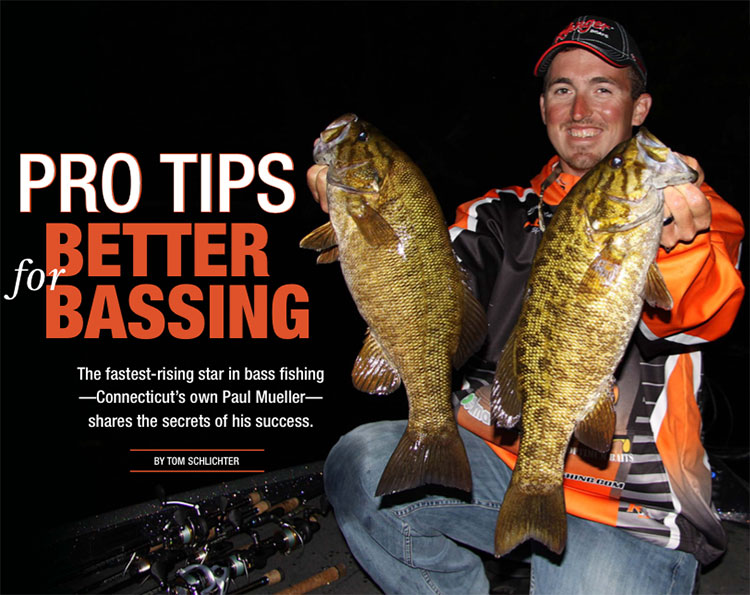
The fastest-rising star in bass fishing – Connecticut’s own Paul Mueller – shares the secrets of his success.
Quick, name a current bass pro who was raised and still lives somewhere between New Jersey and New England and has at least one top-three finish at the Bassmaster Classic.
Now, let me guess: You said Mike Iaconelli—if you were even able to come up with a name at all, right? No doubt this legendary pro, still only 43 years old, heads the list.
While Iaconelli is well known for good reason—he won the Classic in 2003 and took second in 2009, among other tournament exploits—there is another name on the list: Connecticut guide and bass pro Paul Mueller.

With just two-and-a-half years on the professional tour, this relative newcomer to the national circuit has done amazingly well. Last spring, he finished second at the 2014 GEICO Bassmaster Classic on Lake Guntersville in Birmingham, Alabama. During that contest, the 30-year-old bass maven broke the all-time record for the heaviest single-day, five-fish Bassmaster stringer weighing a remarkable 32 pounds, 3 ounces. This November, he qualified for another trip to the big game by winning the Old Milwaukee B.A.S.S. Nation Championship on the Ouachita River in Monroe, Louisiana. As with the Classic, Mueller needed a huge catch to claw his way up the leader board, and he did it with a final-day stringer that tallied a solid 14 pounds, 9 ounces.
“There’s a lot of hard work, time on the water and learning though experience—both good and bad—that goes into being successful at this level,” says the humble but increasingly confident Mueller, who lists “a little guidance from above”, along with support from his wife, Kimber, as two of the primary reasons for his rise to the top. “You have to keep an open mind about things. Some of my worst days, in fact, have taught me the most, so focus on learning from all of your experiences.”
From understanding line choices to figuring out where to fish in windy weather, Mueller ticked off a bunch of interesting examples of how bass anglers can improve their game as we picked away at bronzebacks up to 4.5 pounds in 25 knot gusts last October. Here are a few points he considered most important for increasing success on a year-round basis.
LINE UP FOR SUCCESS
One area Mueller is absolutely convinced most anglers can improve upon is in understanding lines and how the differing characteristics of braids, fluorocarbons and copolymers are best matched to specific techniques.
“Consider braided line, for example,” explains Mueller. “I use it 90% of the time with my spinning outfits as well as my bait-casting gear. Sure, it’s important that it casts far, but more vital is that it excels with finesse- style swim baits and presentations requiring maximum feel. Because of their low-stretch qualities, these lines have superior sensitivity. That makes them perfect when a light touch is part of the equation, but they must be matched to rods that aren’t too stiff. With the lack of stretch, you’ll pull the hook out of some big fish and straighten it on others during the course of heated battle.”
Mueller favors 15-pound test Gamma Torque Braid with an 8-pound-test Gamma Edge fluorocarbon leader for most spinning applications, but he’ll drop down to 10-pound-test braid and a 6-pound-test leader under very clear conditions or when fishing light- weight drop-shot rigs and 1/8-ounce hair jigs. He also likes a long leader (10 to 15 feet in length) attached to the braid’s main line by an easy-to-tie double uni-knot.
“With the super feel and low stretch of braided lines you’ll get real solid hooksets in deep water,” notes Mueller. “I also like that braid is very manageable. It doesn’t have the line twists, wind tangles or memory of monofilament, and one spool lasts a really long time so it saves you money if you keep changing only the leader.”
Fluorocarbon lines also play a significant role in Mueller’s bassing arsenal. They are by far his favorite choice with crankbaits, jerkbaits and any lure he needs to get deep. Many anglers like the low-visibility factor with this line, he notes, but the choice is really about line diameter and the ability of fluorocarbon to quickly sink.
“With crankbaits, especially,” he clarifies, “the thinner the diameter the deeper you’ll dig. That makes it important to experiment with line size. I can get a crankbait or jerkbait to run a foot deeper by using 8-pound fluorocarbon instead of my standard 12-pound choice. That little adjustment can be the difference between a few fish and an epic catch whenever bass hold tight to the bottom. I like the Gamma Edge fluorocarbon – I can go lighter with this line than other brands because of its superior abrasion resistance.”
On the flip side, clarifies Mueller, fluorocarbon is a poor choice for topwater lures because it sinks. Avoid it with offerings you want to keep on or near the surface and use a copolymer line instead. Copolymers have the same basic attributes as monofilament but with a little more float.
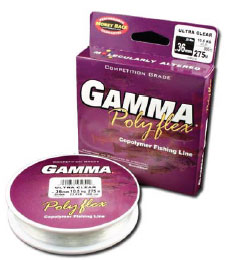
“Gamma Polyflex is my favorite choice for tossing any kind of topwater bait or when using square-billed crankbaits around blow-downs and submerged timber,” states Mueller. “When I’m crashing the bait around a stump, I want it to be a little more buoyant. With floating line you can get through high cover without getting snagged or wrapped in weeds. That alone can make a huge difference in your score.”
Mueller loves to toss a small profile IMA Bill Lowen Square Bill crankbait on grassy waters. That lure typically dives three to four feet deep, but by altering his line choice based on diameter, he can get it to dig down five feet or make it ride less than two feet below the surface. A heavier, thicker line – say 20-pound test – keeps the lure riding high, while lighter, thinner, 12-pound copolymer digs deeper.
“Most people these days think you have to use fluorocarbon or braid for every fishing endeavor,” says Mueller, “but you still need to match the line to the application. I don’t get snagged nearly as much when work- ing heavy surface cover if I use the more buoyant copolymer. That makes a lot of sense if you think about it.”
TAKE IT TO THE BANK
Where do you start your search on an unfamiliar lake? Mueller has a sweet and simple suggestion: Prospect along steep banks or over areas in proximity to deep drop-offs, especially in the spring and fall.

“When you work slopes,” notes Mueller, “you can test different water depths quickly to see if the fish are holding shallow or deep. Once you score a hit or two, use that depth to begin formulating a pattern. You might not hit the mother lode along a steep bank, but you can quickly isolate a productive depth and then explore other parts of the lake while probing the same level.”
“Often,” adds Mueller, “you’ll find the fish shallower or deeper than expected. Rather than work one depth in several areas looking for the fish, try working several depths in a relatively small area along this kind of setup, then set out for greener pastures by focusing on whichever level produces best.”
STEALTH IS KEY
Another point that Mueller says has helped him grow, both as a tournament angler and as a guide who needs to put his clients on the fish day in and day out, is practicing stealth while on the water. It’s a point he feels many bass anglers overlook.
“Stay away from your trolling motor controls,” he advises. “Turning that thing on and off again and again puts big fish in foul moods. Either find a slow enough speed to keep the motor on all the time so it simply becomes background noise or, better yet, use the wind when possible to quietly drift into position.”
Big fish, Mueller suspects, are very conscious of boat noise. Master getting silently into your casting zone and you’ll catch more lunkers. Naturally, you’ll still need to choose the right lures and make proper presentations, but doing so as slyly as possible definitely tilts the odds in your favor.
“Few bass anglers realize just how spooky big fish can be in shallow water,” Mueller says. “The biggest fish are the most shy. They can hear your trolling motor, or even the echoes from your transducer, so you might want to also turn off your electronics when working flats, coves and skinny water.”
A BAIT FOR ALL SEASONS
“I always have some type of swim baits in my boat,” continues Mueller. “They are so versatile that I can toss them in the spring, summer, fall and winter.”
Early in the spring, when bass first start to move shallow and explore spawning areas, is one of Mueller’s favorite times to work these lures.
“Those were the conditions when I set the Bassmaster Classic record for the heaviest one-day stringer,” he recalls. “I was slow-rolling a Z-Man Original ChatterBait Elite, combined with a Reins Fat Rockvibe shad, right over the tops of submerged grass that was growing a few feet off the bottom. It’s a deadly technique on any lake that has grass. You can fish this combo slowly and keep it in the strike zone longer in order to tempt pre-spawn fish that simply won’t give chase.”

For fishing here in the Northeast, Mueller’s go-to with this pattern is a Z-Man Original ChatterBait Elite in the 3/8-ounce size and bluegill color pattern, teamed with a 4-inch Reins Fat Rockvibe shad swimbait. This combo’s painted blade, he believes, can be used to match just about anything a bass in our waters might feed on, from bluegills to perch. On bright days in clear water, his staple swimbait color is moebi. In darker water or under overcast skies, he’ll opt for baby gill. He also likes to dip his swim bait tails in orange Spike-It Dip-And-Glow worm dye to give them a perch-like quality.
“I definitely get more strikes with the dip,” he states.
In late summer, when baby alewives or small baitfish are prevalent, Mueller downsizes to a smaller swimbait to match the hatch with an Optimum 3-inch Opti Shad. This is a very small soft plastic he uses on a 3/8-ounce jighead with a 1/0 hook. Using braided line and a spinning outfit, he can make long casts and get good hooksets.
“Use this setup when you see small baitfish in the water or when a bass coughs up tiny shiners,” he suggests. “It’s something a little different—small enough to put a lot of bass in your boat but big enough to awaken lunkers.”
In the fall, Mueller often favors a Punisher Lures Head Spinner in the 3/8 or 1⁄2-ounce size. He teams this with a Reins Rockvibe shad which, as opposed to the Reins Fat Rockvibe shad, has a slender body that offers little water resistance so it can be fished with thin line on a light jighead at greater depths. He’ll use the moebi color and dip the tail if perch are present. If shiners abound, or when the water is clear and bright, he’ll go to a bluegill color. Under cloudy skies, ghost pro blue is his primary choice.
“With the Head Spinner,” explains Mueller, “anglers can swap out the original blades for smaller ones to go a little deeper, or use bigger ones to ride a little higher. Let this lure fall right to the bottom and use a slow, steady retrieve to bring it back to the boat. For suspended bass, count down and retrieve it smoothly just above the fish.”
Talk to Mueller on any aspect of freshwater bassing and you come away with the feeling that this guy is here to stay. He’s been on a roll lately, of course, but his fishing mechanics, theories and work ethic seem more than sound. The scary part, I think, is that he feels he’s only beginning to scratch the surface of what there is to learn about America’s most popular gamefish. With an attitude like that, there’s no telling how far he’ll go in the long run.
This much seems certain: Paul Mueller plans to enjoy the ride.
Mr. Mueller,
I am new to baitcasting rods and reels. Can you recommend the combos, with sizes, action and speed for mainly large and smallmouth bass?
Medium action 6-7’ are my preference