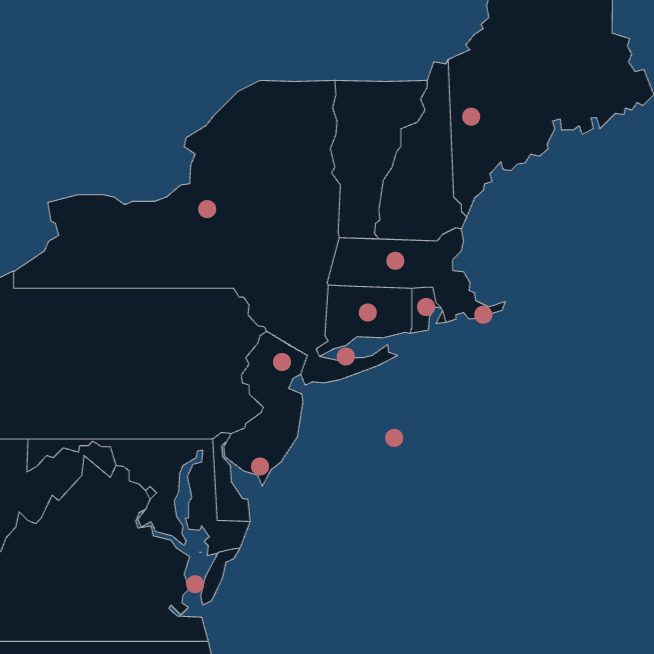


I was just making a few last-minute additions to my tackle bag when On The Water Publisher Chris Megan’s maroon Toyota pickup trailing a 21-foot Skeeter whipped into the dark parking lot of the Ninety Nine Restaurant.
“Come on Fee, we’re always waiting on you!” Chris shouted from a rolled-down window as I closed my truck’s tailgate and threw my rods and tackle in the bed of his pickup. Kevin got into the shotgun seat, I jumped in the crew cab and the three of us started our 1-hour drive from the Upper Cape to the Pamet River launch in Truro.
A few days prior, Kevin and Chris had fished Provincetown, launching the Skeeter at Pamet and motoring over to the waters of Race Point. When they got there, they were met with blankets of sand eels, schools of large sea herring and blitzing stripers and bluefish. The fish had showed up in numbers at the tip of the Cape in early June, and the action had been fast and furious for the better part of a month by the time I had my chance to go.
Most of the traditional tactics used for Provincetown fishing revolve around trolling. Heavy wire line outfits and parachute jigs rule the roost with most of the charter boat captains, who parade back and forth along the steep drop-offs where stripers hang throughout the summer. But with the incredible concentrations of bait that have shown around the tip of the Cape the past couple seasons, stripers have been spreading out and anglers are finding more light-tackle opportunities in these legendary waters.

After dropping the boat and rounding Wood End light, the smell of baitfish in the air hit me like a smack in the face. With light in the sky but about 20 minutes to go until sunrise, there were only a few birds in the sky. Just as we were deciding whether or not to pull back the throttle and start casting, we spooked a huge school of stripers that had been sitting on the surface. That was enough of a sign for us; Chris killed the engine and we began drifting and casting on Wood End Bar, at the south end of Herring Cove Beach. In just minutes, Kevin came tight with a 9-inch Slug-Go on a ½-ounce jighead, and Chris connected on a Hogy rigged on an offset worm hook. When I saw a 30-inch bluefish launch out of the water on the end of Kevin’s line, I switched over from a RonZ to a bucktail and pork rind, for some added durability against the bluefish’s teeth. Two casts later, I was hooked up, but this time to a 28-inch striper. The action continued 15 more minutes, with fish swirling and splashing on the surface all around the boat as we drifted slowly on the tide, before ending abruptly. We picked up and made a short move tighter to the beach, quickly finding another school of bass under diving and shrieking gulls that were plucking sand eels off the surface. Again the fast action began, and perhaps the most remarkable thing wasn’t the fish we landed but the half-dozen fish that followed each hooked fish to the boat.
As I prepared to leader another 30-inch striper, I spotted a submarine of a linesider lurking just below it. “Quick Kevin, cast, I’ve got a follower! A big one!” Kevin lobbed a Slug-Go behind my fish, but a bluefish bolted out of nowhere and lopped off the back half of the soft-plastic lure. Kevin reeled in the 4-inch nub, said “Watch this,” and tossed it back out again. With two twitches of the rod tip, the lure was slammed by what turned out to be a 36-inch striper.
The fishing finally tapered off mid-morning, when most of the fish disappeared and the ones that remained followed our lures but wouldn’t commit. By then a steady stream of charter boats had arrived on the scene and were working the drop-off, where the bottom of Herring Cove plummets from 30 to 8- feet over just a handful of yards.
“The fish are still here,” Chris assured us, “they just might be a little deeper.”
We swapped out our light spinning outfits for two medium-weight conventional setups spooled with 50-pound-test braided line. We clipped a deep-diving swimmer onto each and, rather than joining the conga line, made a quick run around Race Point to fish around the outer edge of the lobster pots in 30 to 40 feet of water. Once we set the deep divers – one Rapala X-Rap and one Sebile Koolie Minnow – behind the boat, we began a steady troll of about 2 or 3 miles per hour.

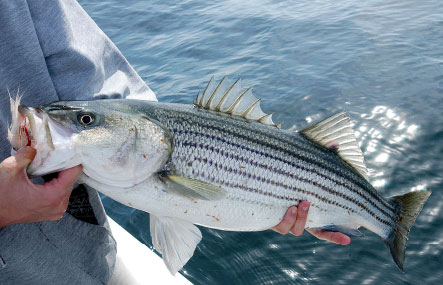
We couldn’t have trolled more than 30 yards before one of the rods folded over. Chris grabbed the rod and worked the 20-pound striper to the boat. A couple minutes later, as Chris was setting his rod back out, the second rod doubled over and just as I pulled it out of the rodholder, the drag began to slip. I took the rod this time, and felt the heavy headshakes of a quality bass. The larger deep divers and deeper water were clearly the ticket to some larger fish, and as we trolled through the area keeping an eye out for marks on the fishfinder, the hook-ups were constant.
By noon the tide had slowed and we were ready for a break, so we picked up the rods and made the quick run back around Race Point to grab lunch inside Provincetown Harbor before making the run back to Pamet River. Ten minutes later we were pushing away from the town dock after taking on two grease-spotted brown paper bags from the Portuguese bakery on Commercial Street, one filled with an assortment of meat-filled rolls and the other holding a selection of sweet treats. Fully fortified by the time we reached the mouth of the harbor, neither Kevin nor I were too surprised when instead of turning back toward the south, Chris hooked a wide right around Wood End and pointed the bow back toward the lighthouse at Race Point.
You can never tell what might happen when fishing the waters off of Provincetown, so when packing the boat, be sure to cover all the bases. Spinning rods capable of throwing ½- to 2-ounce lure will cover most of your casting needs for fish on top or in the middle of the water column. Spool up reels with 20- to 30-pound-test braided line and use fluorocarbon or monofilament leaders of 30- to 40-pound test, or perhaps a bit heavier if big numbers of bluefish are around.
If fish are hanging deeper along the drop-off, a medium conventional outfit will cover the bases for both vertical jigging with metal jigs like the Sting-O PBJ, Shimano Butterfly or Point Jude Deep Force. These outfits can also effectively troll deep-divers like the Rapala X-Rap or Sebile Koolie Minnow that will get down 20 to 35 feet. Spool reels with 50- to 65-pound-test braided line and fish 40- to 60-pound-test monofilament or fluorocarbon leaders.
Also, anytime you are on the waters of the Outer Cape in June, it’s wise to pack along at least one tuna casting outfit, as you never know where these brutes might pop up. Just make sure that if you plan on targeting bluefin, you have the necessary permits for your vessel.
Pamet River offers an easy launch a short distance from the productive waters of the Race, though the parking goes early. Anglers can also run across Cape Cod Bay from the South Shore or other points on the Cape. Cruise along the drop-off with the sounder running and a pair of binoculars handy, keeping one eye on the screen and another on the shoreline. Birds will belie the location of feeding stripers when the fish push baitfish to the surface, but on days when this isn’t happening, stripers can usually be located by jigging or trolling around baitfish concentrations located on the fishfinder. Should you locate a school of surface-feeding fish, stick with them until they sound, and then begin riding in figure-8 patterns to try and locate the bass on your electronics.
Also be very observant of what the fish are feeding on and tailor your presentation to match the forage. If you can’t actually see the baitfish in the water, hooked bluefish will often “offer up” what they have been feeding on once they are brought boatside.
Most of all, enjoy this fishery. It’s a great daytime bite, often taking place during sunny, calm days – a stark contrast to many other striped bass fisheries – so take advantage. Pack the sunglasses, camera and light tackle and head for the Race. The bass will be there.
[…] At my favorite fishing location, the sandy drop-off that wraps around the tip of Cape Cod at Provincetown and down to Truro, a parade of wire-line trollers regularly work the area. They troll up and down […]
[…] At my favorite fishing location, the sandy drop-off that wraps around the tip of Cape Cod at Provincetown and down to Truro, a parade of wire-line trollers regularly work the area. They troll up and down […]
[…] in Provincetown, they only report about boat or kayak fishing. For the most part, other than at Race Point, there just aren’t many surfcasters giving it a go. Especially not after […]
So there really is stripers at the Cape by boat is the way to go.
The shore fisherman has declined in the yrs. I guess its those nasty seals.
Maybee i will buy a boat? That is the lazy mans way of fishing.
Fran
last ten years off the beach sucks,maybe u may have one day a school comes close to shore but a seal will be there waiting for your fish,buy a kayak and wind less then 8mph you will have a better chan ce