
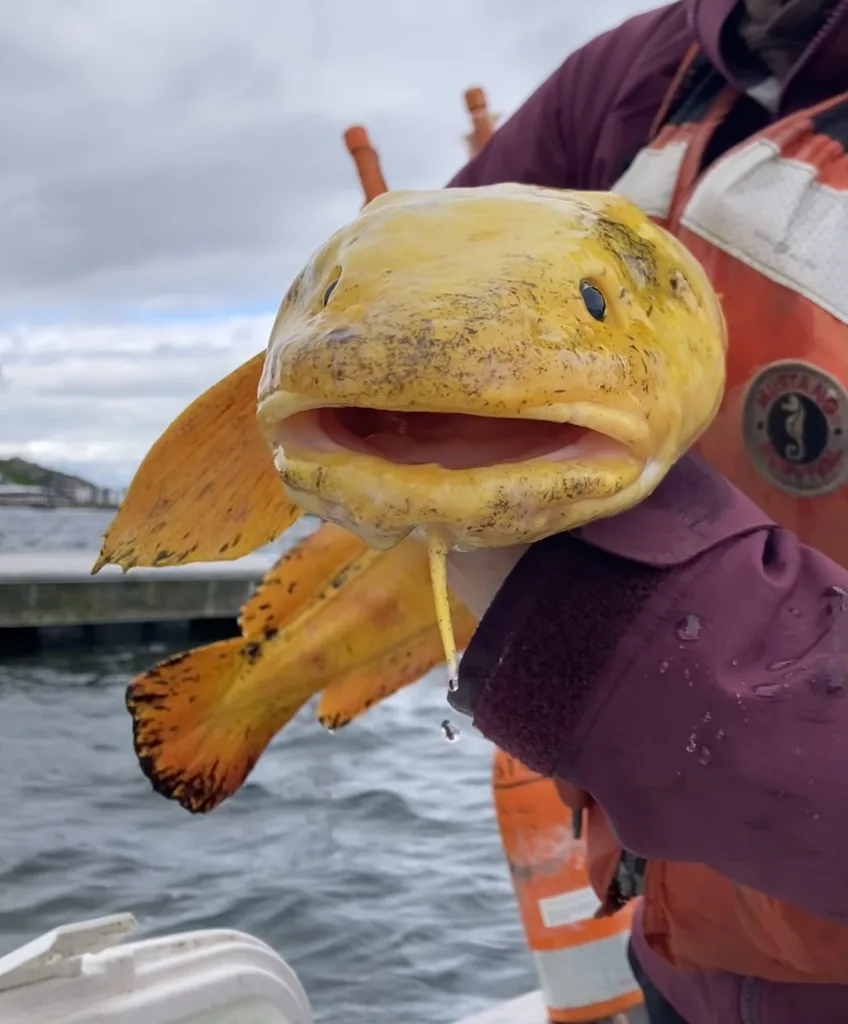
Fish biologists from the U.S. Fish and Wildlife Service (USFWS) caught an incredibly strange-looking burbot while performing an Aquatic Invasive Species Survey on Lake Ontario late last month. According to a web story published by the USFWS, the banana-yellow fish was pulled from Oswego Harbor, which makes it the first documented detection of burbot in the harbor despite a few reported angler encounters.
Burbot (Lota lota)—better known as cusk in northern New England—are nocturnal hunters and the only freshwater members of the cod family. They are a highly sought after food fish by ice fishermen on large, deep water bodies, like Lake Winnipesaukee, and are rarely caught in water shallower than 15 feet outside of their spawning season (which falls between late December and March).
Oswego Harbor has a maximum depth of 27 feet. Needless to say, it’s surprising to find a burbot there in mid-October, let alone one that looks more closely related to a palomino trout. The crew of biologists determined this burbot was living with Xanthochromism—”a rare biological condition caused by a genetic mutation that suppresses normal pigmentation and produces a yellow-orange appearance.”

Unfortunately, the fish was emaciated, which could be due to a number of possibilities—one of the more obvious being that it is likely difficult for a bright yellow fish to hunt efficiently in deep, dark water.
The rare burbot was sent to the Cornell University College of Veterinary Medicine for a health analysis, which may provide some insight into the health of Lake Ontario’s burbot populations to help inform future fisheries management decisions.
Read below for a brief press release from the NYSDEC regarding the unique catch.
One-in-a-Million Catch: USFWS Crew Discovers Rare Yellow Burbot in Oswego Harbor
U.S. Fish and Wildlife Service (USFWS) biologists recently caught a rare, native fish from Oswego that would make a Halloween pumpkin look pale in comparison. During a routine aquatic invasive species survey, the crew caught a burbot (Lota lota) exhibiting xanthochromism, a rare biological condition caused by a genetic mutation that suppresses normal pigmentation and produces a yellow-orange appearance. Xanthochromism in wild fish is considerably less common than albinism or melanism, making this an especially unusual capture.
The finding is particularly notable because burbot populations in the lake are extremely low and the species typically inhabit deeper, cooler waters than those found within the harbor. It represents the first documented detection of a burbot during a fisheries survey in Oswego Harbor, although a few angler catches have been reported.
While processing the fish, United States Geological Survey (USGS) fisheries biologists familiar with the species observed that it was emaciated and appeared to be in poor health. Because of the fish’s condition and the unexplained factors contributing to the continued suppression of its population, it was sent to the Cornell University College of Veterinary Medicine for a health analysis. The discovery could turn out to be lucky for the burbot too; this exceptionally rare fish may provide valuable insight into the health of the species’ populations throughout the basin that can inform management actions.
~ Adapted from article shared with DEC from USFWS