

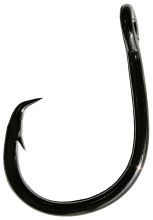
It is well accepted that catch-and-release mortality can be greatly reduced by using circle hooks to fish natural baits. In fact, in two studies by marine officials in Massachusetts and Maryland that focused on bait-fishing for striped bass, the use of circle hooks rather than J-hooks reduced mortality from 15.5% to 3% (Massachusetts study) and from 9.1% to 0.8% (Maryland study). Other researchers have had similar results.
Thankfully, circle hooks are becoming much more prevalent throughout the fishing world. Their tendency to hook fish in the corner of the mouth and not deep in the throat or stomach minimizes damage to the fish allowing for less catch-and-release mortality.
Keep in mind when fishing circle hooks that you should not jerk the rod tip to set the hook. If you jerk the rod tip, you’ll simply pull a circle hook out of the fish’s mouth with little or no chance of a hook up. Instead, after letting the fish “take” the bait, simply start reeling in the line until it comes tight and then fight the fish normally.
With soft, easily swallowed baits such as clams and worms, circle hooks are the only way to go when targeting striped bass – especially if fishing them out of a sand spike. When using larger chunk baits for stripers, circle hooks may hinder hook-up ratios, so using a large J-hook is better in this situation. You can mitigate the odds of striped bass swallowing the bait by holding the rod and not waiting too long before setting the hook.
Wow is that ironic, I was just going to write-up how in love I am with circle hooks again. Back in the 90s that is all we used for live lining river herring and our results were great but for some odd reason I got away from the circle. On Wednesday in Boston Harbor with a livewell full of mackerel and willing bass I decided to dust off the circle again. In this case the bleeding bait non-offset Daichi Circle Chunk 10/0. I was floored at the results. I hooked the macks crosswise through the nostrils and overwhelmingly caught the fish that bit with all but one in the corner of the mouth, while my deckmates who opted for more conventional octopus-style hooks missed many fish including one buddy losing what might have been the fish of a lifetime. Additonally some of the fish were hooked deeply. From my perspective it sure was satisfying seeing that glow red hook stuck in the corner of the mouth as they were brought to hand. These hooks work best when you adopt smooth, gradual movements from when a fish takes the bait until it is landed. Upon strike I don’t react until the rod is bowled over and If I must pump the rod I steer clear of jerky movements which cause slack and slack in the nemesis of the circle or for that matter any hook or lure. The next target for me is eels where arguably the most deep-hooked damage occurs and I can’t wait to unleash the circle!
[…] deep hooking can be largely avoided by using circle hooks, which are widely endorsed by fisheries scientists. Research has clearly demonstrated that such […]
[…] resistance, and all the angler has to do is turn the reel handle to engage the drag and bury the circle hook right into the corner of the mahi’s […]