


Contrary to popular opinion, “bass ackwards” is not a term of the 1990s. The first time I heard that expression was back in the early 1960s after I purchased two Reverse Atoms from Bunnie DiPietro at Red Top Sporting Goods in Buzzards Bay. Back then that popular gathering place had an area named the Bull Pen, and if I remember correctly, a mount of Ralph Gray’s 68-pound striper assumed a place of prominence on the wall above this fisherman’s rendezvous. The Bull Pen was famous for tall tales and useful advice, and few fishermen on their way to Race Point or the Canal passed up the opportunity to stop in to check out the latest reports.
With plugs in hand I was headed out the door when I heard, “Hey kid whatcha doin’ with those plugs?”
A crusty old gent, who looked like he spent the last three days sleeping in the same outfit, quickly closed the distance between the door and me. I was in a rush to get out of there and wet those plugs in the boulder fields where I’d lost the last one to be found anywhere within a 50-mile radius from my home. The old gent blocked the door, so I knew I was in for a lecture.
“Them plugs ain’t nothin’ more than an Atom P-40 turned around to swim backwards,” he winked through a tobacco-stained grin and whispered.
“Bass ackwards, that’s the secret. We doctored those plugs to swim backwards and act like a squid and the bass come roaring up to swallow them. Have to skid them, slide them on top, slow it down every now and then, but don’t stop it and get the gaff ready.”
My newfound friend followed me out to the car where my wife looked on in panic, thinking I’d adopted yet another homeless angler. He walked alongside and tugged at my shirt.

“How did you hear about these lures? We made ’em because of great runs of squid in the Canal, but I didn’t know of anyone west of here that was using them.”
I got into the car, placed the plugs safely on the front seat and drove off looking in the rearview mirror at the old gent still talking and waving a mile a minute. I guess it was a good way for him to kill time while waiting for the evening tide, but it was obvious he was surprised that the cat was out of the bag.

The fact is, there is no such thing as a secret as soon as at least two fishermen know about any lure, spot or technique.
We found out about the plug, but not because anyone told us. Back then it was easier obtaining data about Russia’s space program than getting some useful fishing advice. We put the information together via a combination of timing and luck. We had a ringside seat to an education we were almost too far away from to take advantage of.
Although our attention was focused on the baited hooks we’d cast alongside the ledge, whenever the sun began to dip into the western horizon, we were looking toward the islands to see if the mystery angler would make an appearance.
When conditions were right, the 18-foot skiff would appear off East Island on a course due east for a treacherous boulder field. The angler was standing in the stern, hand on the extended tiller and eyes searching the water for signs of life, as his skiff bounced and slid down the face of the chop toward its destination. The mysterious angler passed up patches of white water and reefs we could only dream and drool over from our fixed perch on the rocky shore, although occasionally he’d stop to cast his lure when he noticed something interesting on the surface.
Frustration is a word often used by those who have never really experienced the desperation and yearning derived from a lack of fulfillment. For three years we sat on this rock almost every night we could get away to fish a spot that had been good to us, almost too good. We had been hounded and dogged by so many lazy fishermen looking for a shortcut to success that on most nights we never drove directly to Bull Rock. That was the name our entourage had dubbed this productive location, and out of fear of leading the caravan of followers in pursuit directly to the large hay field where we hid our vehicle, we took numerous detours.
Life is full of enigmas. Here we were, according to the aforementioned retinue, sitting on top of the world where my fishing partner had beached five stripers over 50 pounds and a number of bass in the 40-pound class, while I cleaned up the fish in the teens and twenties. I was thrilled to be a bridesmaid at such a celebration, yet despite what our peers saw as the height of success, we wanted more, and the stranger in the boat was responsible for those aspirations.
Most of the time the stranger headed directly for a series of lumps off a pronounced point that set the incoming water surging up from the depths as it made its way over a rocky knoll toward the shoreline. For the better part of three years we watched the fisherman appear with regularity. He would kill his engine just outside the boulders and allow the southwesterly breeze to move him quietly across the shallow edges. We couldn’t see what type of lure he was using, but it required an action like nothing we had ever witnessed before. He was casting what appeared to be a modified 8-foot surf rod with a Penn Squidder. With the wind at his back, he could toss that lure a mile. He’d raise and lower the tip to give the lure a skidding action, and while we couldn’t see the shape or color of his lure even at that distance, we could see the large boils and splashes of fish in hot pursuit of it until the rod bent in an arch that signified “fish on.”
Even though we were accounting for some trophy bass (enough to provide my cohort with regional honors in the nine-state R. J. Schaeffer Salt Water Fishing Contest), we were victims of the greener-grass syndrome. A few of the fish that came over the gunwale of that mystery man’s skiff looked to be 70-pound specimens. Those are the observations of a person who has gaffed numerous 50s and a few 60s and was witness to two 70-pounders in this lifetime. I will remind you that objects that far away appear to be smaller than they actually are.
Our nighttime fisherman remained an enigma until one afternoon several years later when I ran an errand for a boat builder who needed 350 feet of anchor line for a boat that he was about to launch. When I drove up to JD Thread Mill I didn’t notice anything unusual until I looked around the west side of the building. There I saw the little bass boat that had been the source of much conjecture over the past several years. The fence was open and I walked up to the boat and looked inside where I saw two casting rods with what appeared to be 9-thread linen line spooled on the Penn casting reels. At the end of those lines were two of the strangest plugs I’d ever seen. They looked like and were colored similar to the large Atom P-40 swimmers, but they were rigged backward, without a lip, and appeared to have holes drilled into the sides to allow water into the plug bodies. I was suddenly overcome with a terrible sense of guilt, the same culpability I’d feel if I had walked into a person’s home and began rifling through his drawers. Although I had no intention of taking anything that didn’t belong to me, I walked away feeling as though I had stolen a secret.
The man who sold me the line was friendly, spry and extremely agile. After the sale was consummated I asked him if that was his boat and he answered yes.
When I asked if he was a bass fisherman the twinkle in his eyes changed and the smile disappeared. He said he only fished for bass on occasion, gave me my change and walked me out the door, perhaps to insure that I went directly to my car and not into his yard.
I couldn’t wait to inform my friend I’d finally found what we’d come to believe was our mythical striper fisherman. I’d never seen those lures before or after until I heard Bob Pimental whisper about a “Reverse Atom” to a fellow member at a meeting of the Linesiders Bass Club in the late 1950s. Bob was mating for Captain Freddy Harris of the charter boat Kitty-W out of Rock Harbor in Orleans. The very next summer my friend and I combined for a boat and motor, and after years of studying every rock and ledge in the area, we ventured out to where the big fish were.
Bob Pimental was the consummate diehard bass fisherman. He’d work all day then launch his boat and fish into the darkness. On one particular day he was anchored up inside of the boulders off a rugged beach, slinging what appeared to be an amber-colored lure that cast like a bullet. The lure made a whistling noise as it left the rod tip, and as soon as it hit the water, Pimental began reeling and sliding it across the water. After one particular cast I caught my breath as he had at least three large bass charging in the wake of the plug until he slowed it just a mite and an enormous maw engulfed his offering. I was less than 50 yards away casting an Atom Junior and a homemade popping plug and my largest fish was a 13-pounder.
That night I visited Joe Souza, who also worked for a sporting goods wholesaler, at Bridge Bait and Tackle, and he told me he might be able to get me a few of the new Reverse Atoms, but he could not guarantee the color or price. At just over three bucks a pop, they were expensive, but after watching Pimental play them like a fine-tuned instrument, I was ready to give them a try. Joe struck out on his attempt to lay his hands on the plugs, hence my trip to Red Top to purchase them.
On my first trip to the same location I caught two fish in the 30-pound class and five from 12 to 22 pounds. At the going rate for stripers at Drapes Sea, 140 pounds of native stripers at 20 cents a pound netted me a grand total of $28 — ample justification for my initial cash outlay. At the time I ran a tab with the proprietor of Bridge Bait, and my next stop after the fish market was the shop on Lindsey Street where I purchased a package of hooks and a pound of fresh squid. The owner also settled the balance of my new Penn Squidder with the red side plates, and the sum of my indebtedness was now a mere few dollars.
It may seem peculiar to people maintaining huge credit card debt, but owing money to a local merchant, no matter how little, was a cause of nervous concern to this young fisherman, who was always of the opinion that his sport should be able to pay for itself and not take away from our deficient family income. Despite whittling down my accounts payable, there was enough money left to take my bride to dinner and a few bucks to fold away in the secret compartment of my wallet.
Bob Pimental went on to capture several 50-pound bass with his Reverse Atoms, while my personal best was 46 pounds on a green version of the plug that imitated a terrified squid. There is so much more about JD, Pimental, Bob Pond and the inventors of the Reverse Atom that it will be saved for a longer discourse at another time.
In my research of the origins of the Reverse Atom, I spoke with old friends Bob Pond and Bunnie DiPietro, who provided enough information for a short novel. My good friend Bob Pond told me the Reverse came to be because members of the Massachusetts Beach Buggy Association and the hungries who fished the Canal were looking for a squid lookalike to replicate the action of a squid.
Huge schools of one of the stripers’ favorite edibles moved into the Canal and the oceanside beaches of the lower Cape in 1947, and the fishermen wanted something to imitate the unusual action of a moving squid.
Many a garage and basement light burned well into the nighttime hours while innovators tried to copy the plug.
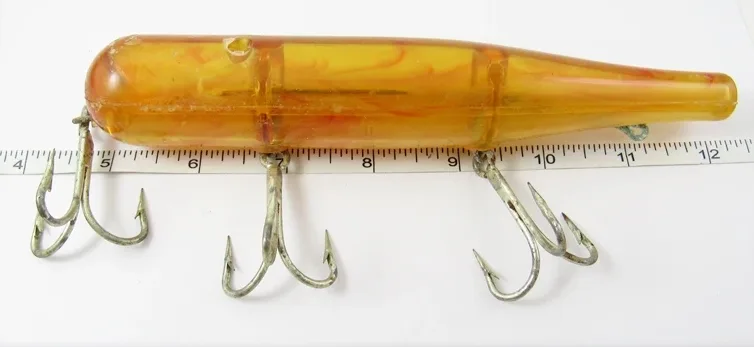
One of the best imitations was the P-40 turned backwards and retooled to skid across the surface. The through wire was removed, along with the swimming lip, and the rear hole was relocated under and well back of the original tail hook. A treble hook was bent on the wire where the nose was, and two holes were drilled on either side, about 2/3 of the way up to the nose of the plug, to hold water and allow longer casts. The plug now whistled through the air and cast like a bullet.
Some fishermen replaced the rear treble with a large single-hook bucktail, which was my preference. Bob said this transformation went on for some time, but it was a long and arduous procedure.
That’s when Jimmy Kay, a fisherman-neighbor from Attleboro, came to the shop to talk to Pond. He showed Bob the reworked plug the manufacturer had heard about for the past year, and asked if he could duplicate it. Pond agreed and Kay put up $1,000 for 1,000 pieces (they sold for $1.95 at the time) and became the sole distributor of these hot new lures, appropriately designated the Reverse Atom, for about two years until jobbers got wind of the deal and screamed for product.
Pond began producing them in amber, blue marble and green. If necessity is the mother of invention, those of her sons who chose fishing did pretty well. Two years ago, Pond sold the Atom Manufacturing Company he founded in 1944 to the Prism Group of Rhode Island. Greg Metcalf, a well-known fisherman, is part of the Prism team, which produces most of the line at their new Pawtucket, Rhode Island, location. The company is expanding their inventory into various other types of lures.
There are old stand-bys and bystanders. The Reverse Atom is a combination of both. A proven lure that has fooled 50-pound bass for over 50 years, it is doing the same thing today. The new versions of the Reverse are made of a heavier cedar foam that will not crack or break, and the lure works as well as the original. We’ve had great success with the new versions from the spring into the late summer when there was not a trace of squid in the area. Work every lure as though there were a bass behind every retrieve, and with that mindset you will catch more fish regardless of what type of lure you are using.
This story was originally published in the October 2001 Issue of On The Water Magazine.