

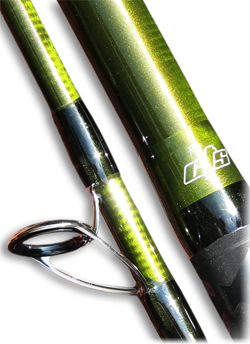
One of my goals with FOTJ is to provide occasional reviews of products I’ve been fishing. These may not always be brand new products, but they will always be ones that I highly recommend. To start it off, I thought a new, unique rod that I’ve been loving for the last year-and-a-half would be appropriate.
When Rich Hedenberg of RH Custom Rods handed me one of the CTS blanks at the Somerset Saltwater Fishing Show in 2010 and told me it could cast up to 4 ounces, I nearly called BS on him. The rod was feather light and no thicker around at the butt than my pinky finger.
In the spring of 2010 when I made my first casts with a 10-foot, 2- to 4 1/4-ounce RH Custom Rods “pencil popping blank” by CTS, I changed my tune right quick. The blank, built with the New Guide Concept and matched with my Van Staal VS200, was as lightweight as my steelhead noodle rods, but easily heaved a 3-ounce pencil popper toward the center of the Cape Cod Canal.
So the casting was an A+, but what about fighting fish? There’s no more rigorous test on surf rods than the challenge of whipping a fish in the screaming currents of the Cape Cod Canal. Quite a few times in the past, I’ve found myself tied into a quality bass during peak current with a rod and reel better suited for an open beach than the Big Ditch. These instances usually ended in a pulled hook or a parted line after the fish takes off with the current and I’m left with no choice but to grab the spool and point the rod at the fish in a last ditch effort to turn it.
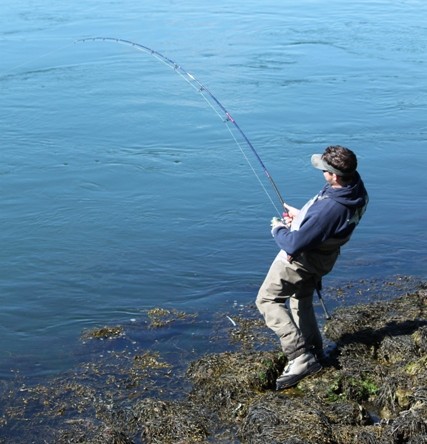
After a good season with my CTS in 2010, catching a number of good bass into the high teens, I finally got the chance to pit the rod against a big fish when the mackerel flooded into the Canal in June 2011. The fish were keying in on the macks, and matching the size and profiles of the slim 7- to 10-inch baits was paramount. The smaller 1-ounce swimming plugs were too small to fish on my heavier canal outfits, but were perfect for the CTS. One morning as I let the plug swing into the shoreline I had a good take and when I set the hook, a big broom tail smashed up the surface letting me know I was about to find out just how well the rod could handle a big fish.
This particular rod blank was parabolic, bending right to the grip. This really softened the run of the fish, taking the pressure off the line and the drag and me, and putting it squarely on the rod. The fish took a good run, followed by a brief pause and then a second run. When the fish slowed, I began to put the heat on, and the rod bent all the way to my hands as I fought the fish and the heavy canal currents.
I was impressed. At no point did I feel like I was taxing the rod too much, and I was putting everything I had into it. In fact, my only concern was bending out the hooks on the smaller plug. Everything held together and the big fish came to hand, a low- to mid-30-pounder that fought like a fish 10 pounds heavier with the current at his back. A few days later, with the OTW TV camera rolling, the CTS rod did it again.
While Rich recommended the rod as a pencil popping rod, I’ve found it does much more. I really like the way the rod fishes small 1- to 2-ounce swimming plugs and needle fish. Shads and metals are also well within the rod’s repertoire. The rod fishes bucktails well, but I still prefer the feel of the Lamiglas GSB blanks when it comes to tossing jigs.
The CTS RH Custom Rods Edition has accompanied me on open beaches, jetties, boulderfields and the Cape Cod Canal, and it’s fit all the areas very well. And with it’s incredibly thin profile and light weight, it is a pleasure to cast and fish, and you might just mistake it for light tackle, until you see how it puts the boots to a big bass.
CTS stands for Composite Tube Systems, referring to the unique way that the blanks, which are made in New Zealand, are constructed. Though I’ve had the whole process explained to me, most of it sailed way over my head, but the important part stuck – the way CTS manufactures its blanks, out of pure carbon with no woven fiber, allows for them to be lighter and thinner while increasing casting distance and not sacrificing strength. The fact that the pro staff is made up of a number of long-distance casters is enough to convince me that these rods can launch. The process also reduces the chance of breakage.

Another one of the cool things about the CTS rods is the custom colors available for the blanks. For my next CTS rod, I think I might have to get a bit more flashy with a lemon or even tangerine blank.
Check out the links for more info on the RH Custom Rod Series Blank and other CTS blanks.
I’m gonna have to get me one of these, Jim. I’m thinking “Golden Plum.” Nice writeup
The CTS 11/2-4 I tested felt like he best rod ever! I have had them all and this rod matched with the Zee Bass 27 might be the best combo yet! Tight lines all! PS Catch and carefully release- please
pl
Hi ,
which green color did you chose for your first rod seen on the small picture above.
Looking for a brosure i hear many good things if you have contact via email
Have not seen one in the flesh yet.
Ty
AP
There is no rod better. You know how your arm hurts after casting for a hour, your not going to be hurting anymore. The rod loads nice
I have 3 CTS rods a 9ft 3pc I bought in Amsterdam a 11ft 4 PC and a 12 ft 3pc Vapor Trail from Rich and made by Atlantic custom rods
The rods are multifunctional perfection
Carolyn.you look like u bin traveling abroad. I am interested in the 9 ft one
Burl indeed is a bteetr material to use imo because it doesnt have those nasty pits and holes as traditional cork has these days.If supply of cork will run out so bad that we need to seek for alternative materials. Then you should use birch bark as I use already at some of my rods (like to one at this picture). That supply will last :)Thanks for posting the pic Opax 🙂