


Two-handed fly rods offer a more efficient and effective way to target stripers from shore.
Hey! Nice Spey rod!”
“Thanks,” I say, not caring to offer a correction. From one perspective, the scene is entirely normal: I’m fishing a double-handed rod over big water with large flies. That makes sense, right? But, here’s the catch. Instead of a large river with salmon or steelhead, I’m fishing an estuary for striped bass.
Cue the needle over vinyl. Spey in saltwater? You bet – just hang with me for a minute.
Knowing how to fish with a double-handed rod in saltwater using Spey techniques can be a great advantage; in fact, I think it might save you in some scenarios.
Say you’re wading in an estuary at sunrise, and there are a few stripers feeding in front of you. Months of waiting, planning, and a bit of luck have all come together at this moment. You lick your lips, strip off some line, and turn around to check that your backcast is clear, only to find the sand bank rising steeply behind you with seagrass adorned by sticks and logs. You’ve got a traditional 8- to 9-weight single-handed rod in your hand. Two scenarios can play out at this point. You refuse to let the fish feed without attempting to present a fly to them, so you make a backcast and either snap it off or get it caught on the logs or grass, causing yourself frustration and wasting time. Or, second, you try to roll cast, but the technique isn’t very accurate and doesn’t allow you to shoot very much line.
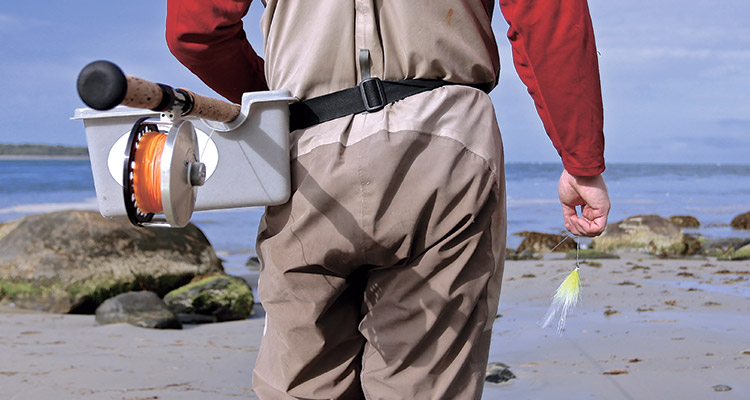
Enter Spey casting, a more efficient, effective, and less-risky technique for presenting flies accurately in a tight casting situation.

What is Spey Casting?
The language around Spey casting, with its line grains measured in grams, its various loops and styles, can be confusing. It’s the form of casting that has, I’d argue, evolved the most in fly-fishing over the last decade. That evolution has been driven by experimentation, which has led to new language and some non-standardized terms.
All fly-fishing requires using the weight of the line to bend the rod to create a trampoline or slingshot-like effect that shoots line forward. In traditional overhand casting, however, it’s a combination of the momentum and weight of the line in the air that forces the rod to bend and then cast line. In Spey casting, the caster uses the surface tension of the line on the water to bend and thereby cast the line.

For me, that concept took a while to sink in. Imagine your fly rod held back at the traditional 1 o’clock position on a backcast. Now, imagine the line is not in the air above you, but is anchored to the surface a few feet to your casting side, and then, as you lift your rod back to this position, the line forms a deep bend in the air that resembles a “D”, with the straight back of the D being the rod, and the curved line of the “D” being the line in the air. When you flick the rod forward, the surface tension of the line that is at the bottom of the curve of the “D” will load or flex the rod, and force it to snap forward, shooting line out in front of you. This is the most basic concept of a Spey cast.
The Spey technique is named after the River Spey in Scotland. I was fortunate to get invited to fish the river a few years ago when I was living in England and discovered that the technique truly was born of necessity: the river is wide, and the banks are steep. If you’re going to cover the water effectively and improve your chances of catching an Atlantic salmon or a big sea-run brown trout, you must cast a long line. In many places, there simply is not enough room for a long backcast.
Back then, the rods they used were long double-handed bamboo rods, often 13 feet or longer. While most of the today’s Spey rods are graphite, they remain long (typically 11 to 14 feet) to give the caster the distinct advantage of height: you can form a larger “D” loop higher over the water and, consequently, cast farther. (Spey lines are a whole other issue, worthy of a lengthy article in and of themselves. I won’t discuss them here so as not to induce narcolepsy in you.)
But, let’s be clear: fishing a double-handed rod does not mean you’re Spey casting. This is the most common misperception I’ve encountered here in the Northeast. A double-handed rod is an excellent choice for saltwater fishing, even if you’re only using it with a traditional overhand cast. It helps you get over the waves, cast farther, and more.
You don’t have to have a double-handed rod to execute a Spey cast—far from it. A Spey cast with a single-handed rod is useful in tight environments when stalking trout with your back to trees, bushes, or rocks. “Spey” principally describes a style of casting rather than all double-handed rods. While this type of rod can be optimal for Spey casting, any double-handed rod you use in saltwater can be used for either traditional overhand or Spey casting.
So, what is the advantage of investing in a double-handed rod and learning Spey casting— especially when we’re so far from the peat bogs and distilleries of Scotland?
No Room for a Backcast? No Problem
A Spey cast requires very little to no space behind you to execute. If you’re wading a rocky section of coastline at low tide and find feeding fish in a spot where there’s a large rock behind you, instead of risking knocking the hook off your fly by attempting a backcast and accidentally bouncing the fly off the rock in the process, this would be the perfect place for a Spey cast.
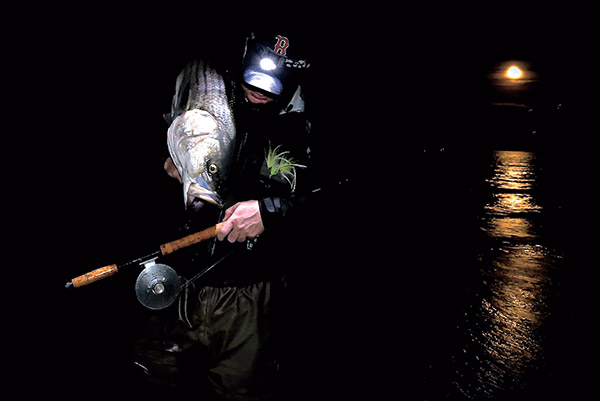
I have found this situation to play out most often in estuaries where, over the course of the tide, you can go from plenty of room for a backcast to only a few feet of room. On a dropping tide when I’m wading below the mud and grass banks, a Spey cast can be extremely helpful.
Other situations when a Spey cast comes in handy include casting under or around a bridge abutment; fishing on a busy beach where curious bystanders stand directly behind you seemingly unaware of the danger of a sharp Gamakatsu hook whipping by them; or, in some urban saltwater environments, trying to avoid parked cars, crumbling pier pilings, or the rusty, abandoned backhoe that looks like a Christmas tree from all of the Rhode Island flatwings I’ve left on it. Note to self: Take your own advice and Spey cast.
Easily Change Direction
A Spey cast easily enables you to change the direction of your cast. This can be very difficult with an overhand cast because you are limited to the direction of your forward or backward motion; even dumping an accurate cast on the backcast is challenging for some. With Spey casting, changing direction is much easier. In fact, some people describe Spey casting as a “change in direction” cast, but I’ve always felt that was describing the cast by one of its advantages, not by the cast itself. Nevertheless, it’s an agile cast that you can deploy quickly in a variety of directions.

Better Casting in the Wind
Wind is a problem for fly fishermen. If you’re a right-handed caster and the wind is blowing into your right side, you risk putting a Clouser into the back of your head. Though barbless is gaining a following, the risk of embedding a fly in these conditions is real. At the very least, a strong wind can challenge your confidence and inhibit performance.
With Spey casting, I find it’s much easier to execute the same cast from either side than it is to overhand cast with my non-dominant hand. Safely handling the wind is much easier.
Less Time Casting, More Time Fishing
One thing many fly fishermen are guilty of is too much casting. Often, when only one or two backcasts are necessary—and more are rarely, if ever, called for purely for the sake of casting—people will take 5 or more. The problem with this is that you spend less time with your fly in the water. Multiply that out over a full day, and your chances for catching a fish go down, sometimes significantly. It’s inefficient and ineffective.
Spey casting is more efficient. A single Spey requires only one D-loop. Once you have the line stripped in, it’s one motion backward, one motion forward, at its simplest.
Spey For Certain Situations
Once, when fishing for striped bass on the Gaspe Peninsula of Quebec, I stood in a crowd of teenagers fishing for stripers with big double-handed rods. We were out up to our chests, with plenty of room for backcasts. Every one of them was tearing up the water with Spey casts, but they weren’t throwing the line very far at all. They weren’t catching anything, either.
A Spey cast is not the everyday, go-to cast for saltwater fishing. It’s situational, for the times when you find yourself with little room or with a troublesome wind. For instance, I would not recommend it for fishing from a boat, when there is typically plenty of room for a backcast. On one occasion, I did make a Spey cast from a boat when I was fishing with another fly fisherman. Faced with busting fish a short distance away, I didn’t want to tangle our lines or wait for him to complete his cast, so I made a few Spey casts from the bow.
Nice read. Looks like I need another flyrod. The money I “will” save on lost junglecock could justify the cost of this new rod, reel, and line… speaking of which- do you need a floating line for this or can you get away with an intermediate?
Same question
Will & Jeffrey: You can use either. But consider an interchangeable tip system in which you can add heads that float or sink at different rates. Much more flexible on the water, to match the situation. Hope that helps!
Meant to add that I fish Beulah’s Serum interchangeable tip system, and it works great in the salt. Highly recommend it.
A 13+ft Spey rod is expensive and a pretty long stick to carry around. Switch rods at 11 ft are easier to deal with but if you already have a solid 8, 9 or 10 weight single handed rod there is no need to buy a two handed rod right away. Short Skagit lines are the latest and greatest expansion of “Spey” casting techniques. If you have an extra spool, you can quickly switch from conventional to Skagit line or for that matter overhand cast the Skagit line. For less than $100 you can be Skagit casting and in a better position to decide if you want to take the plunge on a double hander.
Tom: Good point — there’s some really nice single handed Spey lines out there, which are a good set of training wheels to see if you like the style of casting. I just tried the new Rio InTouch single handed spey line, which had an intermediate tip on it. It was perfect for the fresh I was in, but I also though it could be good in salt. That said, there’s advantages to a longer rod that, once you get hooked on Spey casting, you’ll likely want to try out to see if the longer rod suits you.
Great read, thanks for sharing. As another alternative, I went to an intermediate shooting head right to the backing. I’m talking 15-20 yrs ago, I learned this technique at Sandy Hook from a friend and great fisherman Dan Buss, from nestors outdoor shop in the Lehigh Valley. Our casting was similar to spey casting which included roll casting and more time for the fly in the water, especially with large flies.
If you want to dabble, the Airflo 40+ shoots very nicely and can be used as a conventional single hand line as well if two handed casting isn’t your thing after all.
Thanks Ben, Been casting a 2 handed rod off the beach for years! Saves hooking the Southern Maine tourists not paying attention as the take their after dinner walk at sunset… J
Hah — it sure does! Hope you’re well, Jon.
Great read Chris.Where can I get lessons?I bought a spey rod n a Loop reel with 2 extra spools ,4 yrs ago in a weak moment and have never used them
Tom Conigliaro
WEST CHESTER, PA
Tom: Eldridge Bros in Maine are doing Spey casting classes wither Topher Browne, Maybe 6&7. That’ll be a great event. Also, I know Why Knot Fishing, Cheeky and Beulah are working on some double handed clinics for this summer — those are yet to be announced, but stay tuned. Hope that helps!
Best,
Ben
Andrew Moy, owner of Tightlines Fly Shop in Parsippany, NJ, is an excellent instructor. He taught me the basics right behind his shop. He’s very passionate about it, and he carries everything you’d need to get set up.
Great read, one question are you using an integrated running line and head, or separate head, running line and tip? Wondering because of all the stripping with striper fishing. Seems like you would be stripping loop connections into the guides. Thank
Anthony: Great point — I use an integrated line to avoid this very issue, so no more loops than a typical single hand set up… Great to meet you at the Why Knot event. Shoot me an email if you have more questions. Best, Ben
Spey casting can also be used as a quick load and go setup for overhead casting. If we have a current moving across in front of us, a Spey cast can get the head of the line out of the guides, into a single backcast and then on its way. Beats multiple false casts. I use this technique even with ample backcast room. Even with most of the head out of the guides, the motions of the Spey cast can be used to slip line out so that the cast is made with most of the head out of the guides. I often use a brief water load when wind is an issue.
I use this approach with both single and double hand rods.
I should add that nothing stops us from Spey casting with a single hander. With limited backcast room, we can also use a steeple cast to get our line out there.
Peter Charles
Edit: “Even with most of the head in the guides”
I really like my Sage switch rod and it has been paying off this Spring. Long, two handed overhead or skagit casts, easy line mends, and deep running unweighted flies are perfect for probing the channels of the local marsh.
The setup is simple and I rarely miss a fish that barely nips my fly. Seventy-five feet of Lazer running line attached to my backing, 425 gr – 16.5ft OPST Commando Skagit head, 12 ft T14 sinking tip, 50=>30=>20 lb 15 ft leader, Lefty’s tube fly, 2/0 Owner mosquito circle hook in the junction tubing, and a #1 stinger hook of the same design 2-4″ behind the big hook. I have crushed the barbs on both hooks. I hook about half of my fish with that little stinger. With this circle hook setup, I never ‘set’ the hook and 99% of my hookups are in the side of the jaw or corner of the mouth. Catch and release could not be easier.
Yes, the junctions bump during my end game but since the skagit head is so short, the fight is all but over by the time I am at the junction. All my casts are made with the junctions outside of the guides. Lazer running line takes some getting used to due to its thin diameter but the good news is, I have been able to ditch that annoying stripping basket in most of the places I fish.
If I wanted to cast a surf rod 14 feet long then I would choose a spinning rod. I’m not into the flavor of the month.
Spey casting predates spin casting by about 100 years so maybe flavor of the century might be more accurate. That doesn’t make Spey casting “better”, its just another effective and enjoyable way to catch striped bass. In the surf, I tend to use my spinning rod for prospecting. When I find bass in range, I pick up my double handed fly rod.
I’ve been bringing my 8wt echo spey out to the bridges down here in Islamorada for the tarpon/permit/snook. Trying to dial in my line setup to no avail. Could you provide a little more detail on what you’re using? I know you had mentioned the Beulah Serum Fly Line system, im interested in actual line + tops weights.
Thanks
Kyle
just read your comment Steve or Dave at the sporting gentleman in Glenmills could help you with your casting.
Do you find the salt water ruining a Spey line? What if you were using it in tropical settings? Could it ruin your line in warm salt water?
I use a 15′ two handed Spey rod for inshore fishing. Overhead casting and Skagit. I can tell you this it is more fun than a single hand rod. 100′ casts ,I cover more water and throw big flie’s. From big Bass to Tarpon. Guess that is why I have 5 Two handed rods lol. Tight lines. I liked this article. I live in WinterGarden Florida and fish over at Merrit Island. Now the Blue fish and Jacks are bitting.
I wanted to use my Spay Rod over in Hawaii for Bone fish, along with some small GT, or what ever saltwater species they offer out there. I was told not to bring it, also asked what line would be good for my 9wt 14′ Spay Rod to use on the salt flats. They never answered my question, except bad rod choice to use out there. What do you think about my questions, do you have any ideas to them, any help in this matter would greatly be appreciated.
Great reading Ben, came across your article a few months back. Spay casting is the way to go back then, switch rods are the future now. I remember when I moved back to RI in 2008 fishing in East beach, some of the fly fishermen gave me weird looks at either my Spay Rod or my stand up outcast pontoon. Never said a word to me except for they were mad that I was catching all the stripers. Told them I could see them from my elevated pontoon. Also told them I learned it while living in Idaho since my wife is from there, plus my favorite rider is Ernest Heminway. I did move back to Boise Idaho 5 years later, the wife didn’t like all the crimes or corruption there. Was great for me with all the freestone rivers especially around eastern Idaho with the Henry’s fork,followed by Yellowstone a short distance away. If you are ever around this area send me an email so we might be able to do some fishing. From a Portugy who loves to fly fish, dad doesn’t like that very much, not his tradition or what he taught me.
Three years , but not really late. Thanks for all the info. I have to thank Manny =”SURFSKAGIT” for picking up on his advice to another fellow from SI to check y’all out.