

In the late 1980’s, after finishing a stint with the Army, Armand Tetreault rekindled his interest in fishing. At that time, though striped bass numbers were rebuilding, bluefish numbers were running high, and those toothy blues were happily relieving anglers of their tackle.
“I was tired of losing plugs, but at the same time, I didn’t like the awkward wire leaders,” said Armand. To solve the problem, he began making a popper with a wire leader built in. The through-wire on this plug was extended through the front of the lure, providing protection against the razor-lipped blues. “I caught thousands of bluefish, and never lost a single lure to them.”
Seeing the unique and creative design, other anglers on the beach began asking about the plug, and after giving more than a few away, Armand decided to begin making and selling plugs. Thus, Rhode Island Poppers began.
Rhode Island Poppers makes more than 20 different plugs, from small inshore sand-eel imitations to offshore tuna poppers. The most popular plug, according to Armand, is the Junior Pikie. This lure swims with a “bit of a wiggle and a bit of a wobble” and casts farther than just about any other metal-lip plug available.
“My pet peeve is a plug that swims well, but can’t be cast far,” said Armand. “The best swimming plug in the world won’t matter if you can’t get it in front of the fish.” With this in mind, Armand carefully designs his plugs so they not only have an enticing swimming action, but cast far as well.
Armand’s attention to detail in his plugs goes right down to the wood they’re made of. “You need good quality wood to make a quality plug,” explained Armand. While some “softer” woods are easier to work with when shaping them into a fish-catching profile, they don’t fare well against bluefish and rocky terrain.
When Armand says he’s “old school” about his lures, he isn’t kidding. Many Rhode Island Poppers are made from old-growth heart pine. The heart pine, actually a southern long-leaf yellow pine, once covered much of the southeastern U.S. These very old trees, some living as long as 500 years, were in demand for building structures due to their density and strength and resistance to rot. Many of the factories built during the industrial revolution were built of heart pine. A good amount of the timber was also exported to Europe.
Unfortunately, the slow growth cycle of the tree coupled with some catastrophic forest fires caused by irresponsible logging practices led to a massive decline in the species. Today, the only way to get old-growth heart pine – “newer growth” heart pine is available, but does not have all the qualities of the old-growth – is as recycled wood, often from old factories that have been dismantled. Since the wood doesn’t rot, it retains its qualities more than a century after harvest.
The heart pine used in Rhode Island Poppers is recycled wood that was imported back from Russia. From an ancient forest on the Gulf Coast of the U.S. to a Russian factory to a Northeast surfcaster’s plug bag is an interesting journey for an old piece of timber.
In addition to the old-growth heart pine, Armand works with a number of different woods, matching the qualities of each to the style of plug he’s building.
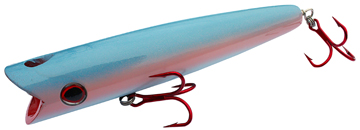
Rhode Island Poppers is a family business. While Armand is the brains behind the designs and the construction of many of the plugs, his sons, Marcel, Andre and Jacques do much of the turning. Even his youngest son, Pierre, helps out by packaging the plugs. Marcel, the oldest, has contributed to a number of the Rhode Island Popper plug designs as well. One of his most notable is the Screaming Popper. As opposed to the rounded, cupped mouth of most poppers, the Screaming Popper has a mouth most similar to a “smilin’ bill” bucktail jig. In a popper, this design will “spit” water out to the sides and really make a fish-attracting commotion. Marcel went a step further and drilled a hole right through the top of the upper lip of the plug.
“That hole allows water to pass through, and on a straight slow retrieve, it almost fishes like a darter,” said Armand. The lure swims a foot or two deep, with no wiggle and a slight side-to-side sway.
“As lure builders, we tend to exaggerate the swimming action in our lures, and this is often what the fish want. But sometimes, a more subtle, straight action gets more hits.”
The versatility of this plug makes it one of Armand’s favorites to fish. “I fish it similar to how you can fish the original floating Rapala for freshwater largemouths.” By that, he means swimming the plug for a bit, pausing and allowing it to float to the surface, and twitching it a few times before resuming the retrieve. Often, the stripers will hit the plug just as it starts to move again.
At 60,000 plugs turned, the Tetreault family has the lure-building process down to a science, putting quality, durability and castability first in each plug they make. Simply put, these “old school” lures catch fish.