

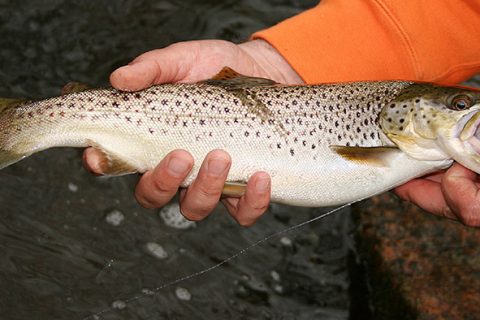
Sea-run brown trout offer one of the greatest angling challenges in New England, yet they receive relatively little attention from the fishing masses. The truth is, few anglers have the patience or persistence required to consistently catch these rare and elusive fish.
In the Connecticut waters where I fish, the sea-run trout are true warriors. If you think about it, the odds of survival are very slim in the many rivers that flow into Long Island Sound along the busy Connecticut shoreline. Voracious schools of bluefish and striped bass cruise up and down the lower estuaries of these waters, chasing alewives, herring and bunker. A school of bluefish could easily make bones out of a 10-pound sea-run, and a big striped bass could swallow one whole. This may help explain why the few sea-run browns that survive these uncertain conditions are some of the smartest and most artful fish that you can target.
The ones we do get a shot at have learned how to survive among their many predators, and accordingly, they’re as easily spooked as trout get. Locating them is difficult enough; catching them is a completely different story. Oftentimes sea-runs will follow right behind your fly, bait or lure, bumping and nudging it but never making a commitment. Once they see you, you can bank on the fact that they will disappear.
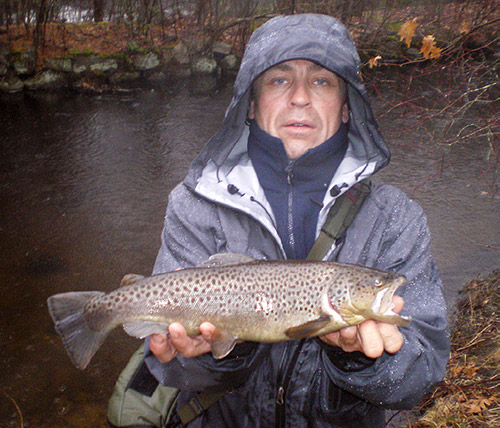
I began fishing for these beautiful, elusive trout at the age of five, when my father began taking me down to the local tidal areas to catch alewives on the fly. Every so often, in the midst of a good alewife blitz, we would hook up on a sea-run trout. Ever since then, I have continued to study and stalk these trout, and on December 30, 2006, I set the new Connecticut state record for sea-run brown trout with a 10-pound, 8-ounce fish measuring 31 ½ inches. My quarry was a post-spawn hen that I caught on 4-pound-test line with a 2-inch Storm WildEye Vibrotail jig. She took drag-ripping runs for more than 20 minutes before I was able to land her.
This catch, like most record fish, did not happen by accident. It took years of persistence and diligent study of the fish’s habitat and behavior. There have been stretches when I’ve visited my favorite tidal areas 20 to 30 times without seeing a thing; other times, I have been rewarded with two or three fish during one change of the tide.

Search for Sea-Runs

Sea-run trout are most active and on the move in the fall and winter months. Sea-run browns spawn in the fall, starting in October and continuing through the end of December. This is the peak time to find them in or near the brackish section of a tributary. The problem is that sea-runs feed very little during their spawn period, which can be frustrating when the fish are finally somewhat easier to find. They can also be caught in the spring and summer, but at that time of the year they are typically seeking thermal refuge. They will find deep, cool holes to hide in, and will often be found around structure and bridge abutments, natural cold-water springs, and at the brackish point of a river where cool water flows in from a river or creek.
When searching for sea-runs, try starting at the point of a river or creek where the water becomes brackish. Areas that have a gravel bottom are best. If a waterway has a fish ladder (which lets anadromous fish follow their natural migration route upstream when spawning areas have been blocked by dams or waterfalls) this is an excellent place to search. Locating sea-runs can be tough because they may be anywhere in a tributary from the point where the water becomes brackish all the way down to the sea. They may even venture out along saltwater shorelines when they are chasing schools of bait. Although they do not migrate like salmon, they will venture into salt water and return to their relatively safe havens in the rivers and creeks.
Fish the Tides
The tide is a key factor when hunting these fish. As the tide rises, the fish tend to leave their holds to search for bait, and you can often see them finning or feeding in the shallow waters along the shoreline. A gentle cast in front of the fish can produce a strike, but there is still no guarantee. A cast made to the fish’s flanks or behind it will usually result in a spooked fish, so you must pay careful attention to the direction in which the fish is swimming. As the tide falls, the fish move back into their protective holds until they feel comfortable enough to begin chasing bait again. In effect, the best time to target sea-runs is when they’re on the move for bait: three hours into the rising tide, three hours into the dropping tide, or at the half tide.
Of course, there are always exceptions to the rule, and I have hooked them at dead high and dead low tides as well. One evening this past December, my good friend Jimmy Orifice and I spent the last three hours of the dropping tide fishing hard for sea-runs without any sign of a fish. We fished right into the dark and were about to leave when Jimmy made one last long cast downstream with a size 6 floating Rapala and began to work it slowly back along the bank. The next thing I knew, he had set the hook and was yelling, “Hey, Ronnie, I’m on!” While he fought his fish, I cast my 1/8-ounce Rooster Tail directly across the river, and as soon as it hit the water – bang! I was on as well, and Jimmy and I wound up landing simultaneous hook-ups of sea-run browns.
Use Stealthy Tackle
I use ultralight tackle not only because these fish are exceptionally line-shy, but also because I enjoy the challenge of landing large fish on light tackle. My typical setup is a 4-foot, 6-inch St. Croix ultralight rod paired with a Daiwa SS reel rigged with Gamma 4-poundtest. Many times I will switch over to 2-pound-test or tie on a 2-pound-test leader. Yes, I have lost some large fish using such light line, but I have also landed some nice fish this way. I get a lot more hook-ups on the ultralight with light line, so it is a chance I am willing to take.

A lot of anglers ask me why I do not use a fly rod, and the answer is simple: sea-run browns disappear at the sight of any type of shadow. They are obviously extremely wary fish, so even laying a fly line on the water as gently as possible can send them packing. It certainly is not impossible to catch them on the fly – I have done so myself – but it is not the most effective method for catching these wily trout. Also, to make room for your backcast, you oftentimes must get in the water to fly-fish. With these fish, staying out of the water as much as possible and blending in with the environment improves your odds. I have met some extremely accomplished flyfishermen who fished for six to twelve winters straight before they hooked one up. That is a lot of hours spent on the water in the freezing wind and cold for one fish!
Match the Forage
The methods for catching these elusive fish are as varied as the type of baits that they are feeding on. Although their habits are that of a saltwater fish, they never lose their natural instinct to feed on small nymphs and flies. In addition, these fish have become accustomed to eating the same baits that migratory fish feed on, such as mummichogs, peanut bunker and shiners, as well as any of the larger baitfish that are found in these estuaries at different times of the year. They will also forage on the bottom of a creek or riverbed in a manner similar to that of a bonefish, searching for crabs, shrimp, snails and whatever else they can feast on. Anglers who have taken these fish have often found gravel (sometimes as large as a marble) in their bellies.
Fly-fishermen will use anything from the usual trout flies and nymphs to large streamer patterns that imitate alewives and shad, as well as flies used for catching local saltwater gamefish. Spin-fishermen’s techniques are widely varied as well. Sinking and floating Rapala swimmers and Storm plastic baits (from 1/8 ounce to the larger sizes used for stripers and blues) are very effective, as are Rooster Tails, Kastmasters, Krocodiles, and Phoebes. It is wise to base your selection of a lure or fly on the type of bait the seas-runs are feeding on. Look for schools of bait moving up and down the estuaries, or you might notice a lot of shiners or shrimp and small crabs. Pay attention to the size of the natural bait that you see and try to match your bait accordingly.
Think Slow and Stealthy
As far as techniques used for searuns are concerned, I have one piece of advice: fish slow. When you think that you are fishing slowly enough, slow it down some more. I have hooked searun trout just by dropping a plastic bait to the bottom, twitching it a few times, and letting it sit motionless. This is why I prefer lures like small Rapalas and Rooster Tails. With a minnowbait like a Rapala, you can work the bait slowly through all levels of the water, which is very helpful as the tide rises and falls. With a Rooster Tail or similar spinner, you can achieve a suspended action by slowly working the bait through the current, in and across rips and eddies. In the fall, the fish seem to respond best to a downstream cast that is worked slowly back toward you. Casting upstream and gently working your bait along at the same speed as the current is also effective, as is casting across stream and twitching it back across current. Pay attention to how the bait is moving in the water and try to move yours in the same manner. As with any fish, the more natural the presentation, the better.
However you present your bait, never forget that stealth is the best tactic for sea-runs. The more invisible that you can make yourself, the better. I can’t stress enough the importance of not letting these fish know that you are there, which entails wearing neutral colors that blend into the surroundings. Bright colors and flashy objects spook fish, so be mindful of your clothing and any flashy objects (such as nippers or hemostats) that you may carry with you. If you are wading, do so slowly and quietly, and make every effort not to push a wake or slosh through the water.
About Sea-Run Trout
Trout of all types are caught in salt water every now and then, but browns are the most common. These fish can be found in the Northeast from New Jersey to Maine and up through Canada. Brown trout are not indigenous to North America, but were introduced from Germany in the 1800s. Since then, they have proliferated in lakes and streams, and they have learned to tolerate the brackish conditions in many cold-water estuaries in the United States. Sea-run browns can also be found on the West Coast, scattered throughout different parts of Europe, and in Argentina. In the 1930s, sea-run browns were introduced to the Rio Grande, where they run upriver each fall. With few natural predators there, the fish frequently surpass the 20-pound mark, and their fall runs have become increasingly larger each year.
In the 1960s, biologists in Connecticut and several other New England states started introducing different strains of brown trout into certain saltwater estuaries that biologists believed could support the fish. The largest fish were produced from a strain of Danish eggs, and these were used to stock Connecticut’s waters. The state scrapped the sea-run stocking program in favor of an Atlantic salmon program in the early 1970s, but it was reintroduced in 2000. This time, the state used a German strain of brown trout called seeforellens, which flourish in brackish water and can grow very large.
The Connecticut Department of Environmental Protection now successfully stocks eight streams annually with sea-run brown and tiger trout. These streams are listed in the Connecticut state Angler’s Guide, although they are not the only streams in Connecticut that hold sea-run trout. Many coastal estuaries that hold sea-runs are not stocked with trout but hold naturally reproducing fish instead. My record fish was caught in one of the state-stocked estuaries, but state biologists later examined the fish and determined that it was not one of their stocked trout. She was around eight years old, had completed six spawning cycles, and had spent nearly her entire life in salt water.

In Connecticut, the season for sea-run trout used to close with the regular trout season at the end of February. That regulation was changed in 2007, and now our estuaries are open for trout fishing year-round. This is great news for anglers, as these fish are most active in the cold fall and winter months.
Catching sea-run trout takes a lot of patience and perseverance, but the payoff is well worth the effort. I have been rewarded with many pictures of beautiful brown and “salter” brook trout that I have caught in our tidal waters. Many anglers will keep sea-run trout just to prove that they caught one, but I think it is a much better idea to keep a camera with you and photograph them instead of harvesting them. Unfortunately, in Connecticut anglers are required to take any fish qualifying for a state record, so I was unable to release my record fish. But I do encourage anglers to release these fish when possible because of their rarity.
So if you decide to brave the elements for some sea-run trout fishing, be prepared to do a lot of casting and make many trips down to the salt. Remember: patience, diligence, observation and stealth are your best tactics. The result will be well worth the effort when you haul in one of the rarest fish swimming in our waters.
Great read. I have wondered about tactics for these fish and now I have a starting point. Thanks!
Any pictures of your record fish? Must have been a beauty.
Yes, there are pics of the sea-run on my facebook page Ron Merly’s fishing Guide Service and on the back cover of Flyfisher’s Guide to Connecticut
I have had some sucessful trips to the Mousam River here in Maine… They are quite elusive but fun to catch on a fly rod….
Hi. Very interesting article on sea run trout – or what we in Europe call sea trout and fly fish for in the shallow reaches around Denmark and Sweden.
I wonder how big sea trout get in salt water where you fish?
Best regards and tight lines from Denmark.
I just caught one close to the mouth of the Piscataqua! Unfortunately my go pro battery died so no pic. I was tossing a small wood spook I made for schoolie striped bass and largemouth/smallmouth. I didn’t like the action but the fish did.
I moved to North Haven on StateSt near the Quinnipiac River . Do you know of sea runs ever caught around there.
They wouldn’t know you caught a state record if you let it go?……..seems like a ridiculous law, it’s the anglers choice whether or not to kill a fish.
Ron, I read your article, picked up some rooster tails, found a nice river on Cape Cod, and caught my first brown trout. It was my 1st trip out. I used a light spinning rod and yellow 1/8 oz rooster tail. Considering this fish was about 20 inches, I can’t thank you enough.
I pursue sea run brown trout in our local area here in Kittery, Me. I found these particular runs of fish are not line shy. Often catching them when fishing for striped bass. Using Maxima 15 lb chameleon leader material.
Hey David, any particular techniques you use to target them? I probably fish some of those same spots but have yet to see one!