

It’s not unusual for surf fishermen to lose sleep over striped bass. But, for much of this season, the insomnia has had less to do with keeping irregular hours and more to do with having fits from not catching. If you’re one of the disheartened, cheer up: I have good news! As soon as the calendar flipped to August, cows came cruising within casting distance of the shoreline. This begs the question, “If the fishing is hot in August, what will it be like in September?”
For an angler who has his roots in surf fishing, I have to admit I’ve been straying because, for far too long this year, stripers have been staying offshore. That all changed in a big way in early August. When we hooked up aboard a friend’s boat, I’d incessantly say things like, “And to think we’re catching these fish so close to shore!” and, “Wow, I could cast from the surf and catch these fish!” I know it’s only a matter of time before my boat buddy calls my bluff, drops me off and tells me to go for it!
A Massachusetts Division of Marine Fisheries biologist weighed in on my observation and claimed that the new wave of bass was part of an offshore aggregate that suddenly moved in close to the coast. Regardless of the reasons, we now have the real possibility of a September to remember for surf fishermen in much of the Bay State.
Of course, blind faith won’t put striped bass on the beach. Focusing on areas where they most likely are feeding certainly will. Two of the more reliable shore habitats where you can find September striped bass are rocky crags and the beaches. Having an understanding of what attracts stripers to such spots and applying proven techniques could be the key to you having a successful shore-fishing September.
Bass on the Rocks


Learning how to “rock climb” improved my striped bass fishing fortunes to the nth degree. There’s good reason why these bass are often referred to as rockfish among Mid-Atlantic State anglers. Craggy, ledge-defined shorelines, which are so prevalent on the North Shore, have all the right ingredients. Cover, in the form of the structure itself as well as the systemic suds, affords the striper sanctuary and a platform from which to launch an ambush. The veritable buffet of finfish, shellfish and crustaceans allows stripers to top off their tanks in preparation for the eventual long journey down south.
For a return in hours invested among the rocky stuff, you can’t beat chunk bait. The best comes from the number one big-bass baitfish in these parts, the pogy. Runner-up status belongs to the mackerel. Above all, freshness matters. Right now, both pogies and mackerel are relatively plentiful this season and many tackle shops are carrying at least one of them.
Don’t be stingy with the baitfish. A sliver of bait might catch a cow, but a big hunk usually will, and pogy heads are the surest way to cull them out. You may catch fewer fish than anglers next to you tossing out bits of herring as if they are feeding pigeons with crumbs, but when your line goes off it’ll be your fish the other guys will be ogling. Also, change out your bait on the hook about every 15 minutes or so; the scent of a fresh pogy is a far greater draw than a washed-out one.

If the surf is up and rollers are causing the crags to fill with foam, often a chunk suspended under a float is the best way to present it. Stirred-up surf reduces the striped bass’ vision and so they will rely more on scent to find a meal. Though a chunk under a float looks unnatural to the human eye, stripers will relish a suspended fish chunk in the midst of white water. Should conditions be calm, skip the float and slip on a rubber-core sinker. The inline position of these makes the rig snag-resistant—something that can’t be said for a gangly conventional terminal rig complete with swivels, sliding fish-finders, dropper loops and leaders. Only use as much weight as necessary to sink the bait. I never use more than a ¾-ounce rubber-core sinker, and I usually stick with 3/8- or ½-ounce weights.
Target areas next to the rocks that are exposed to the most white water. One of my favorite North Shore spots is what we refer to as The Cauldron. It’s a southeast-facing funnel in a rocky promontory that is awash with suds whenever there is any wave action at all. The surrounding area could look as placid as a mill pond, and this spot will look like a washing machine. Not surprisingly, there always seems to be striped bass there!

Bait is not for everyone, and fortunately a striper or two has been known to be duped by artificials. Since the prevalent baitfish in these parts are pogies, sea herring, mackerel, harbor pollock and sand eels, many of the staples of shore sharpies in these parts are homegrown plugs put together by craftsman with local roots. Standouts such as Captain Paul Rogato’s Ocean Lures Swimming Baitfish and Sand Eel, along with Neal Allen’s NTA Custom Plugs pencil poppers and needlefish, have developed solid followings. When pogies are present, I’ve done quite well with the Sebile Stick Shadd, and if peanut bunker, brit herring or river herring fry are predominate, try the Rebel Jumpin’ Minnow, Shimano’s Waxwing in “boy” size, the Sebile Soft Magic Swimmer, or the Queen Cochahoe Minnow. A pitching, yawing surf can throw off a plug’s motion as it nears the rocks, just when you’re ready to lift it out. Ironically, this is one of the times when a striper is most inclined to strike, but it won’t if the cadence suddenly changes drastically. A plug designed to dive more deeply will stay true on the retrieve for those precious last few inches before lift-off. Tsunami’s Timber Series Danny Deep is ideal under these conditions, and its wide wooden body gives off enough wobble and roll to get noticed among the rough stuff.
Rocky Spots to Check Out This Month:
Some surefire North Shore surf spots to frequent are Halibut Point and Folly Cove in Rockport. The backshore of Gloucester out to Eastern Point and toward the Dog Bar Breakwater is also a good stretch. While not as expansive, there is also some interesting rocky shoreline at Castle Rock in Marblehead and Preston Beach in Swampscott, where some big bass have been bested through the years.
Life’s a Beach
Beaches will always hold sway over the surfcaster, but there can be no more frustrating location than a beach that appears to be expansive and empty. Rest assured, there will be big bass feeding along the beaches this September, but they will usually be piled among structure (which can be as extensive as Red Rock in Lynn or as subtle as Kelly’s Rocks off Revere Beach). Striper-attracting structure can also be found where a river meets a beach. Standout examples of this are Coffin Beach in Gloucester and Crane Beach in Ipswich.
September often features nor’easters. The resultant roiled surf spells “clam chowdah” for nearby stripers, making a clump of clam on the hook a best bet for bass this month.
Another method that I’ve seen work well among the suds after a storm is a “worm and worm.” Rig an egg sinker ahead of a barrel swivel, and at the end of a 30-inch lead, snell a 4/0 “J” or circle hook with a freshwater bass-style worm such as a Berkley Power Worm. Then, pair the fake worm with a real sea worm. Rather than just spike the rod and leave it until a hit comes along, this rig is more effective if you actively cast and reel it slowly as you would an eel. If you are wondering where the fake worm comes into play, it provides a bigger profile. Should you lose the real worm from a striper bite, you still have something on the hook that a striper may be inclined to eat!
Distance doesn’t always matter, but if the bite off a beach is out of reach, then you are obviously out of luck. Be prepared to heave some heavy metal when you toe the surf. I pack a few Acme blue-and-chrome Kastmasters and Trophy Spoons as well as an assortment of SPRO Bucktails. Pencil poppers and needlefish plugs are also long-distance travelers. This is my favorite time of the year to pack along some shad baits such as the 5-inch Tsunamis.

As of August, a solid striper bite (with some bass topping 44 pounds) opened up in the Parker River Wildlife Reservation, but due to its relative inaccessibility for the surf set, it’s been the province of the boat guys. By September, parking should be more liberal and the over-sand driving restrictions to protect piping plovers should be lifted, allowing shore-casters a chance at the cows the boat guys have been catching. Nighttime has been best, with eels the bait of choice. Proven locations have been in front of the remnants of Camp Safe Haven and by Emerson Rocks and Sandy Point.
Farther south, the effluence where the Essex River meets up with Crane’s Beach and Coffin Beach are proven performers. On an outgoing tide, an eel slithered where the river splits the two beaches can be magic. Sand Eels abound here so a RonZ, Bill Hurley Mole Tail, Ocean Lures Sand Eel, Micah Dean Sand Eel or NTA needlefish is certainly suited for the task.
Sandy Spots to Check Out This Month:
At first glance, Devereux Beach in Marblehead looks pleasant but nondescript. However, the opposite ends of the beach have fish-holding rock formations. I’m convinced the fish that reside along the outer rim of the beach by the rocky formations of Ram Island (and Sammy Rock as well as Dolphin Rock) make feeding forays into the beach to grovel for flounder and invertebrates, occasionally pinning baitfish against the shoreline. Devereux has the lofty reputation of being a late-season producer with good fishing well into October.
Red Rock in Lynn is often crowded and with good reason: the faces of the anglers may change but this monstrous red ledge, which splits Lynn Beach and King’s Beach, has been a consistent striped bass spot for generations of anglers. The beaches on both sides are also often good, but they can be plagued with a red mung weed that, when draped on 80 yards of braid, will make you briefly consider abandoning your whole rig and calling it a loss. Because of the weed plague, most eschew lures and opt for bait. Sea worms are king off Red Rock for the regulars and most fish it to the right side of Elephant Rock, where there is a bottom interspersed with mud and mussel beds.
Should you find a seam in the mung, then Red Rock can be really hot for artificials. Stick to a slippery” lure with as few hooks as possible, such as a Slug-Go, RonZ, Bill Hurley Sand Eel or Hogy rigged with a light jighead and single hook. A plug with one belly treble, such as the Ocean Lures SP and the Tsunami stubby pencil, are a good alternative.

To the untrained eye, Revere Beach looks like a 3-mile bland and sandy bowl. Striped bass view it differently, and so do a few friends of mine who have landed 50-pounders through the years from it. Because there is so little structure off Revere Beach, you can eliminate much of it and focus on what structure there is. One such spot is the breakwater at the southern end of the beach. Flounder, crustaceans and cunner abound here, and stripers will seek them out among the rocks. This breakwater will always be dear to me since, as a kid, it was one of the first places I caught flounder, and later stripers. Unfortunately, compounding nor’easters have not been kind to this breakwater and the level rocks of my youth have eroded to something more in line with the spine of a mountainside. It is challenging to navigate and there is only about a four-hour window around low tide when the shoreline is accessible without getting wet, but the rewards can make the hassle well worth it.
As the name implies, Kelly’s Rocks is located more or less in front of the legendary Kelly’s Roast Beef (and seafood restaurant) in the middle of Revere Beach. The rocks are only visible at low tide, and on a minus tide can be waded to and reached with a cast. This is a favorite spot for some elder commercial fishermen I know who have made good livings culling cows from this spot through the years. Try casting fresh mackerel, pogies, clams or eels among this structure and hold on! This place is especially effective at night, but be wary of a trough that often forms inshore of these rocks. Buddy-up for safety’s sake and pay attention to a rising tide, which could make the return trip daunting.
Quite possibly Winthrop has been the hottest location north of Cape Cod this entire season! While most of the catching has been via boats, recently the boat anglers have been combing the same water that a surfcaster could work with ease. When discussing Winthrop, you have to begin with Deer Island. The prominent jetty that faces Deer Island Light can be deadly on an outgoing tide while drifting eels. Another effective method here is to punch a metal-lip wooden plug in the direction of the legendary Deer Island Rip. Let the current sweep it along while you impart periodic pulses in your rod, which will make the plug dig in and roll to elicit a reflexive strike from a stalking striper.
The edge where the seawall meets the boulder-strewn shoulder is a high-tide hotspot. I’ve gazed down from that seawall and observed jaw-dropping large stripers groveling for crab and lobster among the rocks and bubbleweed. Casting a whole, fresh pogy can be deadly here. The caveat is that the height of the seawall can make landing a big bass a challenge. Once they’ve hooked up, those who are fleet-footed will work their way past the wall and onto the boulder-strewn shoulder next to it. I’ve seen others lower an umbrella net, cradle the fish and haul it up.
The Yirrell Beach side of Deer Island offers opportunity for an angler to walk and cast along the shoreline and work a big noisy plug, such as a RM Smith Jackhammer or the 9-inch Sebile Magic Swimmer, over the tops of submerged rocks. There’s one especially large boulder on that side that is exposed during lower tides and is famous for holding big bass when covered with water.
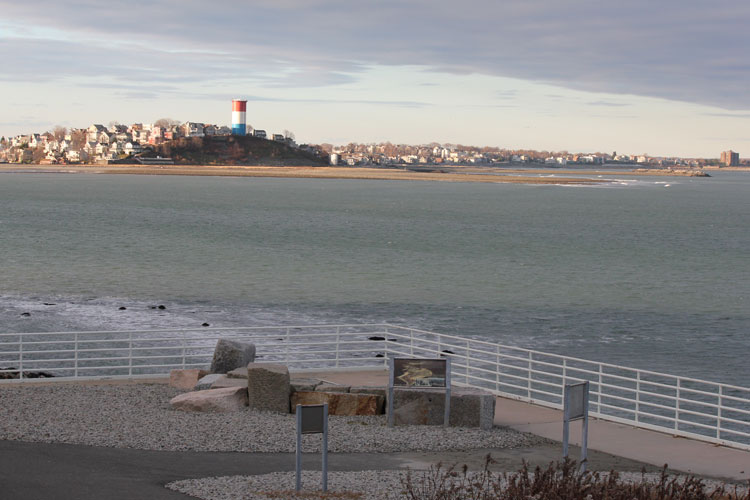
As a kid, when I tired of schoolies and was looking for something larger, “Uncle” Phil Galletta – who for decades owned the Massbait shop at the circle in Revere – preached “the Golf Ball” to me as the place to catch that cow of a lifetime. The Golf Ball was a water tower that defined the shoreline between Yirrell Beach and Winthrop Beach. That water tower is now a striped standpipe, but the rocky, gravelly bars that made this place a big bass magnet remain. Ironically, the very night I wrote this story, the stretch between these bars and the jetty to the south of Winthrop Beach was jammed with boats. I ran into a surf fisherman there who was all pumped up and out for revenge after being schooled and nearly spooled by a monstrous striper that inhaled his clam and proceeded to chafe him off. Apparently that fish had a buddy, since a similar scenario happened to another angler just to the right of him!
As impressed as I was by the tales of those big bass, I was more impressed when I realized that it wasn’t even September!
Great stuff, have been waiting for a report like this for a long time now. I would like to know though, where would I be able to park my truck? Keep sending more needed reports. Thanks
Great article! Love the Winthrop stuff, but your uncle was preaching about the area between Short Beach and Fort Heath as a kid. The golf ball was an old WWII radar dome. Same sort of boulder field but not as easy to access as the southern end of Winthrop Beach.
I spent my formative years in Revere and still love the area. But I never really knew Winthrop until 12 years ago (yikes!) while doing some research for a story with Bob Cox, then owner of Bob’s Bait Shack. I could not believe the access and fishing opportunities which abound there and I’m still impressed. In my opinion it’s fitting that the legendary Bob’s Bass Triangle is named after him! Thanks for the clarification on the Golf Ball.
Glad to hear you appreciated the article Pete. Regarding parking Deer Island has 24-7 parking for over 20 vehicles with signage authorizing after hours parking for fishermen only! Most of Winthrop has exceptional parking; Revere and Lynn less so but it doesn’t take much probing around to figure out where and when to park there either. Some of the more toney North Shore locations are more difficult but an enterprising angler can usually figure it out. I used to bob and weave to park at my favorite North Shore rockpile and eventually I met an angler who lives there and we became fast friends and I now park in his driveway. Often patronizing a local bait shop results in insider leads as to where to park. Sorry for not being more specific than that but I’ve been bitten for over-exposing exact parking locations before and I’m still smarting!
Hi Ron,
I have a 25′ boat in the Back River and am looking for a captain to assist in learning to fish the area. Any suggestions?
Thanks an tight lines,
Tom
Hey Tom, While there are no shortage of skilled skippers in the Greater Boston Area most use live bait, a few umbrella rigs – all of which is nice but I believe it serves the novice better to learn the water, tackle, and fish movements. Wrap it up with catching while casting lures and it’s all the better. For you, I think Captain Bill Smith of Draggin’ Fly Charters would be the best fit, he can be reached at (617)688-1882. I like his style and work ethic and he always seems to put patrons into fish, no easy task for ’14. Plus his boat is about the size of yours and I believe he keeps it near you.
Hope this works out for you!
Ron
Great article! Thanks for such a detailed survey of the North Shore…on a somewhat unrelated note…is mid-September (13th-20th) too early for Stripers to make their way down to the Orleans, Eastham, and Wellfleet area of the Cape? We have a trip booked up there for that week and will not be able to make it up to fish in the Boston area…so we were hoping to have some shore-based success “down the Cape”. (Surfcasting and fly rods in tow)
Thanks again for the great article on an area I used to enjoy fishing “back in the day”
Hi PaulyW, If I could predict “The Run” I’d be nipping at the heels of Nostradamus! From now through the end of October all bets are off, it could be great at any moment. I fish sparingly on The Cape but a buddy is finding his best bass fishing there right now! My fondest memories of The Canal took place in just the time period you described, so it could fish very well then!
Ron
That was a great article thanks it has been needed for a while. The opposite ends of Devereux hold many stripers big and small I can confirm that bucayse I have caught a nice 31 incher and 2 smaller 18 and 15 inch striped bass on a fly last week. As well as many in years past on spinning rods.
Hi George,
When you say opposite ends do you mean the ends of the causeway , Marblehead side and Neck side?
Thanks,
Jay
it’ is 2021 february i am living in indiana now , Old surf fisherman for stripers from the surf
preston beach, red rock, the golf ball., deer island light, marbelhead devereau beach, saugus river railroad tressel bridge and my favorite september spot swampscott pier after dark. landed a lot of cows bass from 1971 to 2019
miss Boston and the sea deeply. hope to vome back and fish again one more time.
God bless rus stearns, paul deluca, jimmy caronie, andy popowicz and his dad. memories that will be discussed in eternity trust in jesus my friends in lynn fish and game, and we shall meet again
What did you use to catch em off the pier?