

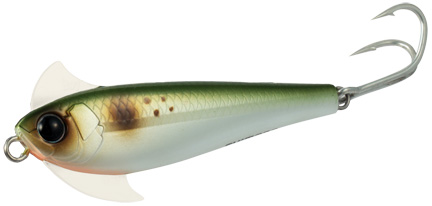
If you had to pigeonhole the Waxwing, you’d probably call it a swimming jig. But that’s like calling a pterodactyl just a bird of prey. After all, your average jig does not ace the “Best Hard Lure” category at ICAST – the world’s largest sportfishing trade show – nor is it likely to feature a hydrodynamic design, upper and lower “wings” for action, stainless wire-through construction and UV reactive paint. But then again, the average jig is not made by Shimano.
The Waxwing, like the Butterfly Jig and the Lucanus, is a component of what Shimano refers to as its Technical Fishing Systems. If the word technical sounds as if it’s code for complex, rest assured that nothing could be farther from the truth. In fact Shimano’s evolution toward adopting a systems-based approach has been to simplify the process.
t could be said that the inspiration behind the Waxwing was perspiration. The popular practice near Shimano America’s home base in California of “throwing iron” has traditionally consisted of wielding heavy 9-foot rods, 24-ounce reels and jigs heavy enough to dislocate something if you aren’t careful. Compound this with a 6- to 8-hour outing and “refreshed” was not a description of how anglers felt at the end of the day.
According to Robby Gant, senior product manager for Shimano, another problem was the lack of uniformity in jig production. When crafted correctly, iron jigs are awesome fish catchers, but they are usually cast from aluminum that is grinded to form. If the angles are off just a bit, then you own little more than an expensive paper weight. Because the Waxwing features a hydrodynamic head, it throws as far as a heavier jig, even in wind. And since it is molded, each one performs exactly as intended, explained Gant.
And it is those wings that give the Waxwing its signature moves, distinguishing it from most any lure that you can think of. “The upper wing causes the Waxwing to swim in a zigzag motion, and the lower wing prevents the lure from rolling over,” said Gant. And then the lure does something really special: after every third or fourth wobble it darts erratically. No finesse in the retrieve is needed; you simply cast and crank, and the action is built in! No snap or swivel is recommended for this sub-surface swimmer, so there is no potential weak link. The shape of the head in synch with that top wing produces that irregular dart. It is this sudden, unexpected “kick” that results in impulse strikes. “The Waxwing is prone to reactionary strikes that you won’t find from other lures that do only one thing,” commented Gant.
Another novel approach is in the hook selection. Tin-coated Owner double or single hooks (the latter only available on the 6.6-inch, 4 ½-ounce “Daddy” version) are positioned to the rear of the lure and face upward. In combination with the hydrodynamic head, the Waxwing is virtually weed proof. This is a boon for East Coast anglers who do not relish reaching into the snapping jaws of a head-shaking gator bluefish that is sporting loose treble hooks. New for 2012 is a freshwater version, which muskie fishermen have been chomping at the bit for. It features a more conventional, under-body twin treble-hook design.
The Waxwing comes in five different sizes, and you might call it a family affair as they range from the 2.7-inch, ½-ounce “Baby” to the wide-profiled 6.6-inch, 4 ½-ounce “Daddy.” Additionally, there are 16 different color combinations for the salty model and 8 for the sweetwater version: many of these hues will resonate nicely with striper and school bluefin tuna anglers, especially mackerel, bunker, purple/black (blurple) and bone.
Fresh from exceeding expectations on the West Coast for calico bass, white sea bass and yellowtail, the Waxwing was taken on a road trip across the country. In the Gulf of Mexico it held sway on sea trout, redfish and snapper. Once on the East Coast, it was similarly greeted by snook, jacks, kingfish and mahi mahi. And lastly in the Northeast, bluefin tuna and the inshore dynamic duo of striped bass and bluefish could not resist the Waxwing. Pelagic pursuers will be pleased that the stainless steel through-wire underpinnings have even withstood the blistering attack of the wahoo – something that cannot be said for most lures.
Don’t be fooled by the delicacy of the Waxwing name; from the onset, this lure was designed to wage war with true brutes. This is simply part of Shimano’s progressive philosophy of putting lightweight, yet extraordinarily powerful gear in the hands of anglers. In the Northeast, one of our most prized fisheries is casting for school bluefin tuna. If you’re one of the afflicted who lives for the adrenaline-fueled rush of shooting a lure in front of a fish that could pull you overboard if you’re not careful, then make way for the single-hook magnum-sized Daddy Waxwing. Its aerodynamic, compact design will allow you to intercept charging Charlie, even at a distance, it has the right moves to get a bluefin to bite, and the lure will hold up under fire.
My time with the Waxwing was spent among the linesider laboratory that is Boston Harbor in the fall. Knowing full well that time is running out on yet another season, anglers flock to the Harbor and it often looks like a boat show come late September. Bedlam is the order of the day as blues and bass binge on bunker and sea herring in preparation for the big move southward. Nearly every offering imaginable gets tossed into the rolling blitzes, and on my first time out with a green shad 118 Junior Waxwing, I crushed them to the point where I overheard one luckless angler murmur, “What does he got there?”
While I’m convinced that you could catch fish on the Waxwing with a hand-line, you’ll fare far better if you take advantage of Shimano’s Technical Systems. Shimano caused quite a stir a few years back with its TC4 rod technology. Tuna-taming sticks such as the Trevala had many wondering how such a lightweight rod could wield so much power. Shimano has applied this same technology to many of its rods, including the Terez Waxwing series, which has a soft tip to cast the lures a long distance and improve their action, while having a stout butt section that allows anglers to put heat on heavy fish. Pair a Terez with a compact, yet stout reel such as a Sustain FG, spool up with 50-pound-test Power Pro, cinch up a mackerel “Senior” Waxwing and proceed to put a hurt on surprisingly big fish.
That is the whole point of the Waxwing and Shimano’s Technical Systems: you can mothball your cumbersome gear, select a combo in which the reel easily fits into the palm of your hand and the rod is light enough to cast comfortably all day, yet lose not one iota of fish-whipping power. Sometimes you can’t beat the system!
I fish on private boats in Southern California waters for yellowtail as well as dorado and tuna when they are here (especially during warm water times).
I want to try the Waxwing system but don’e want to buy a rod and reel especially for that type of lure. Since I mostly fish conventional reels rather than spinning, I want to use the equipment that I have.
I have a Shimano Calcutta 400 and a Calcutta 700 and would mount either one on a Calstar 278-8 which has the first 6″ cut off and is equipped with mini roller guides. I would probably use 40# braid with a topshot of 25# or 30# copolymer line.
Do you think that the above setup will work for waxwing fishing?
Best color for reds and sea trout??? Thanks bob