


It was a sunny day in March, and the hard-water season was drawing to a close. Hunched over an ice hole, I was looking down through 8 feet of water at a sandy bottom mixed with weed clumps and keeping a watchful eye on my small shrimp-shaped plastic bait.
I quivered the rod tip to make the bait dance, lowered it to the bottom, hopped it along the sand and then made it swim upwards in a series of pulsating jumps. Suddenly, several yellow perch cruised by only a few feet under the ice. I brought the bait up higher in the water column, constantly twitching and dropping it to keep up the facade.
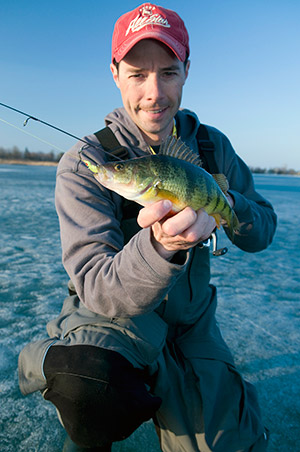
With a startling streak, a perch rushed in from the side and struck, and I responded with a flick of my wrist to set the hook. The fight didn’t last long, and I soon slid the olive-barred specimen on the ice. Quickly lowering the bait back down, I hooked another keeper before the school of perch vanished.
I looked up to see my fishing partner, Jack, moving to another hole, so I softly walked over to intercept him.
“I just got two from a really short run. They were about three feet under the ice. Before they came through I also saw a couple jumbos cruise by, but I couldn’t get my bait to them in time,” I reported.
“I just missed a big one that was right under the ice,” Jack said. “It hit my jig just as I lowered it into the water and caught me off guard.”
“I know, it seems like they will show up anywhere in the water column this time of year,” I responded. “Let’s get moving and try to find them. Whistle if you get a good run of biters going and I’ll do the same.”
We went our separate ways, quietly walking on the slushy ice. I picked one of the 25 holes we had drilled over the shallow, soft-bottom flat and sat quietly, gazing down the icy tunnel. I saw nothing, but lowered my jig and fished for a few minutes. Nothing. I picked up and moved to a hole about 20 feet away.
Dropping my scud imitation to the bottom, I popped it a few times to kick up a silt cloud, let it sit on the bottom for 10 seconds, then jigged it again. I repeated the sequence a few more times, and then a school arrived. Several perch descended on my bait, and one brave fish attacked. I set the hook, horsed the fish in and got my bait back down quickly to keep the group’s interest. Immediately I hooked another one and gave a whistle to Jack, but as I looked up, I could see that he was fighting fish as well. I caught five perch from the school before they got wise and moved on.

The day turned out to be one of those rare ones, when the weather is great and the fish are biting. Jack and I loaded up on dozens of perch, releasing most but keeping a few for a meal. The two keys to our success were to move frequently to intercept the roaming perch, and then sight-fishing them, so we could position our baits at their cruising depth.
Although it’s a specific technique reserved for fairly clear water, sight-fishing can pay big dividends when it comes to catching quality panfish. Watching a fish’s reaction lets you make immediate presentation and lure adjustments to better your chances at teasing out bites. Furthermore, careful visual observation when ice fishing will provide opportunities to learn more than you’d ever expect about various angling subjects. Here’s what you need to know about using your peepers to put more panfish on the ice.
Learn by Watching the Lure
There’s value in taking advantage of sight-fishing whenever you can. Over the years I’ve had some real eye-opening experiences just by watching lures. Experimenting and practicing jigging movements has improved my ability to manipulate various baits to achieve the proper action. Seeing their action also increased my confidence in many presentations.

Sight-fishing will teach you a great deal about the action of jigging minnows like the Rapala Jigging Rap and the Northland Puppet Minnow. After the lift, these lures will glide downward in a semi-circle on slack line. When the line tightens, it causes the lure to swing in from the side, eventually coming to rest directly under the ice hole. What’s fascinating is the time it takes these baits, particularly the light models, to complete the arc-drop and return to the starting position (which is often marked by a faint tick of the rod tip). Furthermore, once the bait comes to center, it still takes a few seconds to burn off the momentum from the fall. During this time it’s not uncommon for it to rock slightly. This is a subtle but important action that often triggers strikes. Sight-fishing has taught me to give a jigging minnow plenty of time to come to rest. I’ve also learned different shakes and side-to-side movements of the rod tip that infuse lifelike traits to these baits.
Watching spoons is also time well spent. All models react differently to various jigging movements. One of the most important lessons I’ve taken away from studying spoons is that less is often more. It really doesn’t take much of a lift, a flick or a drop to make these lures dance seductively. In fact, overworking a lure is probably one of the most common mistakes anglers make. A boisterous bait will scare away all but the most aggressive fish, which is another good sight-fishing lesson.
Although jigging minnows and spoons take plenty of big panfish, ice jigs are responsible for most catches. I’ve noticed by watching ice jigs that vertical jigs, also called teardrops, give off a fluttering, flickering fall that’s particularly effective to call in fish in shallow water. Their sink rate is influenced by the jig’s weight, the width of its body and how much bait you’ve added to the hook.
Horizontal jigs fall faster. These are excellent when you need to dive-bomb your offering into deep water, or to make fast depth adjustments, but their quick decent can sometimes spook fish. The moral here is to swim horizontal jigs slowly down through the water column when fish are not aggressive. This reserved action often attracts fish that might be reluctant to hit other presentations.

By watching ice jigs (and other lures) you’ll also acquire knowledge about proper tipping techniques. It’s amazing how added bait, like an artificial waxworm, if it’s just slightly off-center, will cause a horizontal jig to spin slowly as you dance it around. Then when you pause, the line twist unwinds and the jig spins. This can make for a less-than-natural presentation, keeping your jig from being as effective as it might otherwise be. Dead-straight rigging will reduce twist.
In recent years, I’ve started to use ultra-thin plastics along with ice jigs more frequently. Experimenting with the faintest flicks of a rod tip while watching these baits has revealed a variety of subtle triggering moves that makes soft-plastic tails come alive. Sight-fishing definitely made me more confident using these pliable artificials.
These examples are by no means an exhaustive list. You’ll discover much more on future field outings by watching your lures, and once fish enter the equation, the on-ice education intensifies.
A Window into Fish Behavior
I find it fascinating to watch fish. You learn a lot about the different dispositions of these creatures through observation.
Sight-fishing also has many advantages to triggering hits. Just as you can use a portable sonar unit to tweak your jigging tactics until you find the right combination of moves to entice bites, you can manipulate your presentation through observation to increase ice-fishing success. Yet, instead of interpreting lines on a screen, you’re reading a fish’s body language.
Active fish move quickly and make fast decisions. They don’t delay when it comes to hitting a bait. One discovery I’ve made while watching more active fish is that sometimes they will strike and miss a lure or jig. Fish aren’t the flawless, eating machines we sometimes assume; their kill rate isn’t perfect. A quick-moving bait can be difficult for fish to track. In fact, I’ve experimented with active fish and purposely kept the lure from being eaten. The result surprised me because the action doesn’t have to be lightning fast to make a fish miss. What’s worse is that often when fish attack, they’ll either miss the lure completely or, in the case of many horizontal baits, strike short and avoid getting hooked. So, when fish are willing to hit, be sure to pause the bait and give these pint-sized predators the opportunity for a good attack on an easy target.
Neutral fish will swim in to inspect your lure at a range of speeds. Piquing their curiosity and drawing them toward your lure is half the battle. The next challenge is persuading them to bite. My first response is to stick with whatever jigging sequence attracted them, sometimes they’ll wait and watch for a short while then move in and hit.
When a fish isn’t interested, you’ll frequently see them move just their pectoral fins to back away from the bait. This is a significant sign and means that you need to alter your presentation to reengage your quarry. Try either picking up the pace or slowing things down for a more subtle presentation. Experimentation is the secret to coaxing bites, and because you’re watching the fish’s every move, you can adjust your offering as soon as they appear unresponsive.
Also, not all fish are in the same mood. Overall, a school of crappie might be neutral, but some will be more active than others. As you attract multiple fish, the odds increase that the growing crowd will stimulate competition and, hopefully, prompt one to break down and bite.
Progressing down the categories of fish activity, you are most likely to encounter inactive fish during the mid-winter months. Seeing fish in this condition is like watching them in slow motion. When they’re inactive, there’s no tail kicking and they won’t often travel great distances. Most movement is incremental and happens via the pectoral fins. It’s also common for many species to rest tight to bottom. However, you may also find inactive fish suspended, which is frequently the case with crappie.
Sight-fishing lets you see when fish are inactive, so you can recognize their behavior and know what you’re up against. When you deduce fish are present but inactive, it’s time to use micro-sized ice jigs tipped with fresh bait. Your jigging tactics should be extremely soft to match their activity level. Fooling these finned couch potatoes will be a challenge and demand patience, but stay attentive and you’ll succeed. You’ll also pick up a few tricks to hone your finesse game.
Tricks for Sight-Fishing the Ice
Sight-fishing is usually reserved for shallow water. To sight-fish the skinny water effectively, you’ll need proper positioning over an ice hole as well as a stealthy approach. Drill plenty of holes in advance of when you anticipate a bite might occur. Tunneling new ones at suppertime will quickly spook a school. On thinner ice, I prefer a hand auger over a gas-powered model to reduce noise. Drilling a hole with a smaller diameter makes drilling easier, and also reduces the chances of fish detecting your presence.

When moving on the ice, do so quietly. Although portable shelters are great tools, when dragged over bare ice, they’re noisy and can deter wary, shallow-water fish. Sometimes a pail as a seat works better. The advantage of a shelter, however, is that when deployed, it acts as a shade, improving your underwater vision. Like a northern pike lurking in the shadow of weeds waiting for a fish to swim into an opening, you’ll see much better from a shaded area into sunlit water. When using a pail or other type of seat, you’ll lack this advantage, but in clear water you’ll still see fairly well.
In either case, try to avoid rapidly changing the light conditions around the hole. If using a shelter, avoid raising and lowering the canvas as this alters the conditions below from shaded to sundrenched. Think of how suddenly opening the blinds in a dark room lets in a rush of mid-day sunshine. I also know anglers who even leave some slush in the hole to help reduce light penetration and hide their silhouette.
In the same vein, avoid casting a shadow over ice holes when you’re moving around. Trust me, this isn’t an angling superstition, in open water fish are constantly aware of overhead threats, and these instincts don’t disappear with the arrival of ice. When you walk by an ice hole, your shadow creates a flicker, which corresponds to any noise you make upstairs. Avoiding detection is vital to consistent shallow-water ice-fishing success.
Once it’s time to start fishing, you want to sit close to the ice hole for a good view. When I’m sight-fishing, the ice hole is always between my feet. There are specialty rods available that are shorter than average (18 inches or less) that let you cozy up to the ice hole so you’re not restricted by rod length. Many anglers use a pencil-grip to hold the rod but rotate their wrist upwards (often resting on or near your knee) and position the rod tip so it points inward and over the ice hole. You don’t need a short rod to sight-ice-fish, but having one will definitely improve the comfort and line of sight of your fishing position.
Cameras for Deep Water
For many years, sight-fishing was reserved for shallow-water. The advent of underwater cameras has suddenly opened up another dimension, or depth, to voyeuristic angling. As you’d expect, the amount you can see is influenced by water clarity and light conditions.
One advantage of using an underwater camera is getting a visual on what species and size of fish you’re marking on the sonar. Cameras are also good to get an understanding of bottom composition and what features are attracting fish to the area.

Be warned though, setting up an underwater camera is a bit like lowering an anchor in a boat. You need to feed out line, and once you get set up, it can sometimes foster a stay-put attitude. For this reason, I use my portable sonar for most underwater intelligence and only lower the viewing system when I want more data or if I know I’m on fish.
Most underwater cameras can be set up two ways. One is a side-view, which is the default position for most units. Slowly spinning the lens body gives you a 360-degree view of the immediate area. The other option is down-view. Here, the camera is lowered nose first to deliver a bird’s-eye view and a wider perspective. Many anglers prefer down-view on the ice because you’re able to see more of what’s around your bait.
When setting up a camera, there’s value in drilling a hole specifically for the unit positioned within a few feet from your fishing hole. This helps to avoid hooked fish tangling in the cable. Granted, I’ve plucked plenty of perch and panfish up through the same hole that held my camera cable, but big ones have a way of corkscrewing around the wire and coming unbuttoned.
Sight-fishing is a very specific technique that requires fairly clear water. When the conditions are right, however, take advantage of them because the setting is a great classroom to expand your angling skills and knowledge of fish behavior. You’ll also discover new techniques or refinements you’ll be able to use in future panfish adventures.
 Ice Fishing Electronics
Learn more about ice fishing cameras and electronics in On The Water’s Guide To Ice Fishing Electronics.