

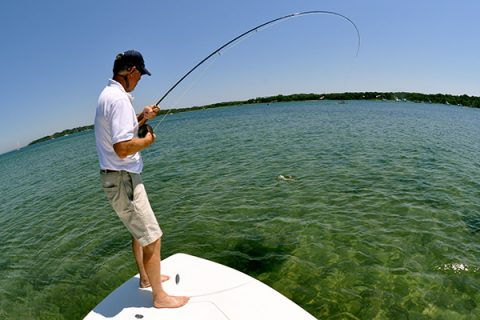
Mention striper fishing in New England, and for most anglers in the Northeast and beyond it brings to mind images of battlewagon lobster boats and Boston Whalers fishing rocky reefs, rips and other rugged pieces of the coast. We picture gruff captains clad in oilskins, trolling heavy wire-line rigs or dropping hunks of lead to bounce eels and bunker chunks on the bottom. While heavy tackle and big water is a big part of striper fishing – and probably the best way to connect with a monster bass – there is another facet of striper fishing that uses equipment and techniques most folks associate with the Florida Keys and other tropical locales.

Imagine that you’re standing on the bow of a skinny-water flats boat. The water is clear, nearly transparent, and the rods are rigged with crab and shrimp patterns. The sun is high, the fish are big, and they’re casting monster shadows. You creep up on them, push pole in the water, silence on the deck. You notice a particularly big fish coming in at 11 o’clock (it’s about 20 pounds!) and already only about 50 feet away. You cast, make one strip, a couple more strips, and within seconds of the hookset you’re listening to a singing drag.
Yes, striper fishing offers many things to many different types of anglers. And throughout New England, we are seeing a growing number of shallow-water skiffs equipped with poling towers and trolling motors. More and more anglers are heading to the shallows rather than the deep, eyes peeled for skinny-water stripers.
The Northeast Flats
With average tides of more than 6 feet in most places, the flats of the Northeast fish much differently than those of the Gulf Coast or Caribbean, where the tidal swings are in the range of 2 to 3 feet. In the Northeast, the stage of the tide can determine whether or not a given flat is fishable. Some flats have a relatively consistent gradient, or slope, and can be sight-fished throughout most of the tide. From the low ebb through the incoming tide, an angler can work his way in from the deep edge of the flats toward the shore, looking for fish as the rising tide provides access to areas offering the optimum depth for sight fishing. Other flats may be broad and have a consistent depth (very little slope), with only enough water covering the flat during higher stages of the tide. Often called “shoulder flats,” these areas fish well during the higher tides because they have a relatively low gradient near the high-water mark. In contrast, some flats only fish well at lower tides because deep water runs adjacent to the shore, preventing an angler from seeing fish. When the tide drops, the depth eventually reaches a level that allows anglers to spot stripers.
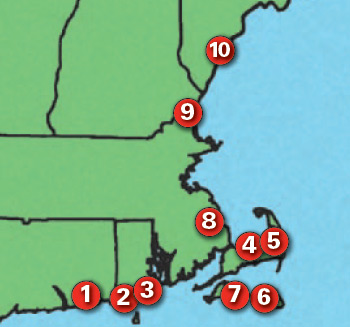
2) Watch Hill, Rhode Island
3) Charlestown, Rhode Island
4) Barnstable Harbor, Cape Cod
5) Brewster Flats, Cape Cod Bay
6) Madaket, Nantucket
7) Chappaquiddick, M.V.
8) Plymouth Harbor, MA
9) Plum Island Sound, NH
10) Casco Bay, Maine
Many different bottom types will attract stripers, but certain bottom types will make it easier for the angler to spot fish. The most important factor when it comes to spotting fish is sunlight. In skinny water, it’s possible even on overcast days to sight-fish to subtle boils, surface breaks, and wakes, but for true southern-style flats fishing, we really need the sun. With the sun high in the sky and the surface glassy calm, even darker bottoms can be sight-fished, but it’s rare for both sun and wind to cooperate. The best flats for sight-fishing have lighter sandy bottoms, which make spotting fish much easier, especially when they are on the move and casting a noticeable shadow. Remember, these stripers aren’t bonefish, and, although they can become remarkably light in coloration, for the most part they appear dark on light-sand bottoms.
With darker bottoms that have either silt, mud, or seaweed, the key will be to look for movement. You may need a considerable amount of sun and minimal chop on the surface to help distinguish these movements, and, for the most part, you won’t be seeing the entire fish as you would on sandy flats. The dark bottom will let up in some spots, however, and the change may only be from a dark mud to a patch of lighter shells, but these subtle differences will make anything that swims over the bottom much more noticeable.

The same goes for my favorite type of bottom, a mix of light sand or silt and dark patches. The wind might have blown weeds onto a sandy flat, or a storm might have swept away patches of silt, leaving a bottom containing a mosaic of different shades. Whatever the reason, these inshore areas make for excellent short-range sight casting. The bottom has the light-colored sand or yellow silt that makes seeing dark fish very possible and the inconsistent color creates great conditions to spot moving fish, as any movement should be fairly noticeable.
Flat-Out Misconceptions
One common misconception among anglers tempted to fish the flats is that the fish will be small and too hard to see. I’ll admit that I too was one of these non-believers, at first. My notion was that large bass stayed away from the flats and had to be fished for in the rips or deepwater reefs. I believed that only small fish would enter the flats and that their bigger brethren spent their time in deep water. Well, my first sight-fishing experience in the shallows near Rhode Island proved me wrong.

On the very first flat we pulled up to, three big bass immediately kicked out from under the boat in a sudden burst, leaving only my scrambled recollection and a swirl of sand. From then on out, I became a believer of what many had talked about before me, sometimes describing big stripers cruising through inches of water looking for crabs.
During that day, and many others after it, our guide Ryan Sansoucy quietly poled along shallow coves and open flats looking for shadows. One after another they approached, and it seemed like an endless supply of fish kept heading our way. The majority of fish were around 30 inches, and they all had their minds on big lady crabs crawling across the sand. Some cruised along the beach and others meandered along the bottom, nose down in the sand. They would push wakes over skinny patches, and others would betray their presence with a tarpon-like roll on the bottom, the sure sign of a fish turning over on a large crab. We watched as fish would come flying up to flies and then let the rabbit strip tickle their nose before kicking off in a memorable snub.
The stripers become almost a different species while on the flats. They go from blitzing idiots to educated snobs that can decipher even the best-dressed clumps of hackle. They also change through the season, and will go from chasing a 12-inch eel pattern on the flats in the broad daylight of May, to being impossibly finicky in August, neglecting all flies that aren’t allowed to lie still on the bottom, barely pulsating.
The ability to spot and see the fish while on the flats has also been a point of skepticism for many anglers new to the flats. The idea that many people have is that the fish don’t like the vulnerability of the skinny water and will avoid it or flee long before they are within range. To counter this, I tell most people that stripers might, in fact, dislike the vulnerability of the super-skinny water, but they also have a primal instinct that drives them to eat. Essentially they go where the food is, and, by mid to late summer, they find abundant sources of food on the flats. Another misconception is that conditions have to be absolutely perfect in order to spot fish. In reality, the sheer size of some of the fish makes them nearly impossible to miss. A friend of mine, who does more skinny-water fishing than anyone I know, said, “Stripers on the flats are like really, really big, dark-colored bonefish.” Often times when I bring out an angler to the flats they are amazed by how easy the fish are to see when conditions are right. When the sun is high, and the chop is low, I have had days when I can see fish almost 200 feet away on a shallow shoal. On bright, light-colored bottoms, the fish sometimes appear black and look more like sharks than anything. It’s pretty crazy. The only exception to this are the stripers in Ningret Pond. This shallow bay, located on the south coast of Rhode Island, has some flats that seem more Bahamian-like than anything else. These fish summer in the ponds and spend so much time in skinny water that they almost appear white. The fish blend very naturally in with the sand, and they have seen more people and flies than one could imagine.
Skinny-Water Fly Equipment
When sight-fishing the flats of New England for stripers, most anglers reach for 8- or 9-weight rods and strong reels capable of holding at least 150 yards of either gel-spun or Dacron backing. The reels should have a relatively smooth drag system as the fish will have nowhere to go except out. The reason a smooth drag and adequate backing is required is because, often times, the tippet is scaled down to 10- or even 6-pound-test in order to attract strikes. This makes fighting the fish a game of finesse. You won’t be able to pull too hard without putting too much strain on the tippet. Also, any mechanical errors in the drag could cause the leader to pop, costing you that keeper bass. While the fish will rarely take you deep into your backing, it’s nice to have a little safety net. Better safe than sorry!
RODS: An 8-weight fly rod will handle most situations, but reach for a 9-weight when bigger stripers are prowling.
REEL: Pick a reel capable of holding 150 yards of backing
LINE: Go with floating or slow-sinking intermediate lines
LEADERS: Taper from a 20-pound butt section down to a 12-pound fluorocarbon tippet. Go lighter if you have to.
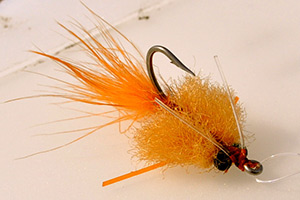
FLIES: Pack an assortment of sand eel and crab imitations in sizes 1/0 to 6.
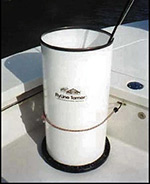
DON’T FORGET: A stripping basket or line tamer, polarized sunglasses, and sunscreen.
Depending on the water clarity, the season, and the sunlight, I will use either leaders tapering down to 12-pound-test or, sometimes, a drastic 6-pound-test tippet. Early in the season, from about late May until the end of June, the fish can be less spooky and I can get away with leaders that taper down from 20-pound test to 12-pound test. This extra strength helps on hook sets and allows me to throw bigger crab and shrimp patterns. By July and August, when the fish have had time to settle in, they can be extremely tough to fool on the flats. In the late summer I find myself throwing smaller flies and using tippets of either 8- or 6-pound test. I know it seems like these tippets belong on the trout streams, but in reality stripers on the flats get so spooky that anything greater in diameter will send them running for the depths. Even heavier fluorocarbon can spook the fish!
When using these extremely light tippets, a couple things come into play. First off, the hook-set becomes extremely important. When a big fish rolls up on your shrimp, your eyes will get wide and the tendency will be to strip-strike hard. You have to keep your composure and let the fish do all the work. A big tug on the line will pop the tippet off every time. Instead, concentrate on keeping the line tight and give a long, slow strip to set the hook.
The flies that we use most of the time are either small tan crabs, similar to the Permit Crab created by Will Benson and Peter Smith, or Skok’s Blind Crab. These two patterns cover the majority of situations and keep the changing of bugs to a minimum. Just remember that the flies must have weight! Often times the fish will just swim under a lighter fly. The key is to have the fly sink quickly so that first strip brings the fly to life off the bottom. The behavior of most crabs is to hide in the sand or drop into a defense position on the bottom, making natural fly presentations require either dumbbell eyes or lead wrapped around the body.

One statement that I hear all the time is that sight fishing to stripers really isn’t possible unless you have an expensive flats boat. This couldn’t be more incorrect. The fact of the matter is that most of the flats I fish can be waded well and the majority of boats can get you into the troughs and channels that act like highways and escape routes for these flats fish. Much of the coastline in areas like Cape Cod have flats and shoulder beaches that can be sight-fished from shore as well. In Cape Cod Bay, for example, we sometimes fish in a foot or two of water, just off the dry sand.
My brother and I used to drive out near Brewster, on Cape Cod, and we would walk to the outer bars at low tide and then make our way back on the incoming toward shore, with dozens and dozens of shots at big stripers.
Alan Caolo has a terrific book, “Sight Fishing for Stripers,” which explains the ins and outs of the fishery including access to great spots and flats. Most of that book is geared towards not having a boat, simply stating that there is a world of sight-casting opportunities in New England for those willing to explore. Lastly, there are a number of ferry services that can bring you out to flats and islands, such as the Monomoy ferries from Outermost Harbor, in Chatham, or the Edgartown ferries on Martha’s Vineyard that can bring you to the flats in Katama Bay or Cape Pogue Bay.
Seasons on the Flats
Migratory stripers generally arrive in New England sometime around late April or early May, but these early fish tend to head straight for the shallow bays with muddy bottoms, which will warm up the fastest on sunny days. These coves and creeks offer shots at waking, and even tailing, fish in skinny water, but generally sight casting doesn’t start until late May and early June when the sand flats heat up enough to hold bait. During this period, a bright, sunny day with calm water conditions can have you spotting and casting to schools of more than 100 fish. These bass are almost all good-sized fish that will pounce on any imitation of a crab or shrimp. This is what we call “foolproof” flats fishing, and maybe the only time of the year where you can get away with dropping a rod on the boat deck or slamming a hatch without spooking the fish.

As the summer progresses, and the heat of July and August begin to fill the shallows, the stripers hunt food with a more careful eye. The flies must be the right color to match the bottom, they must be small flies, like a 6 or 8 hook, and they must have enough weight to get on the bottom. The majority of the takes during this period will be on the bottom as the stripers root out your fly from the sand.
When the autumn air begins to split the humidity of summer, the fish again change character and start looking for different food. Now there are all kinds of forage options. Anchovies, silversides and even peanut bunker get pushed onto flats and they join the daily menu of crabs and shrimp. The days are shorter and the sun retreats early, giving only about a 4-hour period from 10 a.m. to 2 p.m. to see fish. There are still shots at fish, and more often than not, some really big fish, but eventually the cooling water and shorter days signal to the bass that they should abandon the skinny and flee for deeper water as they make their pilgrimage south. Around the end of September, the flats season is completely done, and we stow our crab boxes until the much-anticipated spring run of fish. Only 7 months away!
This is really interesting stuff about sight fishing! I have always wanted to try sight fishing. It seems like such an exciting way to fish. I never realized you could sight fish for stripers, the only people I ever talk to about it sight fish for bass. I will have to look into it some more and check it out. https://www.keywestflatsfishingguides.com
We are sight fishing as I speak on lake Powell in northern Arizona. With more shoreline than the intire west coast of the U S this lake is a dream come true for the fly fisherman for freshwater Stripers 6 wt for schoolies and 7@ 8 wt for the fall boils.
Great article: I have not tried fishing crab patterns here yet.
What size push pole do you recommend for the north east?